The Evidence Behind Physician Coaching
You don’t have to take my word for it.
Physician coaching isn’t a wellness trend — it’s a researched, peer-reviewed intervention with a growing body of evidence behind it. Below is the published, peer-reviewed research on how coaching affects burnout, moral injury, and physician well-being, including randomized controlled trials showing measurable results.
Isn’t This All Just “Woo”?
If physician coaching sounds “too woo” to you, you’re not alone. Most physicians are trained to trust data, not feelings — and that’s exactly why the research matters.
I'm Dr. Michael Hersh, an ICF-credentialed physician coach (Associate Certified Coach) and practicing gastroenterologist, and I wanted you to see the evidence for yourself rather than just take my word for it.
A growing group of physician-researchers has spent the last several years studying coaching’s effect on burnout, moral injury, impostor syndrome, and overall well-being in doctors and physician trainees. Several of these studies are randomized controlled trials — the same standard of evidence used to evaluate a new medication or procedure.
Here’s what the published, peer-reviewed research says.


Does Coaching Actually Work? The Randomized Controlled Trials
These studies used the gold-standard trial design — randomizing physicians and trainees to receive coaching or not — to measure coaching’s real effect on well-being.
Mann A, Shah AN, Thibodeau PS, et al. Online Well-Being Group Coaching Program for Women Physician Trainees: A Randomized Clinical Trial. JAMA Netw Open. 2023;6(10):e2335541.
This RCT shows that a structured online coaching program can meaningfully improve well-being in female physician trainees.
Fainstad T, Mann AM, Suresh K, et al. Effect of a Novel Online Physician Group-Coaching Program to Reduce Burnout in Trainees: A Randomized Controlled Trial. JAMA Netw Open. May 2022.
Solid RCT evidence on how a fresh approach to coaching can reduce burnout rates.
Fainstad T, Rodriguez C, Kreisel C, et al. Impact of an Online Group-Coaching Program on Ambulatory Faculty Physician Well-Being: A Randomized Trial. J Am Board Fam Med. December 2024. doi:10.3122/jabfm.2024.240022R1.
Shows that online group coaching boosts well-being not just in trainees, but in practicing faculty physicians.
Mann A, Fainstad T, Sullivan, et al. Medical Students: They’re Not Just Little Doctors! Impact of an Online Group-Coaching Program on Medical Student Well-Being: A Randomized Clinical Trial. PLOS ONE. August 12, 2025.
A four-month coaching program for medical students didn’t reduce distress scores, but significantly improved self-compassion and flourishing.
Fainstad T, Syed A, Thibodeau PS, Vinaithirthan V, Jones CD, Mann A. Long-Term Impact of an Online Physician Group-Coaching Program to Improve Burnout and Self-Compassion in Trainees. Journal of Healthcare Management. Accepted June 2024.
A follow-up study showing coaching’s benefits aren’t just short-term — trainees maintained a healthier balance well after the program ended.
Understanding Burnout, Moral Injury, and Impostor Syndrome in Physicians
Coaching doesn’t happen in a vacuum. This research maps the specific pressures that drive physician burnout, and who’s most affected.
Kornsawad K, Shah A, Yan J, Aboueisha A, Woodward MA, Mann A, Fainstad T. Do I Belong? A Multivariable Analysis of Impostor Syndrome and Associated Factors in Female Physician Trainees. J Gen Intern Med. August 5, 2025. doi:10.1007/s11606-025-09780-4.
Impostor syndrome was highly prevalent in a national sample of female physician trainees and strongly linked to lower self-compassion — suggesting self-compassion may be a key target for future interventions.
Syed A, Thibodeau PS, Dieujuste N, Jones CD, Dunbar KS, Mann A, Fainstad T. Examining the Impact of Moral Injury on Burnout, Impostor Syndrome and Low Self-Compassion Amongst Female Medical Trainees: A Secondary Analysis. Mayo Clinic Proceedings. 2024;99(12):1905-1912.
Moral injury was highly prevalent among female physician trainees and strongly associated with burnout, impostor syndrome, and low self-compassion. Featured in “Physician’s Occupational Distress: Burnout or Moral Injury?” by Dr. Kristine Olson.
Dieujuste N, Mann AM, Dunbar K, Thibodeau PS, Fainstad T, Dorsey Holliman B. Understanding Challenges Faced by Female Graduate Medical Education Trainees: A Qualitative Content Analysis of Physician Coaching Requests. HCA Healthcare Journal of Medicine. August 2025.
Analyzes real coaching requests from female trainees, surfacing the challenges they’re most often seeking support for.
Why Coaching Matters: Perspectives From the Field
Beyond the numbers, these pieces explore what coaching means to the physicians who go through it — and why it belongs in medical training.
Mann A, Fainstad T, Shah P, et al. “We’re All Going Through It”: Impact of an Online Group Coaching Program for Medical Trainees: A Qualitative Analysis. BMC Med Educ. 2022;22(1):1-10.
A qualitative look at the shared struggles — and wins — of trainees going through a coaching program together.
Fainstad T, Orlov N, Virant-Young DL, Volkova Feddeck M. Why Coaching? The Meaning and Purpose of Coaching in Graduate Medical Education. In: Hammoud MM, Winkel AF, Wolff M, Andrews JS, eds. Coaching in Graduate Medical Education. Vol 2. American Medical Association; 2024:1-8.
A thoughtful look at why coaching matters in medical training — arguing that even the most seasoned physicians can benefit.
Hear From the Researchers
Want this research explained firsthand? Watch our conversation with Drs. Tyra Fainstad & Adrienne Mann on the Better Physician Life Podcast:
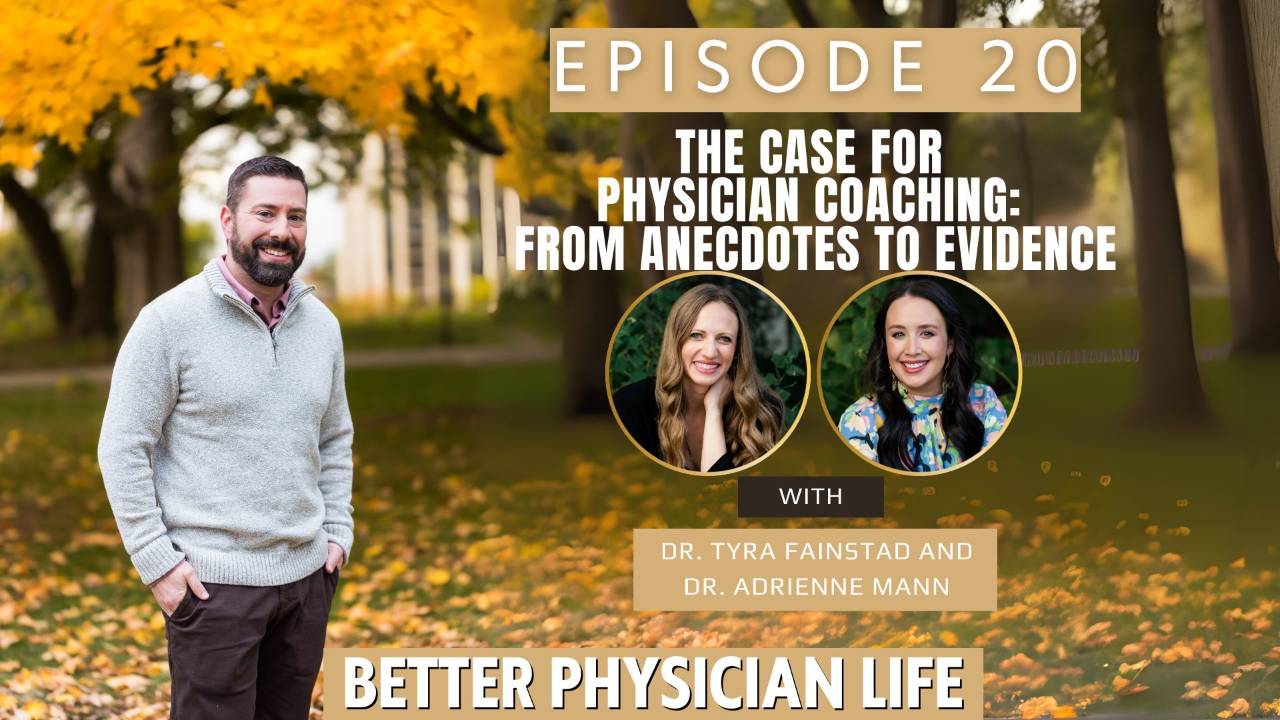
EPISODE 20
The Case for Physician Coaching
Join me, with guests Dr. Adrienne Mann and Dr. Tyra Fainstad, as we explore data showing that coaching reduces burnout and impostor syndrome.

Ready to See What Coaching Can Do For You?
The research is clear: coaching helps. If you’re ready to stop reading about change and start making it, the next step is one call away.