Better Physician Life coaching

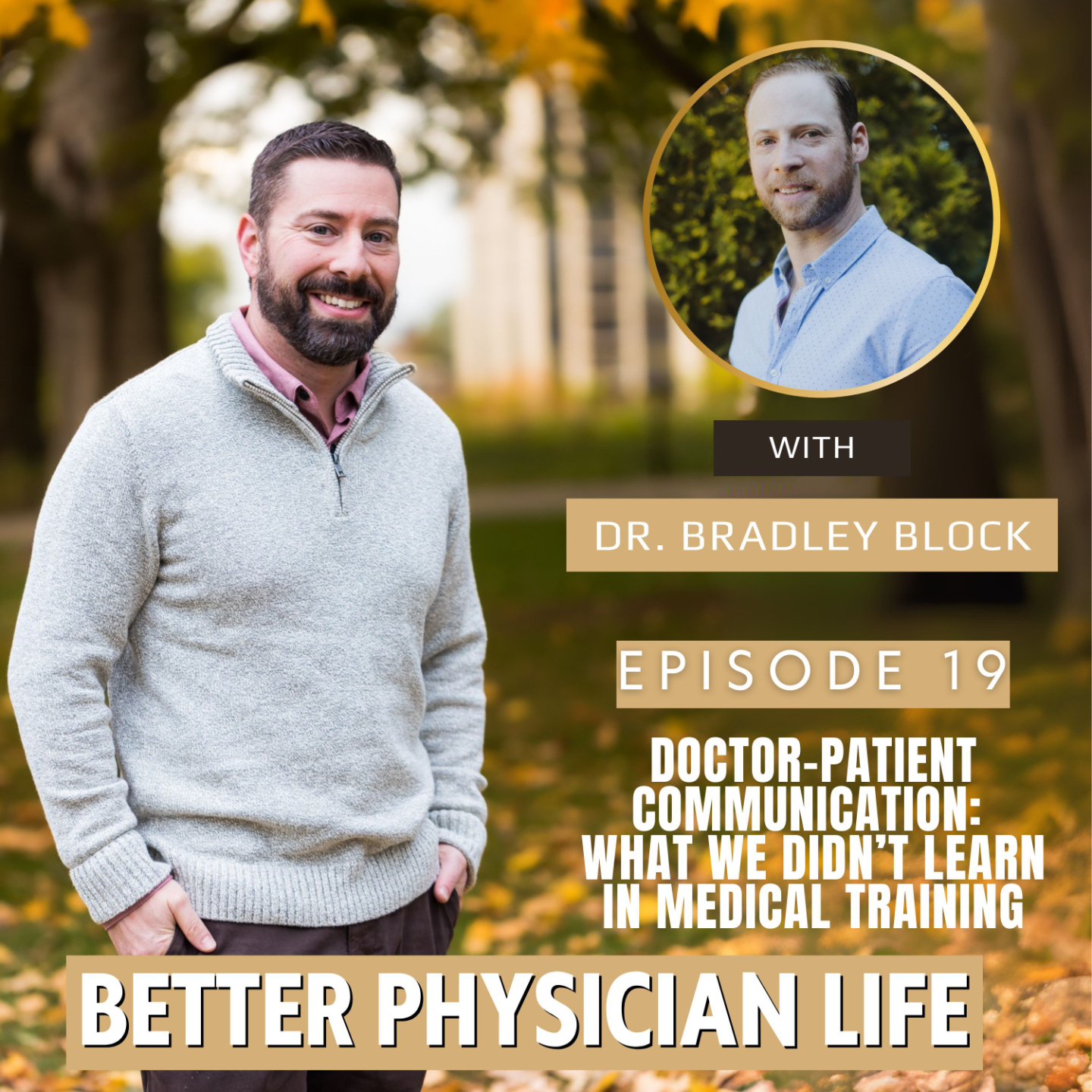
Doctor-Patient Communication: What We Didn’t Learn in Medical Training with Dr. Bradley Block | Ep 19

What if the key to better patient interactions isn't more time or expertise, but how you show up?

In this episode of Better Physician Life, Dr. Michael Hersh sits with Dr. Bradley Block as he shares his journey from communication struggles to mastery. Starting his podcast after a frustrating clinic day that cost him family time, Dr. Block reveals why efficiency serves everyone—from waiting patients to your own well-being. He discusses being methodical in visits, earning trust by appreciating patients as humans, checking in on understanding, and removing distractions for true presence. Plus, insights on his rebranded podcast (over 400 episodes, nearly half a million downloads) and the Doctor Podcast Network, empowering physicians to podcast with ease.

This episode is a must for doctors seeking to communicate effectively, enjoy medicine more, and reclaim their lives beyond the white coat.

Watch on YouTube
Listen on Apple
Listen on Spotify

About the Show:

Created for physicians who want more than clinical competence, Better Physician Life is a space for honest reflection, reinvention, and reclaiming purpose beyond the pager.

Hosted by Dr. Michael Hersh, each episode dives into the questions we didn’t learn to ask in training, offering tools and conversations to help you live and lead with intention

Top 3 Takeaways: 

  1. Be Methodical for Efficiency and Trust: Communication challenges in medicine are repetitive. Identify them and create plans, just like surgical procedures. Dr. Block emphasizes showing patients you take them seriously, value them as humans, and care about outcomes to build rapport quickly.
  2. Prioritize Presence Over Distractions: Look up from screens to catch subtle cues and connect authentically. Dr. Block advises removing phones and other interruptions to give undivided attention, making visits more effective and helping you stay present in family life too.
  3. Leverage Podcasting for Growth: Dr. Block's Succeed in Medicine Podcast covers everything from litigation to productivity for physicians. Through the Doctor Podcast Network, busy doctors can easily start podcasts by focusing on interviews and outsourcing the rest, to network, establish expertise, and combat misinformation.

Watch Now


Video Poster Image

If you’re showing up everywhere but not fully anywhere, physician coaching can help you get your presence back. To lead conversations, not just react to them—in clinic, in meetings, and especially at home.

Click below to book your physician coaching consult and leave with a clear plan to take back control of your time, attention, and energy.

Book A Call
DOWNLOAD TRANSCRIPT

Doctor-Patient Communication: What We Didn’t Learn in Medical Training with Dr. Bradley Block | Ep19

Michael Hersh, MD

[00:00:00] 

Have you ever had one of those clinic visits where you walk out of the room and think, huh, that could have gone better? You listened. You discussed the possible diagnoses and you gave the plan, but somehow it still felt off. The patient didn't quite seem fully on board. you didn't quite connect, and you're left wondering, was it them?

Was it me? I think we've all been there. And maybe what makes the difference isn't more time or more knowledge, it's in how we show up, and that's what we're talking about today.

Well, hey everyone, and welcome to another episode of the Better Physician Life Podcast. Thank you so much for being here today. So today, we are chatting with Dr. Bradley Block. He's a general otolaryngologist and partner at ENT and Allergy Associates, hailing from my old stomping grounds of Long Island, New York.

Dr. Block is also the creator and host of the Succeed in Medicine Podcast [00:01:00], where he explores the parts of medicine. We don't get taught in medical training, especially how we communicate. His work is about helping us be more effective, more present, and maybe even enjoy medicine a little more. He's released over 400 episodes with nearly half a million downloads.

Those are huge numbers. He's also the CEO of the Doctor Podcast Network, which provides community and services to physician podcasters. And I am so proud to say I am a part of the Doctor Podcast Network. Welcome to the show, Dr. Bradley Block. How are you? Thanks so much for having me. I'm really excited to be here.

I always enjoy our conversations and learn so much from talking to you, so I'm excited about this. This is great. We just spent probably a half hour getting to Chit Chat before we hit record, and probably that would've been useful for everybody too. So I'm glad we get to sit down and record this part of our chat.

Yes. So you, love talking about [00:02:00] communication and as I was kind of just mentioning, communication plays such a huge role in what we all do as doctors every single day, and we know it. Most of us don't dedicate a pretty substantial part of our lives to figuring out communication and how to improve it.

Talk to us a little bit about why you decided to really dig in on communication as a life skill that you wanted to get better at. So it was because I wasn't good at it. I wasn't good at it. There was one day where, this was years ago, so my. First kid who's now nine, was less than one. And I ended my office hours, two hours late.

So you can imagine how pissed the staff was, how pissed the patient was. And then I got home and I had long missed bedtime and I said to myself, I have to figure this out because it was an awful clinic day. It was like awful for everybody, patients, myself, my staff, and [00:03:00] then I missed this, 

Really important part of my day, which was, family time, right? Everyone says it goes so fast. Well it goes even faster if you miss that stuff. And so I said, you know what? I need to figure this out. I need to do some research. So I started looking into finding podcasts that talked about communication because Commuting is just the worst. And so I like to make use of that time by listening to audiobooks and podcasts. And I look to find that podcast, and let me tell you, if yours had existed, I probably wouldn't have started my own. But there wasn't, I've been doing this for over seven years now, and so there really wasn't something at least that was geared towards doctors, right?

There was stuff for salespeople, there was stuff for. Attorneys and leadership, but there really wasn't much about doctor-patient communication. And so I had to find those people. And so I decided to start my own podcast. So I'd find those communication experts and I would focus their expertise on our specific lens.

And it wasn't just about being an effective communicator, it was about being an efficient communicator, [00:04:00] right? Because as much as we'd all love to spend an hour with each patient. We can't, for financial reasons, we can't because we owe it to the patients that are trying to make appointments while they're at home.

We owe it to the patient that's waiting in the waiting room. So it's not just about the patient that's in front of you. I mean, they're the ones that should get your undivided attention but being efficient about communication also serves the people that are trying and waiting to see you. So how do we do it well and efficiently has always been my question and my answer has been, if we're intentional about it, we can do it.

We can do this efficiently and effectively without sacrificing that doctor-patient relationship, the trust that you need to earn during that visit. Yeah. And I think, You know, you're spot on. Efficiency is key for all of the reasons that you listed. And then you were beginning to talk a little bit about effective communication.

What have you learned in terms of effective [00:05:00] communication? I think doctors all know how important communication is, and. It can still be a struggle, right? This is not something that gets focused on a ton, or at least it wasn't. I'm pretty far out from my medical school days at this point in my midlife career.

But as you think about how to be a more effective communicator, what have you learned? So one, I would say the patient needs to know that you are taking their problems seriously, that you appreciate them as a human, not just a sum of their symptoms. And that you care about their outcome.

And so, that needs to be communicated to them. The medicine, I think for us, a lot of times, as we get on in our career, figuring out the diagnosis. It tends to get easier, right? There's certainly gonna be plenty of patients out there that have challenging problems, and this is where you refer to your colleagues and other specialties and [00:06:00] Right.

We all know how to manage the medicine part, but the communication part, sometimes for the simplest diagnoses, can be the most challenging part. And so it's about earning your patient's trust. I feel like the, communicating complex ideas is another challenge, right? The curse of knowledge.

It's hard to remember the time where we didn't know so much. So that's something else where a simple solution, and this also goes to trust building, is checking in with the patient, right? So you're building trust, you're communicating complex ideas, and then at the end of the visit, you have to make sure that you've really addressed everything.

And when I say everything, there are unspoken questions that you need to also identify as if Michael, your job wasn't hard enough. You need to be a mind reader. Actually, I interviewed someone a couple of years ago who's like a professional mind reader, he doesn't actually claim to be able to read your thoughts, but you know, there's certain [00:07:00] techniques that they use to convince people that they can read their minds. And so I had him on the show. I was like, so as doctors, we need to actually read people's minds. And so I need some insight from you into how we do that.

And so, bundling all of that into one singular visit. Is a challenge. Our jobs are really hard, right? Because you need to do that while doing the medicine, right? While figuring out the diagnosis, while coming up with a treatment plan, and documenting that all in a short period of time.

And you know, it's really important that's the thing. I think that the conclusion that I'm coming to after answering your question a very meandering way, but I'm getting to the conclusion the key is just being methodical about it. And that's something that when you go into the operating room, you have a plan for how you can approach it, right?

You go into the endoscopy suite, you have a plan for how you're gonna approach the procedure, and if you develop a problem, you have a plan for how you're gonna address the problem. We don't do that in medicine. We just walk into the room and go, so how you doing? [00:08:00] What are you here for today? But we need to be more methodical because the challenges that we have in communication.

Are repetitive. We encounter a couple, a few, a handful of different communication challenges. Certainly, there are gonna be more than that, but they're ones that keep coming up over and over, and they might be different for you than they were for me. And so identifying what those are, and finding ways to navigate them so that when they happen, you have a plan.

That's the key to communication is being methodical about it. Gosh, we're methodical about everything else. Why not this? Yeah. You know? Couple of points I just wanna highlight that you were making is that, All the more reason why we have to look up from our computers and our screens. I think so much of our day has become about documenting everything that's going on in the room.

And you were talking about like, how are you connecting with the patient that's sitting in front of you? How are you picking up on those subtle clues that they don't quite get it or they don't quite agree? And [00:09:00] part of that requires us to look up from the screens that are in front of us and actually be looking at the patient and.

 we're doing all the things right, as you were just saying. Our jobs are hard and we have to be, you know, juggling all of these different things that are going on in the room. Thinking through the problem, coming up with the diagnoses, connecting with the patient, documenting it all as it is happening in real time, and what are ways that can allow you to be more effective at being methodical with those other things so that you can reconnect.

And part of the way that I've done this in my own clinic is I try to, before I even go in the room, I know why the person is there. I've already reviewed the workup that they've had done in the past so that when I walk in the room I can say I've reviewed everything and. Talk to me about why you're here, right?

Yes. And then they don't feel like they're catching you up to the reason that they're there. They know that you're already on board, and then they just get to talk about the things that are top of mind for [00:10:00] them. Yes. And actually if your listeners want to email me at [email protected], I can send them a, one pager that I wrote on how to start every visit.

It's like the first 20 seconds of every visit. If you have a way that you do that, it'll set the tone in a positive way and I'll give away what's in the handout now. I'm not gonna leave you in suspense. It's, first of all, walk in with enthusiasm, right? Walk in with positive energy. 'cause that's gonna set the tone for the visit.

Like if you're still worrying about that last patient or about a phone call, you just got like, we deal with this stuff and it sucks, and how we have to move on is sometimes just we're asking something superhuman. And sometimes it's impossible, right? So don't hold yourself to an impossible standard.

But for most patients, you can walk into the room with positive energy and with enthusiasm, and you thank them for being there, right? This is something for hospitality. Thank you so much for coming to the Marriott. Thank you so much for staying at the Disney [00:11:00] Hotel. Thank you so much for whatever it is you're go.

Thank you for coming to the restaurant today, right? Like they know this in hospitality, so we need to take some cues from hospitality, which is thanking them from coming in because. They might think, oh my gosh, Dr. Hersh, I'm so glad I was able to get a visit with you today. And that's creates this power balance which is already there, but it just reinforces that.

Well, if you can even out power balance by be acknowledging like you're grateful that they chose you as their doctor. Thank you so much for coming in today, right? Takes two seconds and sets the tone in a positive way. Okay. Another thing that I'll do, like you said, I reviewed the records, right?

That's something that, they hate. When I made the appointment, I told them, it was about when I walked in the room, I told the nurse or the medical assistant was it about, and now you're asking me why am I here? It drives them nuts. So I will drop the name of my, medical assistant, right?

Let's call her Melissa. It's not her name. Okay. Oh, so Melissa told me that you're here because you've been dizzy for three [00:12:00] weeks. So just that little bit of information lets them know that we communicated, even if Melissa didn't tell me that she just wrote it in the chart under chief complaint, right?

So those couple things start each visit with. Positive energy thanking them from coming in and letting 'em know that there's been communication within the team. You are now hurdling in the right direction with your communication. A lot of what we do, and this is another point a little bit unrelated, you know, we talk about how it's all in the history, right?

You're gonna get the diagnosis most of the time. 'cause it's all in the history. A lot of the times you don't need the history, right? You're doing this for long enough. There's something from the chart or the way that they're sitting and breathing or something, right?

You can often tell very quickly what's going on. Okay, so then what's the point of all that communication after that is trust building, trust building, and once you acknowledge that, that's why this communication is taking place, it gets much easier. But I already know the diagnosis. Great. You still [00:13:00] need to earn their trust.

They need to tell their story. Let them tell their story. I know you know the answer. Don't be that kid that shoots their arm up. No, it, no. Let them tell their story and they might tell you something that actually leads you in a different direction, but often they won't.

You do this long enough, you see the same things over and over you got it right, but you still need to earn that trust. And another thing that you can do very early on in the visit for trust building, find something to talk about that shows them that you recognize that they're a person more than the sum of their symptoms.

So find like, oh, those are really cool earrings. Where'd you get them? Like, oh, I see in your keychain that you're a Bills fan. Oh, you know there's a holiday coming up. Oh, what are you doing for the Halloween, at least at the time of the recording is coming up. It can be a little tricky 'cause I've got some religious patients that don't celebrate Halloween.

And so asking the kids what they're gonna be dressing up as, but still anything that you can find on their person to latch onto to ask them about, that's unrelated to why they're there. That shows that you're interested in them [00:14:00] as a person. Huge for trust building. So those couple of point, each of those things, they just take a few seconds.

And so you're like, well, we don't have time. I'm running behind. Yes, I guarantee you start doing this routinely. Your visits are gonna be shorter 'cause the patients are gonna feel heard, understood, appreciated. And then they're gonna be less inclined to, perseverate on some of their symptoms that they feel they need to, if the doctor isn't present.

If the doctor isn't listening, they feel like the doctor doesn't care about them. So then they don't need to perseverate and repeat themselves over and over because they know. that's the key, right? People feel the need to repeat themselves if they feel like they weren't heard the first time.

Right? And so if you are being effective in your communication and the person sitting across from you feels like they were heard and you spoke to them in a way that made them feel heard, then they don't feel the need to keep saying the same thing over and over again to make sure to validate.

The [00:15:00] words that they're saying. Yeah. You were just naming something else that, I think it's the resistance of physicians. It's the obstacles we create for ourselves that are, I don't have time for this, or I already know the answer and you know, I need to keep moving because there are, 10, 15 other patients phone calls, all the other things.

And so it's important to acknowledge that we may know the answer that we may have lots of other things to do, and it's all about heading into the room with the right mindset because yes, we've done this many of us for many, many years. We've seen a lot of these things over and over and over again.

And we may know from the moment we walk in the room exactly what our plan is gonna be and exactly what we're gonna do. And to the patient on the other side of the door. None of that matters. All that matters is that when they are leaving that day, they feel like you heard them and that they're leaving with a plan that they believe in.

Yeah. You gotta think of it like [00:16:00] a Broadway show, right? Like if you're an actor in a Broadway show, and this analogy works really well because some of these actors have been training their whole lives and they finally got this position in this famous Broadway show, right? And now they're doing it. Seven times a week, twice on Sundays for years, over and over, but from the family who flew to New York from the middle of Minnesota, right?

This is the first time they're seeing this, and they're so excited. So if you don't bring your energy to the same show that you've done now 600 times, Then you're doing a disservice to that person. And so we need to recognize that even though it's the thousandth time that we've said this thing, it's the first time they've heard it.

And also the fact that we've said it so many times frees up some cognitive energy to read the room. Is it being [00:17:00] heard? Is it being understood? And so this is where communicating complex medical information, you need to check in over and over. During that visit to make sure that they are actually understanding what you're saying in the way that you're saying it.

Because we develop these spiels, right? You say the same thing over and over and you've honed that spiel over years of saying it. You've honed the jokes, the same jokes you make over, you know that joke's gonna land 'cause it lands every time before. But within that, then it's not. A lot of cognitive energy.

because you're just saying the things that you've said so many times, but that frees up the cognitive energy for you to read their facial expressions. They're squirming in their chair, they're losing interest in what you're saying they're staring off into because you've just been droning on and on and you've lost the audience.

Right? And so then it's on you to bring it back. It's on you to use that cognitive energy that you've freed up to recognize that this is happening. Then pivot a little bit in the way that you're approaching [00:18:00] it. Yeah. And to our skeptical colleagues. Right. Because there's a version of me that's listening to us talk and I've got that internal eye roll going thinking, yeah, yeah, yeah.

Like I know all of this. Sure. The question is like, what's in it for me? Like, why do I care about this? And here is what I'm going to offer. Because I love your, analogy of the Broadway performer that's doing the same thing over and over and over again. When you put the effort into the communication, not only does that family that traveled so far to see the show have wonderful experience, but so does the performer on stage.

And if you as a physician are trying to figure out how do I make my day better, how do I leave the office feeling fulfilled, I actually had a good day in clinic. Like I might've seen 15, 20 people, and at the end of it, I feel energized, not depleted. This is the way, [00:19:00] when you can have wonderful interactions with people where you feel like you're actually connecting and everybody's enjoying their time that is how you leave clinic feeling.

Like a better version of yourself. Let's use the opposite to prove our point, right? If you don't do this and you have negative interactions, you leave feeling like crap. You feel unfulfilled, you feel like you're not very useful, right? You know the medicine, right? But you're not actually completing the objective of helping people.

Because if they don't trust you, if they don't feel like you understood them, if they don't feel like you care about them, they're gonna not listen to you and they're gonna go see another doctor, or they're just gonna ignore their complaint and they're just gonna feel dismissed. Or they're going to, end up with an alternative practitioner instead.

Because they just feel alienated by modern medicine in general. And so if you don't pay attention to this stuff, it's not good for them and it's not good for you because Yeah. To your point, I've found that it [00:20:00] is, when I'm intentional about this communication and it sounds like it takes some of the fun out of it, right?

Because it takes some of the spontaneity out of it. Right? If you're this methodical about how your communication is. It's not true, right? All of these encounters are different. All of your relationships with the patients are different. All of their management has its own nuance, so you're not, what you're doing is you're smoothing out the rough spots, so then you're making more room for the good stuff.

A hundred percent and I'm wondering, right, so there's this aspect of things , there's like the patient-facing aspect of improved communications. How has this work impacted your life outside of clinic and procedures? How do you bring these tools into the rest of Brad Block's life? Think about it, right?

If you're a better communicator. This translates to everything, right? Like how I communicate with my wife, how I communicate with my kids, how I communicate with my family members at my practice, right? How I communicate [00:21:00] with my staff, with my partners, right? If you bring that intention to all of your communication.

It's also an interesting thing because my tolerance has gotten lower for people that aren't very good at it. So when people aren't like, I can see like, so one of the other things that we didn't talk about yet is like being present. So when you're present with your patient, like yes, there's paying attention and there's listening, and then there's being present.

And being present means they have your undivided attention without distraction. And they know it because they can read it in your face, right? That's being present. So when I'm communicating with people and they're not present, oh. Burns me up now. Whereas before this I wouldn't have noticed it, and now it really gets under my skin.

And so, I know that when I'm doing it with other people, how it comes off. And so I've become a better communicator in all aspects of my life. And I've gone from someone who wasn't good at this, right? This was not my thing. And I would still argue my wife is an amazing communicator. She [00:22:00] is still miles ahead of me.

I am miles ahead of where I was when I started this journey. And so it is gone from a liability in my life to an asset. I didn't really answer your question in like, how has it impacted my life? But it's just, made it so much better in so many dimensions. Is the best I can do.

Are there any tips that you would give on how you can be more present because I wholeheartedly agree with you. Yeah. I am like so zoned in when I know people aren't paying attention. I think, apple watches for me are the bane of my existence because I'll be having a conversation with somebody and they just start scrolling on their watch.

So I might've given a tidbit about like how I try to be more present, but what do you do to make sure that you're fully engaged and present? So I know this is something that you talk about and that you teach on being present. And so I definitely have a lot to learn from you because when I'm at home with my family, I need to constantly, recognize that I am not being present right now and bring it back to that, right?

Like, I'll be [00:23:00] lying with my kids at bedtime and I'll be thinking about what I need to do next instead of just enjoying, right? Everyone says it goes so fast, right? Like one of the ways to slow it down is to be present. Is to start noticing thing. Like you can feel their like fuzzy hair, like brushing up against you.

You can feel their heartbeat. You appreciate like their warmth next to you, right? You start noticing these details right about what you're doing right now. It doesn't mean I'm good at it. I need to work on it and constantly remind myself when it's happening. And I think that's part of it is just recognizing you're not present.

Then being able to bring it back to that. And I think that's what like meditation is about, right? When you meditate, your mind wanders. And the goal isn't to stop it from wandering. The goal is to be able to recognize when it has wandered and bring it back. And so kind of the same idea, but when you're with patients specifically, I mean, the idea is undistracted.

Your thoughts are only about them and what they're saying in this moment, undistracted, [00:24:00] and they can read that on your face. Sometimes if you are present, it might not show up on your face. I have a whole episode on nonverbal communication, so making sure that it is present. The fact that your facial expressions are consistent with the fact that you're present, but it is possible also if you are distracted, they'll be able to read that, like you can't fake presence.

But if you are present, it's possible that you're not showing it on your face. So, yes. It's just about being undistracted and when they know that, yeah, they're less likely to repeat themselves. Oh, but I gotta document, I gotta write things down. Yes, yes, yes. Sometimes I do turn to my computer to document, and then I do it in such a way that they know I'm still listening.

But still having those periods where you are doesn't need to be the whole visit, but there should be a significant amount of time where you are. 100% on them. They feel like they're the only people in the universe. Yeah. And I'll add, nobody is inherently good at this about being present.

And you, use the idea of meditation, and so many people [00:25:00] just think, I'm bad at meditation. But the truth is, you just have a normal human brain. All of our minds wander and it's not about the wandering, it's how you recognize that your mind has wandered and bring yourself back. And so that is what meditation is, but that's also what presence is, right?

So when your mind starts going to clinic the next day, or procedures the next day, or a bad patient encounter, it's not about not having those thoughts. It's about recognizing that they're happening and then bringing yourself back to bedtime and your kid that's snuggling with you and like the moment that you've actually waited for all day long to be present for just bringing yourself back to it.

And in terms of like little tips and tricks, right? I never have my cell phone on me when I am at work, I leave it at my desk. it is almost always in a focus function or a do not disturb function. I love do not disturb because every time your phone is pinging you. You just get super curious and you want to take it out, and then who knows how long that, quick [00:26:00] glance at your phone is gonna last for.

So just figuring out ways, like where are you getting distracted and how can you remove those distractions so that you can be present in the moments that you wanna be present in. Right? It doesn't have to be all the time, but you get to choose. Yeah, don't rely on willpower. Make it easier for yourself.

Don't make it harder for yourself by having all these distractions that then you need to pull your attention away from. Make it easier for yourself by identifying what those distractions are and then get 'em out of there. Yeah, like we make it harder for ourselves unnecessarily, because we think this time will be different.

I will have the willpower to ignore that vibration in my pocket. I won't bring my phone. Yeah. Why is this time gonna be any different? Just make it easier for yourself.

Absolutely. And then you have turned this love of communication. It's interesting to hear you say you know, that communication has been a struggle for you because now you've turned it into this incredible podcast. Over 400 episodes, over half a million [00:27:00] downloads. Which is amazing. And your job is actually communicating with other people and physicians on a regular basis in an educational way.

Tell us more about the show and where you see it going. Thanks for asking. Because I love to talk about my podcast. people are always like, so how's work going? I'm like, yeah, it's fine, but let me tell you about my podcast. So the original impetus for creating the podcast was communication.

But when I was starting the show I didn't think I could just call up a stranger and be like, Hey, I don't have a podcast that even exists yet. Can I interview you on it? So what I started with is interviewing people that were in my circle. And something cool about being a doctor is that most of the people in your circle are experts.

Either you know, you did well in high school, so your friends from high school, probably experts at something, right? Your friends from college, also experts, all of your friends from medical school. Experts in their chosen field. So I just started interviewing people about things that weren't related to communication, but that I thought it was important for doctors to know about.

And so [00:28:00] the ideas just kind of exploded from there. And a lot of the themes, track stuff that's going on in my life. You know, I've been sued and so I had a couple, a whole bunch of episodes on litigation and what it's like and all the, struggles that we, in isolation that we go through for litigation.

There was a point at which my practice might have been acquired by private equity. So then I had a whole bunch of episodes on private equity and medicine, right? So a lot of these things track my life. So recently I had a bunch of episodes with a bunch of ADHD experts where we didn't talk about ADHD, but we talk about the fact that they coach adults on how to be productive and avoid distraction.

Just what we were talking about. And so what is it that they coached their clients and their patients about that we as high performers could use to make ourselves more productive? And so basically the concept behind the podcast is everything we should have been learning while we were remembering Krebs cycle.

Like, at one point we bought a short-term rental property. Because if you're [00:29:00] a doctor and online you need to be in real estate. It's like a requirement, right? If you open an Instagram account about being a doctor, you are gonna be bombarded with real estate and investing as a doctor, and Right.

So we have a real estate, we have a short-term rental property. You know, it's everything that through the lens of being a physician. I have a bunch of episodes on parenting 'cause I was worried about screwed up my kids, right? Like we're high performers. So we had to achieve, achieve, achieve, achieve.

Is that the be-all end-all, right? Is that the type of thing that we should be really pushing our kids into? Or is there a different way? Like, am I just putting my values that my parents put on me, on my kids? So how do I avoid screwing up my kids? So everything that goes up into being a doctor and one of my favorite episodes, right?

We all hit this mid-career rut. So I had you on a couple of weeks ago. We were talking about how a lot of the stuff that we, the conversations that we have, the things that we treated, becomes routine. And so how [00:30:00] do you avoid stagnating when that happens?

So that was a great episode with you. So it really runs the gamut. It's everything that goes into your life. Everything where your white coat follows you at home, at work, everywhere. Everywhere. Everywhere. Everywhere. Yeah. and just as a reminder, succeed in Medicine. That's the name of the podcast.

Yeah. Succeed in Medicine and however you define. So I recently went through a rebranding. It was, it used to be Physicians Guide to Doctoring but now it's Succeed in Medicine and like, what does it mean to succeed in medicine? And that's gonna be different for every person, and it's gonna be different throughout your career.

And so the show focuses on everywhere that you can succeed. In medicine, however you define that. fantastic. We all have so much to learn from you and your guests. Your podcast is doing incredible work Anything else that you want our listeners to know? Obviously they can find you weekly on your Succeed in Medicine [00:31:00] podcast.

What else do you want our listeners to know? Well, I guess we could talk about our network, right? We have the Doctor Podcast Network. So usually when people use to ask me like, should I start a podcast? My answer would be no, because I don't need more competition, right? There are a finite number of listeners.

I don't want you to start a podcast too, because you might poach some of my listeners. Right? But now since we have a Doctor Podcast Network that helps physicians to start. Grow produce, monetize your podcast. Now, I do want people to start podcasts because it's self-serving. So we have the Doctor Podcast Network, which is a thriving community of physician podcasters.

And we can help you with all aspects of your podcast if you want us to only get involved a little or get involved a lot. I love the way I have it set up for myself. And so that's really what I wanted to share with the world, which is I sit down , I identify someone I want to interview, I reach out to them, I schedule them, I come up with the questions, I record it, and then I close my laptop and everything else is done for me.

Why? 'cause we're [00:32:00] busy physicians. Our time is very valuable and it shouldn't be spent doing things you wanna do. I don't like social media. I don't like editing. I don't like all this other stuff that goes into it, but I love the conversations and I learned so much from them. And my life is better, as you can tell, because of all these conversations.

I'm just better at life, right? All these different things doesn't mean I'm good at life, but I'm just better than I was before, right? And so, podcasting is great if you wanna establish yourself as an expert if you want to grow your network and or if you just wanna have interesting conversations with people that you otherwise wouldn't encounter.

Or if you have something like if you're a coach like yourself, right? It's a great way to get yourself out there, and we wanna help physicians to do it. And so the doctorpodcastnetwork.co, we did get the.com. It's a long time coming. I don't know if the website's gonna be actually on the.com yet, but drpodcastnetwork.co. If you're interested in joining us, we'd love to have you there's a link, put your email in and we'll get back to you. and to the physicians out there that have thought [00:33:00] about making a podcast, because our voices matter and we do have so much to share with the world.

The Doctor Podcast Network has really made this process seamless. so huge plug for the work that, you are doing with the Doctor Podcast Network because, you know, there's always that voice in the back of your mind like, does anybody really need this? Does anybody really need to hear me on a weekly basis talk about these things?

And the answer is yes. And I really feel like Doctor Podcast Network has made it such that I was able to lean into the discomfort of putting myself out there and getting back on the airwaves. And so thank you, thank you for the work that you're doing. It really is making a difference and we're glad you remember.

Yes. For all those people that are reluctant, like, yes. Does the world need another podcast? No, it doesn't need another podcast of someone spewing misinformation or, you know, talking about. With their friends about reruns of a show that was canceled 15 years ago, right? We've got enough of those, but as a physician, you've got a lot of [00:34:00] important information and we need it out there.

And if it's not your information that's getting out there, then it's misinformation that's getting out there. And so the more positive, knowledgeable people we have getting information out there, the better the world's gonna be for it. I couldn't agree more. All right so for the listeners, go check out the Succeed in Medicine podcast.

If you're interested, check out The Doctor Podcast Network. Tons of great resources. Dr. Bradley Block, thank you so much. As always, love chatting with you and to the listeners, thanks so much for spending some time with us today, and I'll see you on the next episode of Better Physician Life. Take care.

Previous Episode
Next Episode