Better Physician Life coaching

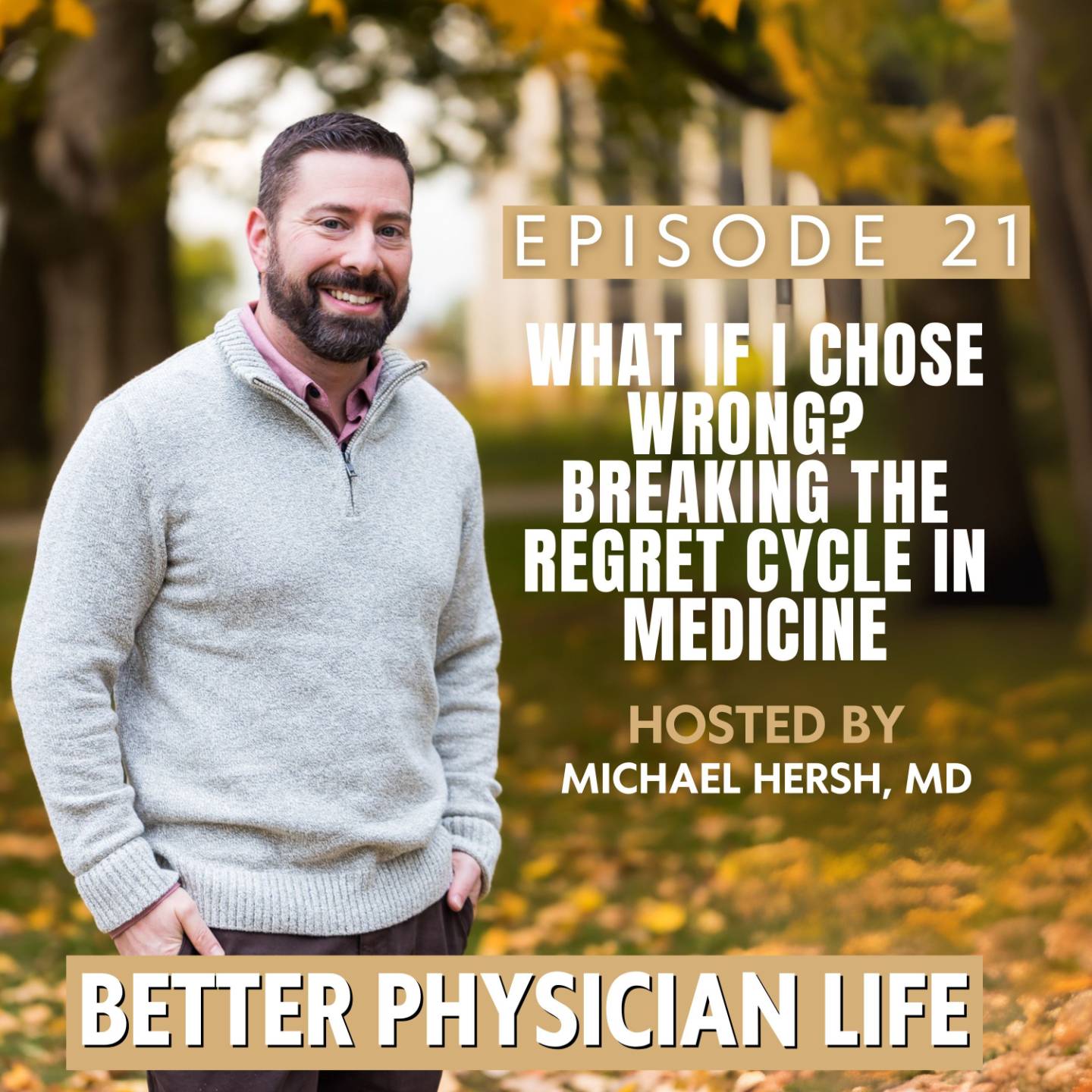
What If I Chose Wrong? Breaking the Regret Cycle in Medicine | Ep 21

What if regret isn't truth, but a story stealing your present?

In this episode of Better Physician Life, Dr. Michael Hersh unpacks regret's grip on physicians—from specialty choices to life paths. He reveals how regret is indulgent and impedes progress. Dr. Hersh explores the impact of shifting from “what if?” to "what now?" through reflection, naming gifts, and intentional action. With examples of pivots and physician coaching breakthroughs, this episode empowers doctors to drop the weight, embrace growth, and build futures without romanticizing unchosen paths.

🔗 Design Your Life: A Goal Setting Guide for Physicians: betterphysicianlife.com/design-your-life


Watch on YouTube
Listen on Apple
Listen on Spotify

About the Show:

Created for physicians who want more than clinical competence, Better Physician Life is a space for honest reflection, reinvention, and reclaiming purpose beyond the pager.

Hosted by Dr. Michael Hersh, each episode dives into the questions we didn’t learn to ask in training, offering tools and conversations to help you live and lead with intention

Top 3 Takeaways: 

  1. Reframe Regret as a Story: Regret feels urgent but spins wheels. It's rumination, not reflection. Dr. Hersh explains: you made the best decision you could with the information you had at the time. Practice asking "What now?" instead of "What if?" to break the loop and focus on present decisions.
  2. Name the Gifts in Your Path: Every choice brings unseen benefits, like relationships or resilience. Dr. Hersh shares how a client's medical career regret transformed into a pivot. List three "gifts" from your past decisions this week to shift from loss to gratitude.
  3. Use Physician Coaching for Momentum: Grinding on our own ignores patterns. Physician coaching helps to provide perspective. Try one small forward step, like journaling, to build accountability and turn regret into growth.

Watch Now

 

Video Poster Image

If you’ve been stuck replaying old decisions or looping on what-ifs, physician coaching helps you stop second-guessing and start making decisions that move you forward.

In one call, you’ll see where regret’s been running the show and what’s been holding you back—and walk away with a clear next step to take back control of your time, direction, career, and life.

Book A Call
DOWNLOAD TRANSCRIPT

What If I Chose Wrong? Breaking the Regret Cycle in Medicine | Ep21

Michael Hersh, MD

[00:00:00] 

Regret feels useful, like if you replay it enough, you'll finally figure out what went wrong, but it's lying to you. You can't fix the past. All regret really does is rob you of the future you could be building right now. That's where too many of us in medicine get stuck.

Well, hey everyone, and welcome to another episode of Better Physician Life. Thank you so much for being here today. So today I wanna discuss something we don't talk a lot about in medicine, but it's there. Creeping in the background and that's regret the late night. What ifs? The nagging voice that says you should have chosen differently.

It's that weight you carry around when you wonder if the last 15 or 20 years of training and practice were the right decision for you. [00:01:00] I've seen it in my colleagues and I've seen it in myself. I've coached so many physicians who just can't shake the feeling. They're haunted by the choices they made in medical school, residency, fellowship, marriage, career moves, and they've convinced themselves their best life slipped away years ago.

They're missing something in their life right now because they might have chosen wrong. Regrets, like those feel like truth. It feels like evidence that we did something wrong, that we chose wrong, but most of the time it's just a story your brain keeps replaying and like most old stories, it leaves out the details that actually matter.

Here's how it usually works. Regret runs like a bad highlight reel. You hear the voice, you should have known [00:02:00] better. You should have seen this coming. And once it's in your head, it's relentless. I remember reading Robert Frost's, the Road Not Taken Back in Middle School. And even back then, I felt the weight of that traveler at the fork in the road.

One path well worn, clearly laid out, the other one far less traveled and he picks one and promises himself that he's gonna come back to the other path, but then admits he probably won't. And then there's that last line. I took the one less traveled by, and that has made all the difference. It's pretty striking, but here's what you don't notice until you're older.

I certainly didn't realize it back in middle school. Frost never says the difference was good or bad. He just says it was different. And [00:03:00] that's regret in a nutshell. We build this fantasy about the road we didn't take. Perfect hours, perfect balance, perfect life. But that's a lie. That road doesn't exist.

The one you did take, that's real. That's where you learned. You built relationships, you earned some scars, and you became who you are today. And I see it every day in medicine, especially in those Facebook groups that are supposedly there to support doctors. A physician will post something like, I made the wrong decision by choosing a career in medicine, or I should have chosen another specialty, or another city, or maybe even another life.

And then the comments start rolling in. Empathy, encouragement, sometimes even [00:04:00] concern. And unfortunately, there are also some keyboard warriors who offer much less helpful and sometimes even shaming comments. But underneath it all is this unspoken truth. That regret is everywhere in this profession. We just don't talk about it much.

So why is it that regret sticks? The answer is because it feels important. It feels urgent. Like if you replay it enough times, you'll finally figure out the move you should have made. But regret doesn't move you forward. It just spins your wheels and burns your energy. We regret because we tell ourselves life would've been better if we'd chosen differently.

We built this whole fantasy where everything turned out perfectly. But when you actually look back, you forget what it was [00:05:00] like in that moment when you were making the decision. The lack of information, the pressure, the fatigue, the fear. And when that happens, I like to remind myself of this. You made the best decision you could with the information you had at the time.

That doesn't mean the decision was flawless. It means you weren't careless. You weren't weak, you were a human being, doing your best with what you knew. Sure, you might have handled that same decision very differently today, but you are not making the decision today. Today, you're using knowledge that you gained after you made that decision.

That's growth, that's wisdom. But you can't beat up the younger version of yourself for not knowing then what you know [00:06:00] now. And here's the most important piece of the puzzle. If you'd chosen differently, you'd still have regrets. They'd just be different ones. Because regret isn't about the decision. It's about the story you are telling yourself about the decision.

Regret doesn't just weigh on you; it robs you. When you're caught in it, you're not here, you're not really with your spouse, you're not really hearing your kids, and even the quiet moments start to escape you because your mind is somewhere else. It's stuck in a loop and it's replaying old tapes, and while you're busy arguing with the past, the present just kind of slips away, and then regret gets really sneaky .

A small thought slides in, I've never been good at this. Things never work out for [00:07:00] me. I can't do that. And those aren't harmless lines. They're anchors. They tether who you are to who you've been. And the more you rehearse that story, the more it becomes true because you never give yourself permission to imagine something different.

That's the real danger of regret, not the pain. It's the lie that you're stuck. And for physicians, regret cuts even deeper because medicine isn't just what we do, it's who we are. Our entire adult life has been wrapped up in this single identity, doctor. That white coat isn't just a uniform, it's pride, it's sacrifice.

It's years of training and missed milestones. So when regret creeps in, it doesn't just feel like I made a bad [00:08:00] decision. It feels like I am a bad decision, and I've felt that myself when I started questioning whether medicine still lined up with my values. The fear wasn't just about walking away from a job.

It was about losing an identity I built over decades, and the weight of that sunk cost. The time, the energy, the years of call nights hit made that regret feel enormous. But here's the truth. We are so much more than our profession. Who we are is not limited to what we do. And if we keep defining ourselves only as ‘doctor’ regret will keep owning us.

Every frustration with medicine will feel like proof that our whole lives were a mistake. But if you start seeing medicine as part of your story, not the whole story, you create [00:09:00] space, space for growth, space for pivots, space to reinvent yourself if you choose to. So what are the alternatives? Well, the first step is curiosity, not judgment.

Curiosity, instead of hammering yourself with, I blew it. Try asking, why am I regretting this right now? What story am I telling myself about what that decision means today? Most of the time regret shows up because we've convinced ourselves a door has slammed shut forever, that there's no going back. But is that actually true?

So there was this post I saw recently where a physician, posted I regret going to medical school because no other industry will take me seriously, which is a heavy thought. [00:10:00] Let's be honest. If a college kid introduced themselves as a doctor, you wouldn't take them seriously either. They hadn't done the work yet.

What makes you credible? The thing that opens doors is exactly that. It's the training, the long road we've already walked, and if you want to be taken seriously in another field, you'll have to do the work that that field values. So the real question is, how badly do you want it? Because medicine doesn't pigeonhole you, it equips you.

It equips you with skills, and it equips you with the ability to learn new things. The question isn't, can I pivot? It's will I let regrets stop me from doing the things that I want to do? And here's another thing to think about the decisions you made. Didn't just come with regrets, [00:11:00] they came with gifts.

Maybe you met your spouse in residency. Maybe you landed in a city you love because of fellowship. Maybe you built friendships, resilience, financial stability, things you would've missed on another path. None of that is small and none of it was guaranteed if you'd chosen differently. There are always gifts.

You just have to name them. So let's pause for a moment. What makes regret so heavy compared to other emotions? Some emotions, even hard ones move us forward. Like determination pushes us to act. And anger can fuel change and grief as painful as it is, lets us process and heal. But regret. Regret just [00:12:00] spins.

It loops the same story again and again. It burns energy and builds nothing. You replay conversations, you rewrite choices in your head. You imagine versions of the past that never existed, and while you're stuck in that loop, nothing in your present actually moves. That's what makes regret dangerous. It's an indulgent emotion.

It feels productive, like reflection, but it's not. It's rumination wearing a disguise, and the alternative is to turn that attention forward with curiosity, reflection, and then action. That's where growth happens. That's where momentum returns. And here's where the real Power lives.

Regret is about the past, but you don't live [00:13:00] there. You live right here in the present, and the present is the only place you get to decide. Picture yourself five or 10 years down the road. Looking back at this exact moment, what do you want that person to say? You want them to say thank you. Thank you for making the hard call.

Thank you for deciding who I was going to be. Right then, right there. That's the move. Not wishing the past away, not romanticizing the road you didn't take, but deciding today who you're going to be, and then taking one small step toward it. You don't need permission. You do not need perfect timing. You get to just make the decision right here, right now, and this is where coaching comes in because [00:14:00] if you are anything like me, or like most physicians, you can't always see through your own fog.

You get stuck in the regret loop without even realizing it. Physician coaching shines a light on those patterns. It shows us the indulgent emotions and what's draining us, and it gives us the ability to practice new thoughts, new choices, and new ways of showing up in our life. So I'll give you one example of a physician that I had coached who was drowning in regret over her specialty.

Every time she thought about her career, the same loop played. I chose wrong. I wasted all this time, and now I'm trapped. I'm stuck here. She was exhausted, cynical, and convinced there was no way out. But through coaching, she started to see those thoughts for what they [00:15:00] were. Stories, not facts, just stories.

And once she saw them that way, everything shifted. Her training hadn't trapped her. It equipped her. Within a year, she'd pivoted into a role that she loved and was much better suited for her. One she never would've discovered without her specialty training. The regret didn't disappear, but it was able to change shape.

For the first time, she could thank her past self instead of wishing she had chosen differently. That's the power of coaching. It doesn't rewrite the past. It doesn't sugarcoat reality. It helps you stop living back there and start living in the here and now. And I'll be blunt, most of us cannot pull this off alone.

I know I can't. We're too conditioned to [00:16:00] grind. Too skilled at ignoring the pain too practiced at just powering through and physician coaching gives us the thing we can't give ourselves perspective, accountability, and momentum. If you've been circling the same regrets for years, maybe decades, consider this your invitation.

Put the weight down, stop carrying it, start building something better. So let me leave you with this. Where's the regret that keeps circling in your head? And what if, instead of asking, what if you started asking what now? The past is fixed, but the future is wide open. The only question is, will you keep looking backward or are you ready to face forward and choose today?

Because today is the only [00:17:00] place you actually get to decide. That's where freedom lives. Thank you so much for being here with me today and for listening, and I'm gonna see you next time on The Better Physician Life Podcast. Take care.

Previous Episode
Next Episode