Better Physician Life coaching

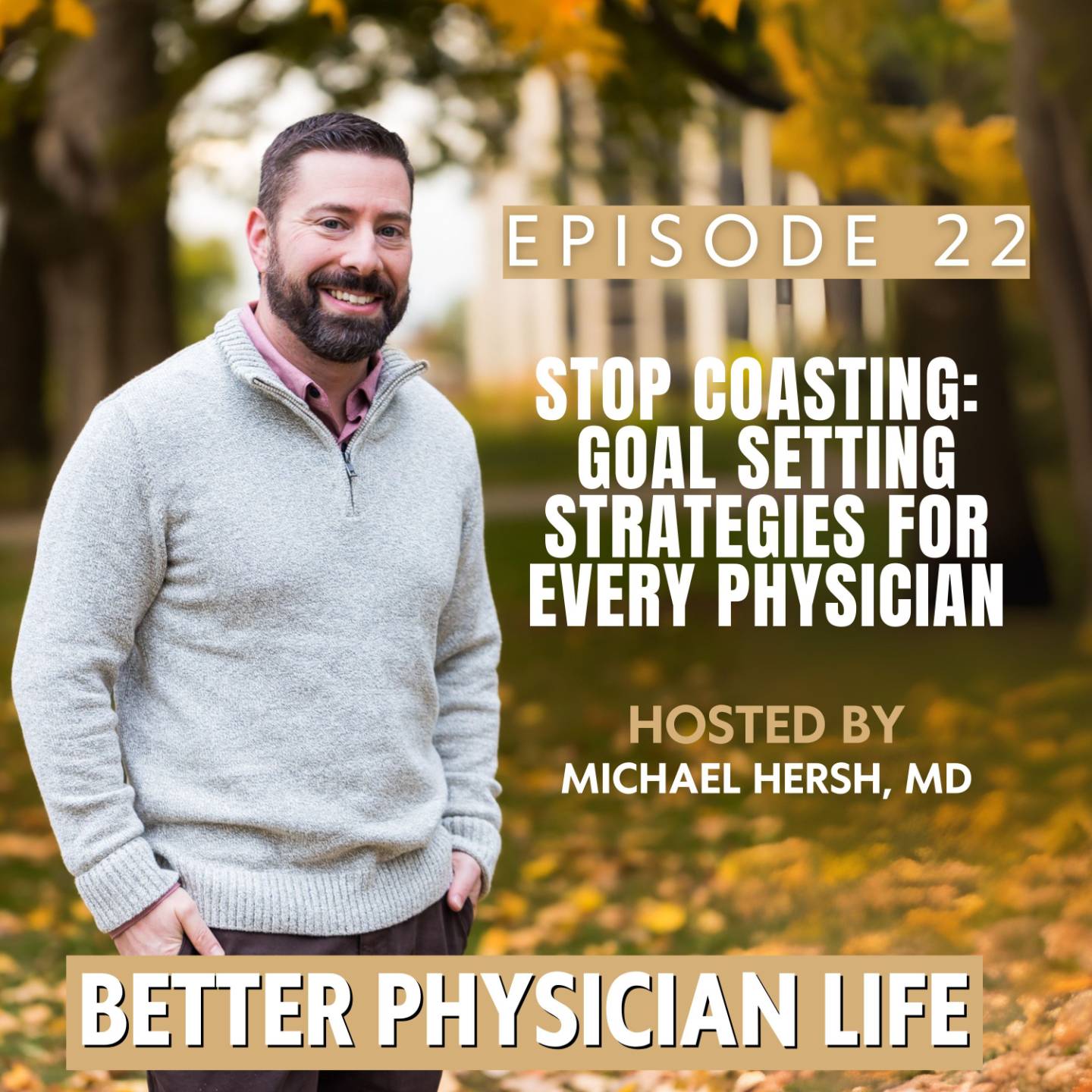
Stop Coasting: Goal Setting Strategies For Every Physician | Ep 22

What if New Year’s resolutions aren't the answer, but goals rooted in your "why" could transform your year?

In this episode of Better Physician Life, Dr. Michael Hersh shares his shift from post-fellowship coasting to purposeful goal-setting. He explores why resolutions fail (no plan, no why), the fear holding us back, and how to set rooted goals with curiosity, systems, and celebration. Perfect for mid-career physicians feeling stuck, this episode offers tools to enjoy the process, navigate obstacles, and build a life beyond brute force—starting now.

🔗 Design Your Life: A Goal Setting Guide for Physicians: betterphysicianlife.com/design-your-life

Watch on YouTube
Listen on Apple
Listen on Spotify

About the Show:

Created for physicians who want more than clinical competence, Better Physician Life is a space for honest reflection, reinvention, and reclaiming purpose beyond the pager.

Hosted by Dr. Michael Hersh, each episode dives into the questions we didn’t learn to ask in training, offering tools and conversations to help you live and lead with intention

Top 3 Takeaways: 

  1. Tie Goals to Your "Why": Resolutions fade without a clear purpose. Dr. Hersh explains how a single-sentence "why" (e.g., gym for more energy) makes goals stick. Try journaling one goal with its why this week. 
  2. Embrace Discomfort and Obstacles: Half the journey feels tough, but that's growth. Dr. Hersh urges viewing hurdles as guides, not blocks. Practice by naming one uncomfortable step (e.g., boundary-setting) and taking it. "The hard thing is frequently the right thing."
  3. Celebrate Small Wins: Track your progress. Dr. Hersh keeps a running tab of the progress he is making toward his goals. Start your own list. Note three small moves toward a goal weekly to build momentum and remind yourself of how far you’ve come. 

Watch Now

 

Video Poster Image

You don’t need another resolution. You need a system.
One physician coaching call can give you exactly that — a clear structure to stay accountable, lead your days instead of reacting to them, and follow through when the grind gets heavy.

If you’re ready to stop drifting between “fine” and “frustrated,” book your physician coaching call today and start designing what’s next.

Book A Call
DOWNLOAD TRANSCRIPT

Stop Coasting: Goal Setting Strategies For Every Physician | Ep22

Michael Hersh, MD

[00:00:00] 

Think back, how many New Year's resolutions have you made over the years, and how many have lasted past February? And here you are staring down another year wondering, is this it? Another round of resolutions you won't keep. Another year of doing the same thing, hoping it somehow feels different. If that sounds familiar, stick with me because today we are talking about the kind of goals that actually change your life.

Not someday, not next year, starting now.

Well, hey everyone and welcome back to the Better Physician Life podcast. Thank you so much for being here today. If you're like most mid-career physicians, the new year doesn't feel like a clean slate. It feels like another shift. Clinics reopen, the inbox refills, and somewhere in the back of your head, you're asking yourself, [00:01:00] should I even bother setting resolution?

Well, here's the short answer. No. Resolutions sound noble, but they rarely stick. They're promises without a plan. And physicians, we don't need more empty promises on our plates. What actually moves the needle in our lives is setting goals that matter, and more importantly, knowing why they matter.

That's what I wanna unpack today, why resolutions fail. Why goals matter, why so many of us stop dreaming altogether, and how to reframe goal setting, so it feels like fuel not just another chore on your already overcrowded to-do list. When I look back at my life, the shift really happened somewhere after finishing fellowship.

During medical school and residency, the goals were obvious. Get [00:02:00] in survive, pass the boards, publish, match, apply. Every step had a built-in milestone. The grind was brutal, but at least the path was clear. Then you arrive. Attending partner, husband, dad. For a while it felt like enough, like I checked all the boxes, but at some point the clarity started to disappear.

You're not climbing anymore, you're coasting. That's where I found myself. I had stopped setting goals altogether. I was great at executing, but terrible at imagining. And if I'm being honest, it wasn't because I was uninspired. It was because I was scared. Scared of slowing down to figure out what I truly wanted.

Scared to want something outside of [00:03:00] medicine, scared to fail, scared of what other people would think. When I finally started setting goals again with the help of a physician coach, the difference was night and day. Instead of empty resolutions like work out more or read more, I chose goals that were tied to a real why, like relearning French because I wanted to take my family to France for my 50th birthday and actually be able to speak the language.

Like recommitting to the gym and lifting regularly because I wanted to decompress after work and reclaim some energy for my family, and read not just to check a box, but because I wanted to challenge my brain with something deeper than up-to-date. That shift tying my goals to a why has made all the [00:04:00] difference.

It made my goals actually stick. So let me ask you, when was the last time you set a goal that actually made you excited? Not a checkbox, not another should, but a goal that pulled you forward, that made you wanna get out of bed early or stay up late because it mattered to you. If you can't remember, you are not alone.

That's exactly why this is such an important discussion. Resolutions fail because they're fragile. They're built on who we wish we were not on, who we're willing to become. They sound impressive when we say them out loud, but when life gets loud, they fold. They just go away. Goals with a why. [00:05:00] are different.

They may not sound as flashy, but they're rooted. They're rooted in what you truly want for your life. And when you know why you want something, you've got something to lean on. When the grind gets heavy and the grind will get heavy. Nobody coasts into lasting change.

For me, I try to use a simple filter when I'm trying to figure this out for myself. If I can't say the why in a single sentence, my goal's not ready, then it's like I'm trying to explain it away, and if the why isn't truly mine. I know it won't last. I can't create goals based off of what somebody else wants.

For me, it has to be deeply embedded in why I wanna do it in the first place. And if I'm waiting to feel ready, I already know [00:06:00] what's happening. I'm just stalling. Readiness is an illusion. The only real test is this. Am I willing to be uncomfortable for it? Because that's the line that separates resolutions from goals that actually change your life,

And it ties to something deeper. Because before we can set goals worth chasing, we have to remember how to dream. Think back to when you were a kid, adults asked all the time, what do you wanna be when you grow up? If you had a million dollars, what would you do? If you could be a superhero, which one would you be?

And back then, we dreamed easily, no hesitation, we had answers. I was the same way. I was reading about medicine before I even understood half the words. In high school, a guidance counselor told me [00:07:00] that my dream college was too ambitious and that I needed to aim lower. I applied anyway, and I got in.

The doubts never disappeared, but the dream kept me moving. I didn't know the how, but I knew the what, and that was enough to keep me going. And then one day, the dreaming just stopped. It happened somewhere in the blur of long hours and commuting and kids and the EMR and the pressure to perform. I bought into this lie that I'm a doctor now, and that's it.

That's the box. The thought of failure started to carry way too much weight. The liability, the reputation, the expectations they piled on. The voice said, that's not for you anymore. You can't do that. You are a doctor, and that's how dreaming [00:08:00] dies. Not with a crash, but with a quiet resignation. But here's what we forget.

You didn't always know how to be a doctor. You figured it out. You waded through fear and doubt and setbacks. And you build your way forward. And if you could do that, you can figure out anything. The only real barrier is whether you'll give yourself permission to try and the space to figure it out. And this is where I hear the lie come up over and over again from colleagues.

I'm a doctor, I can't do that. Start a company, not for me. Write a book out of reach. Go part time, too risky, change specialties too late. We file these under fantasies, and then we just keep trudging in our current lives. But let [00:09:00] me challenge you. Is that really true or is it just familiar and easy? Most of the time the ceiling isn't real.

It's just the story we've rehearsed. And every time I've seen a colleague test that story, they discovered that the ceiling was fake. Medicine wasn't trapping them, it trained them. It gave them discipline and resilience and problem solving skills. And with that, you can do anything. The only catches you have to let yourself use them.

So why don't, most of us, why do we resist setting goals in the first place? I can think of two reasons. Uncertainty and discomfort. first. Uncertainty. You don't know how, and if you did, you'd already have done [00:10:00] it.

That's not a flaw. That's the work. Second, discomfort. Change feels hard. Your brain is designed to avoid that kind of discomfort. Of course, it feels easier to stay the same. But we have to remember that there is discomfort in staying who we are also. So what can we do? Well, we can start by expecting both of those things.

Expect not to know how. Expect it to feel uncomfortable if you never feel resistance. You didn't set a goal, you wrote a wish. That's why your why matters. Your why is the brace you lean on when the knee buckles, when the week explodes and your energy [00:11:00] is gone and you just wanna punt and give up. Your why is what keeps you going.

Write it down, read it, say it out loud. Make it real. And if a full why feels heavy, or maybe you're not ready yet, try this. Just pick a single word for the year, something that you can bounce your ideas and your questions off of just one, this kind of north star for when you're tired or drifting or just unsure a word like strength or focus.

Presence, build enough pause, embrace whatever word fits the season you're in so that when self-doubt and fear or frustration creep in, you [00:12:00] have a word that you can look back on and let it pull you into motivation and into meaning. Make sure you put your word where you're gonna see it on your lock screen or on a sticky note on your computer or in your calendar, and once a day, ask about the choices that you're making.

Does it honor the word that you chose? It's not magic, it's just about aligning your decisions with the things you truly want in your life. And sometimes one word can cut through the static better than any mission statement ever could. And here's another thing: stop outsourcing your life. In medicine, we've been trained from day one to care about what other people think.

Peer reviews and patient satisfaction, quality metrics. Approval has been [00:13:00] our currency, but your personal goals, they don't need a peer reviewer. They are not up for a committee vote. If the only reason you're holding back is fear of how it looks to other people. Call it what it is 

You're asking for permission. And let's be real. No one's going to hand it to you. You've already proven you can do hard things. You don't need permission anymore. You need to decide. And part of deciding is unlearning this belief that harder is always better. Grinding feels noble. It's what got us through medical school, residency, and those long call nights.

But let's be honest, it's not a long-term strategy. You can want impact without worshiping exhaustion in the second half of your career. The better question is how do I create more with less struggle? That [00:14:00] doesn't mean laziness. It means stronger boundaries, better systems, and clearer thought, not just more brute force.

And even then, don't expect it to feel good all the time. Half the time it won't feel good at all. Expect it, name it. Keep going. We love to fantasize about the win at the end, but what about the middle? The messy middle is where most of life is actually happening, and if you bail every time it feels bad, you'll never build anything that truly matters.

That's actually why obstacles are so important. We all want a GPS that shows us every turn from here to the finish line, but that's not how life works. What you get instead are obstacles. And they're not there to block you. [00:15:00] They're actually there to guide you. Each one narrows the path and guides you into the direction that you need to be headed.

And when something flops, don't take it as a failure. Ask, what did this teach me? And what is the next step I can take? And then take it. That's the work. Try, learn, adjust, repeat. That's how Every big goal is built and along the way, you've got to find ways to enjoy the process.

Otherwise, you fall straight into the arrival fallacy. That quiet belief that there is better than here. It's not, and I fall for it too. So to fight it, I started by keeping a simple document in my Google Drive. Each month [00:16:00] I go back to this document and I just write down the things I've done that move me closer to my goals.

And they don't have to be big things like released a podcast episode can go on my goal sheet, or maybe I had a challenging conversation or miraculously made it to the gym three times this week. Little markers that when I look back, I don't need to see perfection. I don't need to see the full story. I just need to see proof that I'm still moving and that's what keeps me going.

And of course, don't skip the wins. Celebrate them, and they don't need to be huge. They don't have to impress anyone. Maybe it's finally getting the dog you've been wanting or planning out next year's vacations with your family, or carving out time to write or start a side gig or learn about investing or just read for pleasure.[00:17:00] 

If it matters to you, it counts. Period. So here's my challenge. Take a moment right now to think about this. What's one win you've brushed off? Because it didn't feel big enough. Name it and claim it, because those so-called small wins are the bricks. Your future is built on. They're proof. You're still moving, still showing up, still building something that matters even if it's not flashy, even if no one's watching.

So as you think about your next goal, don't start with what you should do. Start with why. Ask yourself, what do I actually want in this next season of my life? What do I want it to look like? What do I want more of? Energy, presence, freedom, meaning [00:18:00] what am I willing to be uncomfortable for? Because that's the trade-off, not pain for pain's sake, but discomfort for growth.

You've already done the impossible before. You've made it through training call nights, impossible hours. You've built a career in one of the hardest professions on Earth, so do not tell yourself you can't change. You've already proven you can. The difference now is that the stakes are higher, not because the world expects something of you, but because you do this year.

Skip the resolutions. Set goals that are rooted, not rushed. Goals that align, not impress. And as you start moving toward them, don't forget to look up. Enjoy the process, mark the small wins, and just let [00:19:00] yourself dream again. Because when you start dreaming with intention, when your why gets clear and your goals line up with who you are and where you're going.

You stop coasting and you start living. So maybe this week, take five minutes and ask yourself, what's one word that captures what you want this year to stand for? What's one goal that would make you proud? Not because it's big, but because it's yours, and then write it down. Say it out loud and take one small step toward it today.

You don't need to feel ready. You just need to start. Thanks so much for being here today and I'll see you next time on the Better Physician Life Podcast.

Previous Episode
Next Episode