Better Physician Life coaching

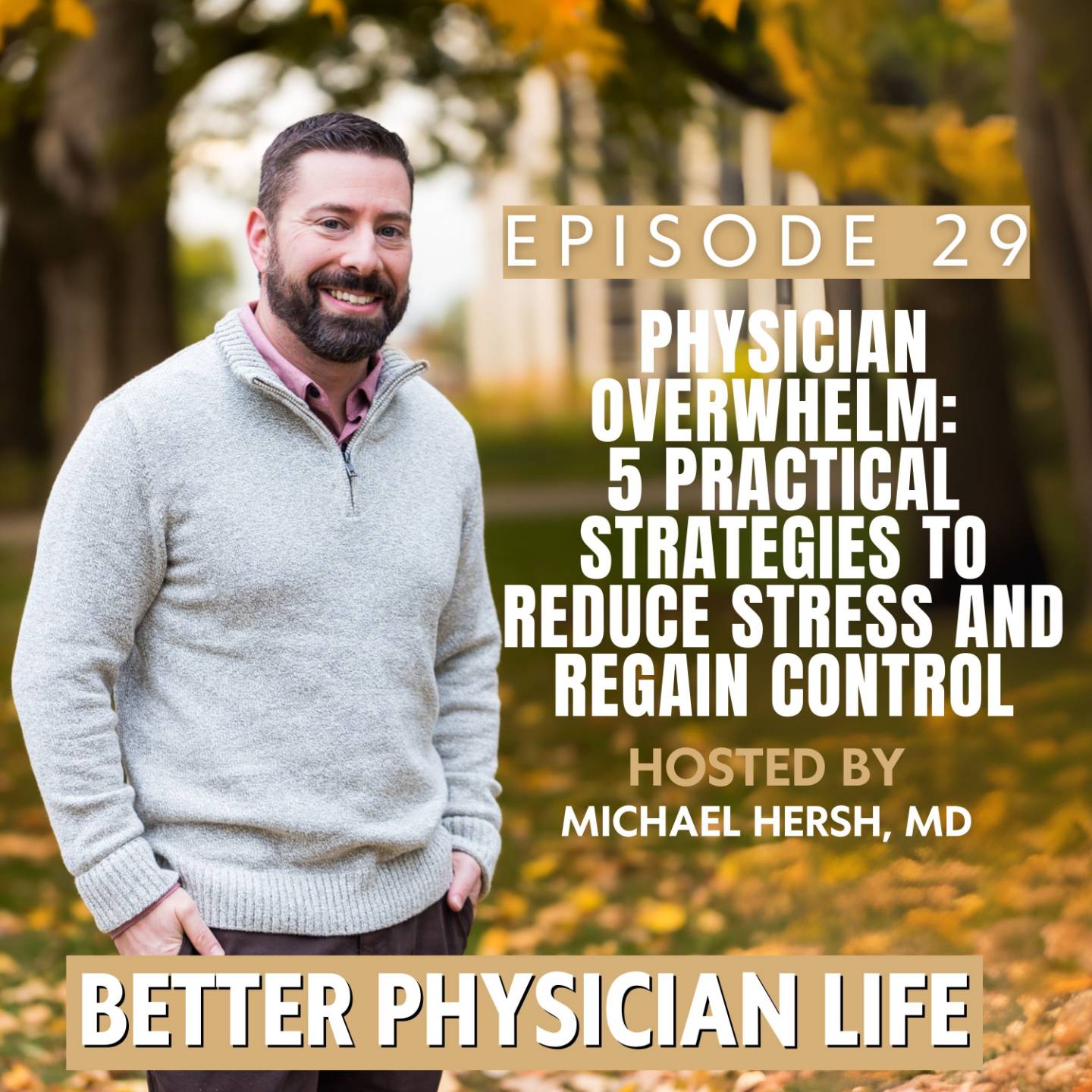
Physician Overwhelm: 5 Practical Strategies to Reduce Stress and Regain Control  | Ep29

Do you ever finish a ‘good’ day feeling like you’ve accomplished nothing because everything still feels urgent and unfinished?

Overwhelm doesn’t just hit physicians out of nowhere; it builds quietly from carrying too many unanswered questions and subtle resistance. In this episode of Better Physician Life, Dr. Michael Hersh breaks down what overwhelm really is and what it isn’t, why it feels so heavy even on busy-but-manageable days, and the five key shifts that help physicians take back control.

You’ll learn how to treat resistance as valuable data, close the mental loose ends your brain is carrying, stop wrestling with unwanted thoughts, shift from “I can’t handle one more thing” to clear priorities, and build simple systems that reduce decision fatigue and create traction.

This isn’t about working harder or adding more hours; it’s about responding differently to what’s already in front of you so you can stop feeling like the day is running you.

Free 5-Minute Commute Reset for Physicians:  betterphysicianlife.com/commute-reset 

Watch on YouTube
Listen on Apple
Listen on Spotify

About the Show:

Created for physicians who want more than clinical competence, Better Physician Life is a space for honest reflection, reinvention, and reclaiming purpose beyond the pager.

Hosted by Dr. Michael Hersh, each episode dives into the questions we didn’t learn to ask in training, offering tools and conversations to help you live and lead with intention

Top 3 Takeaways: 

  1. Overwhelm is not about workload; it’s about unanswered questions. Your brain treats every loose end like a threat, keeping you on high alert. Closing those mental loops, even with “I’ll decide tomorrow at 2 PM” reduces the weight dramatically.

  2. Resistance is information, not failure. That “ugh” feeling when opening a chart or email signals something unclear, overbooked, or exhausting. Get curious instead of judgmental, ask “What am I resisting? What’s the smallest next step?” and the pressure eases.
  3. Structure beats willpower. Small, consistent systems (a 5-minute EMR pause, a weekly reset, clear yes/no guidelines) reduce decision fatigue and move you from reaction mode to traction. You don’t need more time; you need fewer loose ends and better support.

Watch Now


Video Poster Image

If overwhelm keeps showing up, it’s usually not about effort. It’s too many loose ends and not enough structure.

One physician coaching call can help you sort out what actually needs attention, put simple systems in place, and stop relying on willpower to get through the day.

You don't have to figure this out alone. Schedule your complimentary physician coaching call today.


Book A Call

DOWNLOAD TRANSCRIPT

Physician Overwhelm: 5 Practical Strategies to Reduce Stress and Regain Control  | Ep29

Michael Hersh, MD

[00:00:00] 

Overwhelm doesn't usually just happen. For most physicians, it builds over time. We're already running at near maximum capacity. Patient care, inboxes, leadership roles, home responsibilities, and of course, that quiet mental load, it never quite shuts off. It feels like one more thing is always waiting to tip the scales in the wrong direction.

We're doing so much and the margin between I've got this and I can't handle one more thing, can feel razor-thin. If we're not careful, that edge bleeds into everything. Our patience, our work, our relationships, and eventually, overwhelm becomes the default setting. Common? Yes. Useful? Not really. And it doesn't have to run the show.

Today we're talking about what [00:01:00] overwhelm actually is, why physicians get stuck in it, and five practical ways to take back control without more time, more willpower, or a different job. Ready? Let's get into it.

Well, hey everyone and welcome back to the Better Physician Life Podcast. Thank you so much for being here today. So we are talking about something almost every physician has thought at one point or another. For me, it's practically on repeat throughout my day, every day, I am overwhelmed, And I wanna be clear.

This isn't burnout, although overwhelm can absolutely push us in that direction. This is the day-to-day weight we carry as we move through clinic and meetings and notes and family life. That feeling of moving fast, but not actually going anywhere when everything feels urgent and somehow nothing feels [00:02:00] doable.

And here's the tricky part. Overwhelm usually feels pretty accurate. It feels like a fair assessment of our lives. To make sense of it. We tell ourselves all kinds of stories. This is just what medicine is. Now I'll just power through and eventually I do not have the bandwidth for one more thing. But here's the thing.

Overwhelm isn't caused by the number of tasks in your life. If it were, we would fall apart every time we opened the EMR and saw a packed schedule. But weirdly enough, we don't; some of our busiest days are the ones where we're the most locked in. So if it's not the workload, what is it? Overwhelm is what happens when your brain is holding too many unanswered questions at once.

[00:03:00] Questions like. How am I gonna do all of this? What am I missing? When am I gonna finish? What's falling through the cracks? Where do I even start? Your brain treats those unanswered questions like threats, so it stays on high alert. That's why overwhelm feels so heavy. It's not the work, it's what you think about the work.

And once your brain is on high alert, resistance shows up and adds weight to all of those unanswered questions. Resistance is that subtle internal pushback we feel about a task, a conversation, a decision, or really anything we're not ready to look at or just don't wanna deal with. Although it doesn't always feel like it, resistance can be an incredible piece of information, like a neon light showing us exactly where the problem is.

[00:04:00] It's your brain saying something here isn't clear, or I don't know the next step, or I'm tired and I haven't quite admitted it yet. When we ignore that resistance, overwhelm starts to ramp up big time. One other thing to keep in mind is that overwhelm is an indulgent emotion. An indulgent emotion is one that keeps you spinning without actually moving you forward.

It burns energy, but it doesn't create traction. It feels active, but nothing changes. And that's how physicians end up functioning at capacity, while still feeling like the day is running them instead of the other way around. So let's talk about where overwhelm actually starts to shift. It starts with noticing that resistance.

You know, that moment when you open a chart or an email and immediately feel that [00:05:00] internal, Ugh, I do not want to do this. Most of us turn that into self-judgment. I'm procrastinating. I should be better at this. I'm already behind. If I had finished my charts yesterday, I'd have the time for this today. But remember that resistance isn't about you or your character.

It's information. It might mean my schedule is overbooked today and something has to give. Or I need more information before I take the very next step, or even I'm exhausted and I need time to rest. Ignore resistance, and it just gets louder. Judge yourself for it, and you completely shut down. But when you get curious, even briefly, the pressure starts to ease up a bit.

Ask yourself, what exactly am I resisting? What here is unclear? [00:06:00] Am I tired or do I just need some direction? What's the smallest, very next step I could take? Putting words to resistance gives you room to move. And remember, overwhelm isn't created by doing hard things. It's created by avoiding hard things without understanding why.

And once you've cleared even a little bit of that resistance, something else becomes easier to see. All the loose ends your brain is carrying in the background. The quiet questions that hit during your commute while brushing your teeth. Or the second your head hits the pillow. Did I miss something? Am I forgetting something?

When will I finish those charts? What's gonna blow up tomorrow? Your brain hates loose ends. It treats every unanswered question like a possible threat even when you're not at work, [00:07:00] especially when you're not at work. Anxiety lives in the questions and dies in the answers, and those answers don't need to be perfect or even correct.

They just need to be the best answer you have right now. Most physicians aren't overwhelmed because their lives are impossible. They're overwhelmed because they're juggling 15 incomplete thoughts at the same time, and trying not to think about something never works; tell your brain not to focus on something and it grabs onto it even harder.

That's the point. Avoidance just adds more pressure to the questions you haven't answered yet. The way out is simple. Answer the loose ends. Ask yourself, what am I actually worried about? What decision needs to be made? What information [00:08:00] am I waiting on and what's the next step? 

You don't need certainty. You need a clear next step and a clear next step will quiet things down. Take your phone or a scrap of paper and list every question your brain is holding. Answer what you can. Even if the answer is, this doesn't need to be answered today, I'll decide tomorrow at 2:00 PM. That alone takes the pressure down and makes the day feel more manageable. You don't always need more time. Sometimes you just need fewer loose ends and one place to put all the questions your brain has been carrying. And once you've dealt with some of the loose ends, another pattern becomes obvious. Physicians spend a lot of mental energy trying not to think certain thoughts.

We compartmentalize because the job requires it. [00:09:00] But that same skill backfires when we use it on ourselves. Don't think about it. Just get through the day. Deal with it later. And the more you try not to think something, the louder it gets; suppressing your thoughts never works. The moment you push it down, it comes right back up like a beach ball, trying to be submerged in water.

The overwhelm isn't necessarily from the thought itself; it's from the fight, from the tension. So instead of trying to force thoughts away, just notice them, not in a spa retreat kind of way. In a practical physician who has zero extra time way. Oh, there it is. There's that thought again. Okay. My brain is flagging something.

You are not indulging in it. You're acknowledging it. You're recognizing it this way. Your brain doesn't have to keep sounding the alarm. You would [00:10:00] handle a patient in a pretty similar way. You wouldn't dismiss them or shame them for asking a question. You'd say, I hear you. Let's take a look. Treat your own thoughts the same way, and then the tension drops.

Overwhelm loses one of its major fuel sources. Once you're no longer fighting your own thoughts, you can hear the sentence that shows up all the time for physicians. I can't handle one more thing. This is one of my all time favorites and I can count exactly zero times where it's been helpful in getting me through my day.

But every time it feels a hundred percent true. Then I need to remind myself that statement is a signal. It means I haven't been careful about prioritizing things. It means I don't know what matters most. Right now, everything feels [00:11:00] urgent, and I'm the bottleneck, holding up all the progress. And when I'm in that place, it's almost never about my actual capacity.

It's about the story my brain is telling me in that moment. Usually, it's one of three things. I've taken on too much without noticing I'm behind on something and pretending I'm not, or my priorities have gotten fuzzy and everything feels equally important. When that happens, I can't handle one more thing becomes the default headline for the day.

But if I take a step back just for a second, I can see that for what it is, data, my brain is asking for direction. So instead of believing that sentence, I start asking better questions. What actually matters right now? What can wait? What can be delegated? What can I take [00:12:00] off my plate on purpose? And what's the smallest next step that will give me some traction, because nine times out of 10, it's not that I need more hours in the day, it's that I need a smaller target, and smaller targets shift everything.

They take the pressure down and make the next move obvious. Here's what I had to learn the hard way. Smaller targets only work if there's a structure to support them. Without structure, you end up right back in the same cycle, reacting to whatever hits your inbox next. The truth is most overwhelmed physicians don't have a capacity problem.

They have a systems problem. If your day depends on willpower, luck, or hoping nothing blows up. You're gonna feel behind no matter how hard you work. That is not a character issue. It's a lack of structure. [00:13:00] Systems save energy because they reduce decisions, they add predictability to a job that's inherently unpredictable, and they give your brain something steady to lean on when your bandwidth is gone, and this is the final shift.

Building systems instead of relying on willpower. These systems don't have to be complicated. A five-minute pause before opening the EMR, a simple email rule, delete, delegate, or schedule a shutdown ritual before leaving the hospital, a 10-minute weekly reset to review what worked and what didn't. A guideline for when you say yes and when you don't. Nothing fancy, just structure. That's what creates traction, not perfection, not grinding harder. Traction. And when you have traction, you [00:14:00] stop living in reaction mode. You stop white knuckling your way through the day. You shift from chaos to something that feels steadier, and that is when control comes back.

Okay, let's bring it home. Overwhelm isn't a sign that you're failing. It's not proof that you can't keep up. It's your brain trying to protect you with incomplete information. And once you understand what's actually driving it. Resistance. Loose ends. The fight with your own thoughts, Unclear priorities. And a lack of systems.

It becomes a lot less mysterious and a lot less heavy. You can treat resistance as information. You can clean up the loose ends. You can stop wrestling with every thought that pops up. You can see I can't handle one more thing for what it is, a request for some direction. And [00:15:00] you can build simple systems that make your day feel less chaotic and more stable.

This is what taking back control looks like in medical life, not adding more hours, not blowing up your career, just responding differently to what's already in front of you. And here's one last thing I hope you take with you. You are capable of far more than your overwhelmed brain suggests.

You've proven that again and again. You don't need more grit or more resilience. You just need a clearer structure to support the work you're already doing. And one of the best places to build that structure is in the transition between work and home. That moment when your body walks through the door, but your mind is still rounding. That transition doesn't fix itself.

You have to shape it. That's why I created the Five-Minute Commute Reset for Physicians. It's a short guided audio and [00:16:00] worksheet designed to help you clear your head before reentering your life outside the hospital. It's free and you can download it at betterphysicianlife.com/commute-reset.

And here's why this reset matters. It's not about having a perfect routine. It's about building small points of control into a day that's built to pull you in every direction. Everything we talked about today. Clearing resistance, answering loose ends, setting smaller targets. Building systems comes down to the same thing.

Creating structure where your brain can finally breathe. The commute reset is just one small way to practice that one small move that makes the rest of your life less reactive. Thank you so much for listening, and I'll see you next time on the Better Physician Life Podcast.

Previous Episode
Next Episode