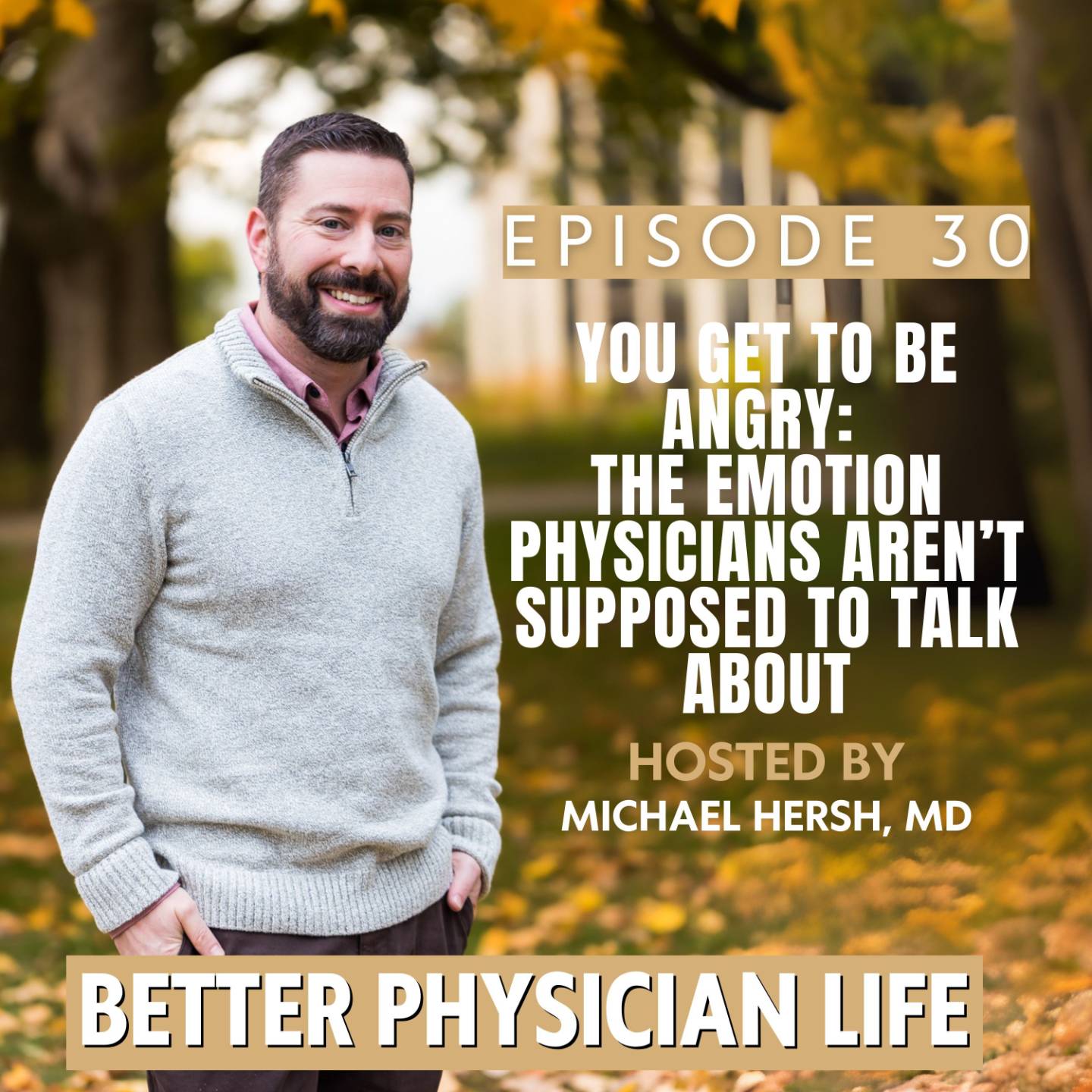
You Get to Be Angry: The Emotion Physicians Aren’t Supposed to Talk About | Ep30
Michael Hersh, MD
[00:00:00]
Do you ever feel it coming up so fast you don't even see it coming? You're fine, you're fine, you're fine. And then someone says one thing. A patient complains about the wait time. Your colleague questions a decision you made. Your kid rolls their eyes, your spouse says, can you not talk to me like that? And suddenly your chest tightens, your jaw, locks your thoughts speed up. Your brain goes straight to, are you kidding me right now? And here's the part that makes it worse. You don't just feel angry. You feel ashamed that you feel angry. Like anger isn't allowed, like a good doctor shouldn't feel that like a good parent shouldn't feel that like a good person shouldn't feel [00:01:00] that.
But what if the problem isn't the anger? What if the problem is that you've been trying to avoid it, but it keeps catching up with you anyway? Today we are talking about anger, why you get to feel it and what to do next.
Hey everyone, and welcome back to the Better Physician Life Podcast. I'm Dr. Michael Hersh, and I'm really glad you're here today. So I spent a long time thinking about what I wanted to call today's episode, and well, I landed on you get to be angry because whether we admit it or not, you do.
And I want to be very clear about what I mean. I am not saying anger is always helpful. I am not saying you should act out of anger. I am definitely not saying it gives you a [00:02:00] free pass to blow up your life or your relationships. What I am saying is this: anger is a normal human emotion, and pretending you don't feel it does not make it go away.
If you've ever tried to ignore feeling angry, how'd that go for you? For physicians, anger shows up more than we like to admit, and definitely more than we like to talk about. Not because we lack control, not because we're undisciplined, not because something is wrong with us, but because we live under pressure. Time pressure. Expectation pressure. Responsibility pressure. The constant need to be right. To be steady and to be composed, no matter what's happening inside.
And most of us were never taught how to [00:03:00] allow anger without letting it take over. So instead we judge it, we suppress it, and we try to pretend like it's not there. But not allowing anger doesn't make you calmer, it just makes it leak out sideways.
It shows up as sarcasm, as impatience, as snapping at the people you actually care about, as carrying around a low-grade edge throughout your day, especially in medicine, because pressure doesn't disappear just because you ignore what you're feeling. Pressure does what pressure does. It squeezes. And when you get squeezed, something comes out.
There's this quote from Wayne Dyer that really stuck with me when I first heard it a couple of years ago. He says that when you squeeze an [00:04:00] orange, orange juice comes out because, well, that's what's inside. And when you squeeze a person, when they're under pressure or criticized or caught off guard, whatever comes out is what was already there. And I remember hearing that and immediately feeling defensive because 20 years ago I was the angry GI fellow and I didn't want that quote to be describing me or worse defining who I was. It felt accusatory. Like it was saying, this is who you are, but that's not actually what the quote is pointing to.
It's not about labeling you. It's not about blaming you. It's about awareness because back then I was living at the effect of [00:05:00] my life, meaning things happened to me and I reacted. Colleagues made me angry. The system made me angry. My schedule made me angry. Other people's behavior determined how I felt, and that way of living feels right and justified and logical in the moment.
But it comes at a cost because when you're living at the effect of your life, you don't actually have much control. You're always responding, always bracing, always one comment or one convenience away from being set off. And the problem wasn't that I was angry. The problem was that I didn't think I had any say in what happened next.
And once I could see that, once I could see that I wasn't just reacting to life, [00:06:00] but letting life set the terms. Something really important shifted, not overnight, and certainly not perfectly, but I started to notice a pattern that anger wasn't random. It wasn't coming out of nowhere. It was showing up in very specific moments.
Moments where something felt off, and that's when I started to understand the next piece. Anger is rarely the first emotion. It's usually the second. Anger tends to arrive after something else hits first. Something quieter and something much easier to miss if you're moving fast. Something like disappointment, or fear, overwhelm, embarrassment, shame. That subtle sense of losing [00:07:00] control. Those emotions don't feel productive. They don't feel strong, and for a lot of physicians, they don't feel safe to sit with, but frequently anger does. Anger feels active. It feels decisive. It feels like you're doing something instead of just sitting in that discomfort.
And that's why frequently, it becomes the default, not because you like being angry, but because anger becomes familiar. It gives you a quick sense of control in moments where you feel exposed or uncertain. And for people trained to fix problems and take charge, that matters. So anger steps in, it becomes the cover emotion, and it sits on top [00:08:00] loud, obvious, obnoxious, and easy to point at while something underneath goes unaddressed.
And if you only try to manage the anger, if you tell yourself to just calm down, be more patient or let it go, you end up missing the whole point because the anger isn't the problem, it's the messenger. And like most messengers, it gets louder when it's ignored. And this is why the same situations keep setting you off. The patient interaction. The comment from a colleague, the chaos at home after a long day, you promise yourself you'll handle it better next time. And sometimes you do until that underlying thing shows up again. Because nothing actually changed. [00:09:00] The anger quieted down for a moment. Whatever it was, protecting never got addressed.
So the cycle repeats, and this is where things start to shift, not by trying harder, but by asking a different question. Instead of asking, why am I so angry? You ask what just happened inside me? What felt threatened ? What felt out of control ? What expectation did I have for how this was supposed to go and what boundary just got trampled on?
Those questions don't weaken you. They give you leverage because when you address what's underneath, the anger doesn't have to do all the work, and that's where control actually comes from. Not from suppressing anger, but from understanding [00:10:00] it. And once you understand that, once anger becomes a signal instead of a problem, the goal shifts.
The goal isn't to get rid of anger; it's to slow the moment down enough to choose what happens next. So let's talk about what this looks like in real time, because understanding anger is one thing. Working with it in the moment is something else entirely. When anger hits, your body typically reacts first before logic, before perspective, before intention.
Your heart rate goes up, your muscles tighten. Your thoughts narrow. And that's not a personal failure, that's physiology. So the first move isn't insight, it's interruption. [00:11:00] It's noticing your body, clenched hands, tight jaw, just long enough to create a little bit of space. And again, that space doesn't have to be big.
Sometimes it's just a deep breath. Sometimes it's just unclenching your jaw. Sometimes it's choosing to say nothing for five seconds longer than you want to. That pause matters more than it sounds because the pause breaks the reflex. It reminds your nervous system that there's no immediate danger here.
No emergency that requires you to react right now. And once you interrupt the reflex, you get a choice. Not a perfect choice, not a calm, enlightened choice, just a better one. This is where naming [00:12:00] really helps. You can say things like, I'm angry right now. I'm feeling activated. This is hitting a nerve for me.
You don't need to explain it. You don't need to justify it. Naming it is enough to slow things down and bring in some awareness, and then comes the most important decision in the moment. Do I address this now or do I wait until later? Sometimes the answer is now, and sometimes it's not. And knowing the difference is a skill.
If you can feel yourself ramping up, if you know that anything you say right now is gonna come out sharp, the strongest move is just a delay. To say, I do want to talk about this, but not like this. Or, can I have a few minutes? That's [00:13:00] not avoidance, that's leadership, that's control. That's taking responsibility because reacting might feel powerful for a moment, but it usually costs you later in trust, in connection, in credibility.
Pausing does the opposite. It protects the relationship while you regain clarity. And clarity is what lets you come back to the conversation with intention instead of impulse. Not every time, but more often and over time, that's how the pattern actually changes. Now, let me be very honest about something.
You are not gonna get this right every time. I certainly don't. You're still gonna snap sometimes. You're still gonna miss it sometimes. That doesn't [00:14:00] mean the work isn't working, it just means you're human. And this is where something really important comes in repair, because awareness without repair turns into more shame.
Repair is what closes the loop. Being able to say to somebody, that wasn't my best moment, or I took my frustration out on you, or that's on me, not with excuses, not with explanations. Just ownership. That kind of repair builds trust faster than pretending nothing happened. And if you're a parent, it teaches your kids something incredibly important: that strong people don't pretend they're perfect.
They take responsibility. Now, this work can look a little different depending on where you are. [00:15:00] At work, anger often shows up as sharpness, efficiency without warmth, cutting conversations short. Getting rigid instead of curious. You might still be professional, you might still be effective, but connections take a hit.
And over time, that costs you in team trust, in leadership presence, and how people experience you. And at home it's usually different. Anger shows up as impatience, as snapping over small things. As having nothing left by the time you walk through the door, and that's not because your family is the problem, it's because you've been trying to hold it together all day.
And home is where the pressure finally releases. That's why the transition matters, because if you don't intentionally shift out of physician mode, anger doesn't disappear. [00:16:00] It just relocates. This is also why I wanna say this clearly. Sometimes anger isn't just an emotional issue; it's a boundary issue.
Anger shows up when you keep tolerating things you don't actually agree with. When you keep saying yes out of obligation, when urgency becomes the default, when you're carrying more than you're meant to carry alone. When your life starts to feel like something that's happening to you instead of something you're directing.
So if anger keeps knocking, don't just ask how to make it stop. Ask what it's trying to point out. That's where real control comes from. Before we close, I want to offer something practical. If you've ever walked through the door after work and realized your head is still at the hospital or clinic, still replaying conversations, [00:17:00] still tense, still carrying the day, that's frequently when anger spills over at home.
That transition really matters, and that's why I created the Five-Minute Commute reset for physicians. It's a short audio guide and worksheet designed to help you leave work at work, clear your head, and walk into your evening with more intention. And it also includes a simple lock screen reminder you can use anytime, and you can download it for free at betterphysicianlife.com/commute-reset. And I'll link it in the show notes because presence doesn't happen by accident, it happens by choice. That's really what this whole conversation has been about, creating enough space to respond instead of react. And here's the takeaway I want you to sit with. You get to [00:18:00] be angry, not as an excuse, but as a starting point.
And when you stop shaming yourself for feeling it, you can finally understand it. And when you understand it, you can respond differently. And when you respond differently, everything downstream starts to change, and that's the better physician life.
Thank you so much for being here and for listening, and I'll see you next time on the Better Physician Life.