Better Physician Life coaching

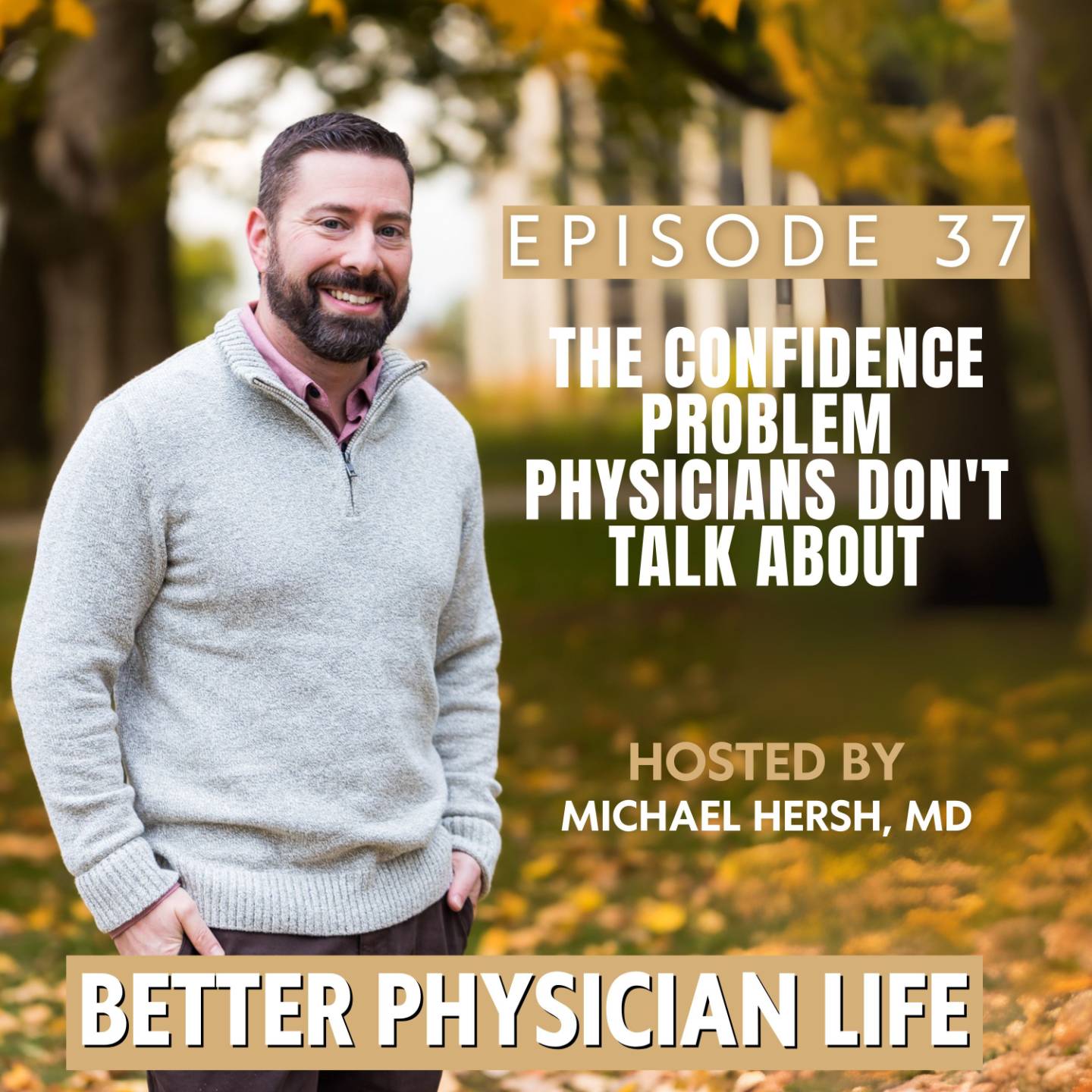
The Confidence Problem Physicians Don't Talk About | Ep37

What if your hesitation isn't about ability, but trusting yourself to handle the unknown?

In this episode of the Better Physician Life Podcast, Dr. Michael Hersh dives into the self-confidence gap that keeps high-achieving physicians stuck in the familiar rather than pursuing new roles, boundaries, or pivots. Drawing from his own journey, he distinguishes clinical confidence ("see one, do one, teach one") from self-trust ("I can handle discomfort"), revealing how fear of feelings, like rejection or inexperience, fuels waiting. With practical insights on signaling steadiness, settling rooms as a leader, and navigating transitions, Dr. Hersh equips mid-career doctors to act without full proof, embracing action as evidence. Essential listening for anyone tired of "maybe later" when it comes to what you truly want.

🔗 Free 5-Minute Commute Reset for Physicians:  betterphysicianlife.com/commutereset 

Watch on YouTube
Listen on Apple
Listen on Spotify

About the Show:

Created for physicians who want more than clinical competence, Better Physician Life is a space for honest reflection, reinvention, and reclaiming purpose beyond the pager.

Hosted by Dr. Michael Hersh, each episode dives into the questions we didn’t learn to ask in training, offering tools and conversations to help you live and lead with intention.

Top 3 Takeaways: 

  1. Distinguish Confidence from Self-Confidence: Clinical wins build execution skills. Self-confidence is trusting you'll handle discomfort or failure. Dr. Hersh suggests reframing “I’m not ready” to “I can figure this out,” then taking one small, clean action (like stating a preference without qualifiers), to build tolerance over time.

  2. Signal Steadiness to Lead Without a Title: Self-doubt shows in hedging language ("I'm probably wrong, but..."), teaching others to undervalue you. Swap it for direct statements to ease rooms and foster respect. Practice: In your next meeting or at home, state one decision plainly; notice how it settles energy and invites steadiness from others.
  3. Train Transitions to Expand Beyond the Familiar: Stuck in mental loops post-shift? Self-trust means leaving unfinished tasks without clinging to control. Start with Dr. Hersh's Commute Reset: Use the 5-minute tool daily to clear your head, proving you can adapt and be present, turning hesitation into momentum for new pursuits.

Watch Now

 

Video Poster Image

If you’ve been thinking about doing something new (speaking up more, setting a boundary, exploring a different role) and keep telling yourself you’re not quite ready yet, you’re not alone.

Most physicians feel very confident in their clinical work. The hesitation usually shows up when we’re outside the settings where we’ve done something hundreds of times before.

A physician coaching session can give you space to talk through where you are and what your next step might be. Use the link below to schedule a call with me.


Book A Call
DOWNLOAD TRANSCRIPT

The Confidence Problem Physicians Don't Talk About | Ep37

Michael Hersh, MD

[00:00:00] 

Have you ever looked at an opportunity and thought, Hey, I want that, and then immediately followed it with, yeah, but I probably couldn't pull it off. Not because you're unqualified. Definitely not because you're lazy, but because this one's different. A job you hadn't done before, a side gig, you keep thinking about a move where failing is a distinct possibility.

So you don't apply, you don't start, you don't take the shot. You tell yourself I would if I knew how, but here's the real question. Is it that you don't know how? Or that you're not sure you can handle it if it goes sideways. A lot of physicians are confident in the day-to-day work, but struggle with self-confidence when it comes to trying something new.

That's what we're talking about [00:01:00] today, the difference between confidence and self-confidence and why it keeps so many capable doctors stuck. 

Well, hey everyone and welcome back to the Better Physician Life Podcast. Thank you so much for being here today. So today we are talking about self-confidence, and I wanna talk about it because I think self-confidence is something almost every physician wants and frequently struggles with, but very few of us deliberately try to build it.

We think about it a lot. I wish I had more confidence. I wanna speak up more. I wanna go for that role. I want to take a risk. I wanna stop hesitating. And the interesting part is that the doctors who have these thoughts are usually doing very well. Respected. Competent. They've already done really hard [00:02:00] things.

So why does self-confidence still feel like it's missing? For me, this has been a huge part of my own journey. I've had plenty of wins in my life. Big wins. But even with that, I've spent a lot of time questioning whether I could do the next thing, wondering if I really earned the last one, or if it was just dumb luck.

And that doubt usually didn't always show up in a big dramatic way. It was usually pretty quiet, just enough to slow me down, just enough to create hesitation. There were real moments where I almost didn't go after something I wanted, not because I didn't care, but because I wasn't sure I had what it took to handle it or just to figure it out.

Over time, I started realizing what was actually happening. I was mixing up two [00:03:00] very different things because in medicine we are trained to build confidence in a very specific way. See one, do one, teach one, you watch someone do it, you do it, and then you teach it. Self-confidence matters most when you are doing something you haven't done before.

A new job, a leadership role, a hard conversation, a boundary you've never held. A career pivot, a side project, something outside the usual lane. There's no see one, do one, teach one for any of that. And if your confidence depends on proof, anything new is going to feel risky. Even if you're more than capable.

This is where I see a lot of physicians getting stuck. We're great at competence, we're [00:04:00] great at execution, but self-confidence is a different skill. Self-confidence sounds more like this. I trust myself to handle what happens next. Not, I'm guaranteed to win, not I won't make mistakes. More like if this gets uncomfortable, I can handle it.

If I mess up, I'll learn. If someone doesn't like it, I'll still be okay, and most importantly, I can figure it out. And that's why self-confidence matters because it simplifies things. When you have self-confidence, you stop spending so much mental energy protecting yourself from outcomes. You stop overthinking.

You stop rehearsing, you stop waiting to feel ready. Are [00:05:00] you ever gonna feel ready? No. You move. And when you move, things change. I was thinking about this a lot while I was putting this episode together. Why self-confidence is so appealing in the first place. Why we want it so badly, and a few themes kept coming up.

The first is how it affects the way other people respond to you. Not because you can control what people think, because of course you can't. People are gonna think what they think. Partners, patients, administrators, colleagues, everyone has opinions. That's just part of the job. But self-confidence, it does send a very powerful signal.

When you show up respecting yourself, talking about yourself like a competent adult, not an imposter. You make it so much easier for other people to respond [00:06:00] to you that way too. And this shows up in small everyday moments, how you talk about your decisions, how you state your preferences, and how you handle disagreements.

A lot of physicians unknowingly undercut themselves with the way they talk, right? They say things like, I'm probably wrong, but, or, this might be a dumb question, but I don't know, maybe. I'm so sorry to bother you, but sometimes that's just politeness. But a lot of time it's self-protection, and if you do that enough, you start teaching everyone around you how to treat you, not because you are weak, but because you are signaling uncertainty.

Self-confidence isn't being loud. It's showing up like you belong in the room. [00:07:00] Because you do. And that leads into the second reason why self-confidence matters is because it reads like leadership. Even if you don't have a title. In any group of people, someone is always setting the tone. People are looking for that steadiness. In the trauma bay in the OR, or procedure room in clinic when everything's backed up.

At a committee meeting, even at home, when someone is steady, when they're not constantly second-guessing themselves out loud, it puts everyone else at ease. That doesn't mean you're always right. It means you're not rattled by the fact that you could be wrong. There's a difference, and if you are trying to lead, whether it's a team, a department, or just your own life.

Self-confidence matters because it settles the room. [00:08:00] Third, self-confidence tends to make people easier to be around, and I'm not talking about positive vibes or anything like that. I mean something way more practical than that when you're not fighting for approval. You don't need to compete as much. You don't need to tear other people down.

You don't need to posture. You don't need to prove you are the smartest person in the room, and we've all met that person, the physician who needs everyone to know their right. That's not confidence, that's insecurity wearing a white coat. Which brings up a really important distinction. Self-confidence isn't arrogance.

Arrogance is, I'm better than you. Self-confidence is I don't need to prove myself. Big difference. Arrogance needs an audience. Self-confidence doesn't. Arrogance is [00:09:00] fragile. Self-confidence is steady. So if you've avoided anything labeled confidence work, because you don't want to turn into that guy, I totally get it, but they're not the same thing.

And that brings us back to the real pain point. Why do so many physicians who are clearly capable still hesitate? Why does doubt show up right before the next step? Here's what I think most of the time. The issue isn't that you don't believe you can do the thing. It's that you don't trust what you'll feel if it doesn't go well.

This is where I see a lot of physicians getting stuck. We are trained to avoid error. We're trained to reduce uncertainty. We're trained to anticipate problems before they happen. That's what makes us good clinicians. But it can make us overly cautious in our own lives because outside of [00:10:00] medicine, you don't get clear algorithms.

You don't get guarantees. You have to act before you are certain, and if your brain treats discomfort like danger, you'll keep choosing the safe route even when you're unhappy there. I see this all the time. A physician wants to speak up more in meetings, but doesn't want to feel exposed. A physician wants to set boundaries at work, but doesn't want the pushback.

A physician wants to apply for a role, but doesn't want the sting of rejection. A physician wants to build something outside of medicine but doesn't wanna feel inexperienced again. So they wait. They all wait. They tell themselves it's not the right time, or they need more experience, or it'll get easier later.

But most of the time, what they're really doing is trying to avoid a feeling, and that's why self-confidence isn't really [00:11:00] about belief. It's about tolerance. It's the ability to say, I can handle discomfort. I can handle embarrassment. I can handle someone not liking my decision. I can handle not being good at something yet.

That's self-confidence. And here's the problem. If your confidence only comes from what you've already done, you'll just keep repeating your past. You'll get better at what you already know, but you don't expand. To expand, you need a different kind of confidence. The kind that shows up before the proof.

And here's a simple way to think about it. Action creates evidence. But most physicians try to wait for evidence before they act. That's the trap. You don't get to feel fully ready before the next step. You get to act, [00:12:00] you get to learn, you get to adjust. Yes, sometimes you fail, but failing ahead of time, doing nothing, teaches you nothing.

It just keeps you comfortable and stuck. And I'm not saying that in a motivational way. I mean it in this same way you'd think about resistance training. If you don't load the muscles, it doesn't adapt. If you don't step into discomfort, it doesn't get easier.

The same thing applies here to self-confidence. One place I see this show up for a lot of physicians is how we handle not knowing. We're trained to know, we're expected to know, and a lot of us have this unspoken idea that uncertainty makes us look weak. So we hide it. We avoid asking questions. We avoid being new.

We avoid anything that might expose a gap. [00:13:00] What actually matters is being willing to be new at something again. That's a skill, and this shows up at home too. A lot of doctors will grind through work stress all day, bring it home, and then wonder why they're short, distracted, or impatient.

It's not because they don't care, it's because they never learned how to transition. They never built the skill of actually putting work down and showing up as a spouse, a parent, or a partner. And that transition turns out to be a self-confidence issue too, because it requires you to believe things like, I can put work down.

I can leave some things unfinished tonight. I can leave some things unresolved and still be okay. That's self-trust, and when it's missing, your brain does what it's trained to do. It clings to the list. It clings to control. If there's one thing I've noticed over time, [00:14:00] it's this: Self-confidence isn't believing you'll always succeed.

It's trusting yourself to handle the experience no matter what. And that's not something you fix in a single episode, but there is a practical place to start, one that fits into real physician life, because one of the places self-trust breaks down the most is right at the line between work and home. You leave the hospital, you leave clinic, you leave the OR, but mentally you're still there.

Running the list, replaying conversations, thinking about tomorrow, and you walk through the door with your body at home and your mind still at work. That's a transition problem and transitions are trainable. That's why I created the Five Minute Commute Reset for Physicians. It's a short guided audio and a simple worksheet you can use on the way home to clear your head, downshift, and walk in the door more present.[00:15:00] 

If you want it, you can download it for free at betterphysicianlife.com/commutereset, and I will link it in the show notes because when self-confidence is missing, it doesn't usually announce itself. It shows up as hesitation, as waiting, as telling yourself maybe later about things you actually want right now.

It keeps you doing what you already know how to do. Not because it's right, but because it's familiar, and over time, that costs more than a shot and missing. Self-confidence isn't arrogance, it's not bravado, it's not believing you'll always win. It's the ability to try anything to handle the discomfort, the uncertainty, the learning curve.

And most of the time that ability isn't built in the big decisions. It's built in the small ones. The transitions, the moments where you move forward without [00:16:00] fully knowing the outcome. That's when self-confidence actually gets practiced. And the more you practice it, the less time you spend waiting on things you already know you want.

Thank you so much for listening, and I'll see you on the next episode of Better Physician Life.

Previous Episode
Next Episode