Better Physician Life coaching

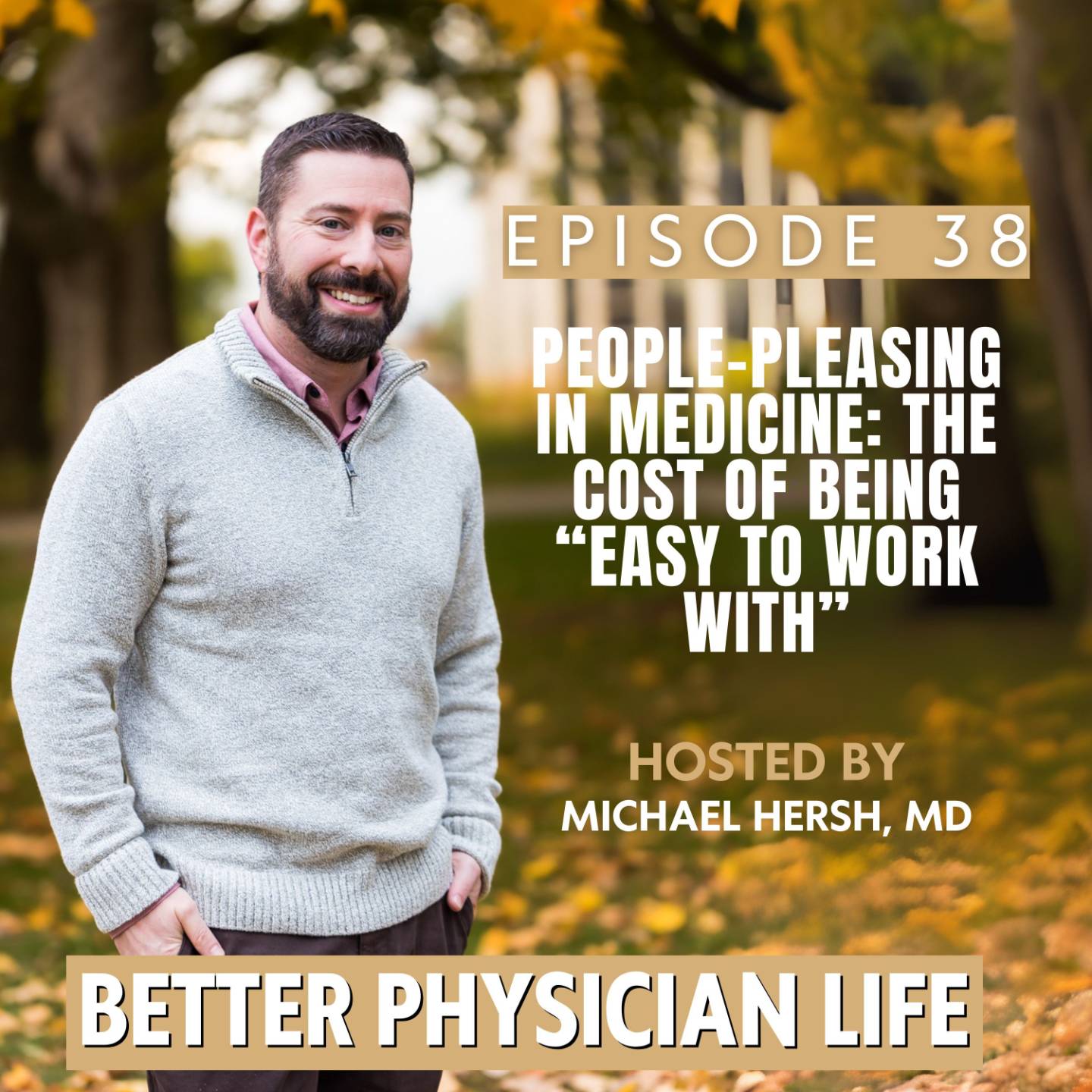
People-Pleasing in Medicine: The Cost of Being “Easy to Work With”  | Ep38

What if your "team player" yeses are quietly eroding your energy and authenticity?

In this candid episode of the Better Physician Life Podcast, Dr. Michael Hersh exposes people pleasing as medicine's unspoken training ground, from med school squeezes to mid-career overloads, where obligation masquerades as reliability, leading to irritation, resentment, and half-present relationships. 

Sharing his pivot from yes-to-everything to purposeful boundaries, he reveals the avoidance reflex behind it all, why it doesn't serve anyone long-term, and how to pause for honest yes/no decisions that protect what matters. A must-listen for physicians tired of smoothing over at the expense of self, with tools to rebuild integrity and make your yeses meaningful again.

Watch on YouTube
Listen on Apple
Listen on Spotify

About the Show:

Created for physicians who want more than clinical competence, Better Physician Life is a space for honest reflection, reinvention, and reclaiming purpose beyond the pager.

Hosted by Dr. Michael Hersh, each episode dives into the questions we didn’t learn to ask in training, offering tools and conversations to help you live and lead with intention.

Top 3 Takeaways: 

  1. Spot the Avoidance Reflex: People pleasing isn't niceness. It's dodging discomfort, like saying yes to extra shifts or family asks to skip awkward pauses. Next request, pause and ask, "Does this yes reflect what I want, or just avoid a negative reaction?" Choose honesty over obligation.

  2. Differentiate Obligation from Purpose: Early-career yeses build skill. Mid-career, they often stack resentment. Dr. Hersh invites you to ask, “What do I actually want to say yes to now?” Identify 3 draining yeses this week, and convert one into a clean, purposeful no to create space for what restores you.
  3. Reclaim Integrity at Home and Work: Managing everyone else’s mood drains your presence. Real care sounds like, “I want to be here, and I need 10 minutes.” Dr. Hersh suggests using a brief pause in transitions to make your capacity clear (not to create distance, but to prevent the silent no’s to yourself that erode connections over time).

Watch Now


Video Poster Image

If you’ve gotten used to saying yes because it keeps things smooth (at work or at home), you’re not alone.

Many physicians build a reputation for being reliable, helpful, and easy to work with. Over time, that habit can make it harder to notice when you’re agreeing to things you don’t actually have the capacity for.

A physician coaching session can give you space to step back, look at where your time and energy are going, and decide what you actually want to keep saying yes to. Use the link below to schedule a call with me.


Book A Call

DOWNLOAD TRANSCRIPT

People-Pleasing in Medicine: The Cost of Being “Easy to Work With”  | Ep38

Michael Hersh, MD

[00:00:00] 

Most physicians don't think of themselves as people pleasers. We think of ourselves as reliable, as the easy ones to work with. The ones who step up time and time again. But if you've ever said yes, when you meant no and then felt irritated, resentful, or just drained afterward, this episode is for you because people pleasing doesn't usually look like a problem. It looks like being a good doctor, but over time, it costs more than we like to admit. 

Well, hey everyone and welcome back to the Better Physician Life Podcast. Thank you so much for being here. So today we are talking about people pleasing and whether or not you use that phrase for yourself, you'll definitely recognize the pattern.

This isn't about being overly nice or lacking confidence, or not being assertive [00:01:00] enough. It's about something that gets trained into us very early in medicine and then follows us into the heart of our careers, saying yes when it would be a lot more honest to say no, saying yes, not because you wanna say yes to the opportunity or the committee or the extra work, but because saying yes feels easier in the moment.

If you think about our medical training, it's basically a masterclass in this. Can you squeeze in one more patient? Can you stay late? Can you cover this shift? Can you join this committee? Can you take this extra call? And early on, saying yes works. It builds trust. It builds skill, it builds a reputation.

It creates opportunities. I did the same thing when I joined my practice. I said yes to everything. [00:02:00] Extra patience, leadership roles, committees, interviewing candidates, opportunities I didn't fully understand in the moment. And for a long time it paid off. My practice grew. I got heavily involved in medical group and hospital leadership, and most importantly, I learned a ton.

But at a certain point, the costs started piling up. Early mornings, stacked on late nights, clinics packed tighter and tighter with more and more patients. Always one more thing hanging over the day, and the issue wasn't the workload; it was how I started to feel about it. I wasn't energized, I wasn't fulfilled.

I was irritated. And at first I thought that irritation was coming from other people asking for too much, but that wasn't what was happening. It was coming from me saying yes when I didn't actually [00:03:00] want to. That's the part we don't like to look at because people pleasing doesn't feel dishonest in the moment.

It feels helpful, it feels responsible, it feels professional. Until it doesn't, and that's when the shift happens. You start doing things out of obligation instead of on purpose. And when you do things out of obligation, resentment usually isn't far behind. Not because the request was unreasonable, but because some part of you already knew you didn't actually want to say yes.

You had a signal, you felt the hesitation. And you talk yourself out of saying, no. This happens for a lot of different reasons. But usually there are some pretty big unspoken assumptions. Things like they'll remember this, this will count for something later on. [00:04:00] Or saying yes now will open doors in the future, but the hard truth is that agreeing to do the thing doesn't actually guarantee any of that.

Saying yes doesn't obligate anyone else down the road. It doesn't necessarily buy goodwill, and it doesn't secure your future. And when that return never comes, or if it takes too long to arrive, that's when resentment shows up in full force. You start keeping score. You notice how often you are the one stepping up and not getting rewarded.

You replay the conversation afterward because the yes was never really about the task. It was about getting out of an uncomfortable moment, and that's the hard part. When you say yes from that place, it isn't generosity, it's discomfort avoidance. [00:05:00] Not because you're manipulative, not because you're dishonest, but because saying no felt more challenging than dealing with the reaction.

Most people pleasing isn't about being nice, it's about keeping things easy and non-confrontational. Smooth sailing. You're not saying yes because you want to, you're saying yes because you don't wanna disappoint someone. You don't want to experience the awkward pause. The look. You don't wanna risk a follow-up conversation.

Here's another way this plays out. You get the request, you know it's a no, and instead of just saying no, you don't respond. Two days go by, then a week, and now you're just not deciding. You're stuck. Not because you're unsure, you know exactly what you want, but because avoiding the moment feels [00:06:00] easier than having it.

And here's a simple way to tell the difference. If saying yes requires you to pretend, pretend you have time, pretend you're fine with it, pretend you don't mind. That's not generosity, that's avoidance. And physicians are especially good at this. We call it professionalism. We call it being a team player.

We say, this is just how medicine works. Over time, being easy to work with starts to feel like part of our identity. So disappointing someone doesn't just feel uncomfortable, it feels like you're failing at something you're supposed to be good at. But if you keep agreeing to things you don't actually want to do Something predictable happens.

You start feeling irritated after the fact. You replay the conversation, and you think, why did I just say yes to that? And that [00:07:00] irritation is feedback. It's telling you that you crossed your own line. Most of the time, the other person didn't force you into that. Yes, they just asked. The yes was all yours.

This shows up everywhere. At work, it sounds like, sure, I can fit that patient in. No problem. Happy to help at home, it sounds like. Yeah, that's fine. Whatever you want. I don't care. And then later, you're distracted, you're annoyed, you're withdrawn. Usually, while you're doing the very thing you never wanted to do in the first place, because you weren't honest.

First with yourself, then with them. A lot of physicians confuse people pleasing with being a good person. They're not the same thing. You can care about someone and still tell them the [00:08:00] truth. You can respect a colleague and still say, no, you can be a good doctor without being endlessly available. Because the truth is, people pleasing doesn't actually serve anyone.

If you invite me to a concert with you and I say yes, but I don't really want to go, do you actually want me there? I show up distracted, half present. I'm staring at my phone, counting the time until it's over, not actually enjoying the show. That yes, didn't help you. It certainly didn't help me. Most people pleasing works exactly like that.

It keeps things smooth in the moment, but over time, it degrades the relationship, and when the only way you can maintain peace is by editing yourself, that piece isn't real. It's temporary, and you pay for it later. [00:09:00] And I want to be clear, this isn't about never saying yes. Early in your career, saying yes is frequently the right move.

It builds skills, it opens doors, it creates opportunity. But later on, saying yes to everything stops helping, and it starts costing you. What I had to learn and what a lot of physicians eventually run into is that just saying no isn't enough. I did start saying no to things that didn't really make sense for me anymore, and that did help.

I slept more, my schedule was more predictable. I got some time back, but saying no, didn't magically make everything feel right. It just kind of took the edge off because boundaries aren't just about keeping the bad stuff out. They're how you protect the good things, too. 

What actually mattered was realizing the real question wasn't what should I stop [00:10:00] doing, but what I actually wanted to be spending my time on, what I really wanted to say yes to. Because not all yeses are the same. Some of them drain you. You feel it before you even say the word, but other yeses stretch you.

They're uncomfortable, but in a way that feels worth it. That's where integrity comes in. People pleasing feels good in the moment because it smooths things over, but over time, it costs you integrity. And integrity isn't about being rigid or confrontational. It's just about being honest. Does this yes, actually, reflect what I want?

Or am I just trying to avoid an uncomfortable reaction? That question alone changes everything, and this doesn't end when you leave work. A lot of physicians bring people pleasing home. [00:11:00] You stay on, you keep trying to manage the mood of the room. You avoid saying you're done or tired or completely tapped out.

Not because anyone asked you to, but because you don't want to disappoint the people you care about the most. Even when you are exhausted. Then those same physicians wonder why they're distracted or irritable at home. It's not because they don't care, it's because they never learned how to put down the responsibility once the workday ends, that transition from doctor to partner, parent, or just a person. is another place where people pleasing just shows up. Like at work, a lot of physicians confuse being a good partner or parent with never disappointing anyone, so they keep saying yes. They keep carrying things, they keep showing up even when they're empty. Most of the time it doesn't even show up as a conversation.

[00:12:00] You don't ask, you don't negotiate. You just take it on and tell yourself you should be able to handle it. You tell yourself that being supportive looks like this, but there's a difference between caring and doing something you don't actually have the capacity for. You can care about your family and still say, I wanna be here, but I'm not at my best right now. Can I have a few minutes? I'm really sorry. It was a tough day. Can I just have a little space right now. 

If you are saying yes at home and calling it being easygoing. Then you're resentful later. That wasn't generosity. It was avoidance, avoiding tension, avoiding a reaction, avoiding saying what's actually true.

And just like at work, it doesn't actually serve anyone because there's a cost that shows up later. Shorter fuse, less patience, more [00:13:00] distance. If you look closely, it's the same exact pattern, just a different setting. At work, people pleasing looks like saying yes to avoid friction. At home, it looks like saying yes to avoid disappointing the people who matter most.

Different stakes, same reflex. You keep smoothing things over. You keep carrying more than you wanna be carrying. You keep telling yourself it's fine until it isn't. And the tricky part is that none of this feels like a big decision. It's just a lot of small yeses, small concessions, small moments where you don't quite say what you mean.

That's how people pleasing usually works, not in big obvious ways, just enough that it starts affecting how you feel at work and how you show up at home. And at some point, the work becomes noticing these moments in real time. Finding a way to pause before the, yes. Being intentional with the decision [00:14:00] instead of relying on the reflex to smooth things over.

Because integrity is about saying the more honest thing, even when it feels a little awkward, even when it disappoints someone in the moment, even when there's no guarantee, it will land the way you hoped. Not to create conflict, not to prove a point. But to stop abandoning yourself in the small ways that add up.

Because when you stay in integrity, it doesn't just serve you. It makes your yes mean something again. And by the way, people pleasing doesn't actually spare you from saying no. It just changes who you say it to. When you say yes, to avoid disappointing someone else, the person you are usually saying no to is yourself and over time, that's the relationship that takes the biggest hit of all.

Thank you so much for being here and for listening. I'll see you next [00:15:00] time on the Better Physician Life Podcast.

Previous Episode
Next Episode