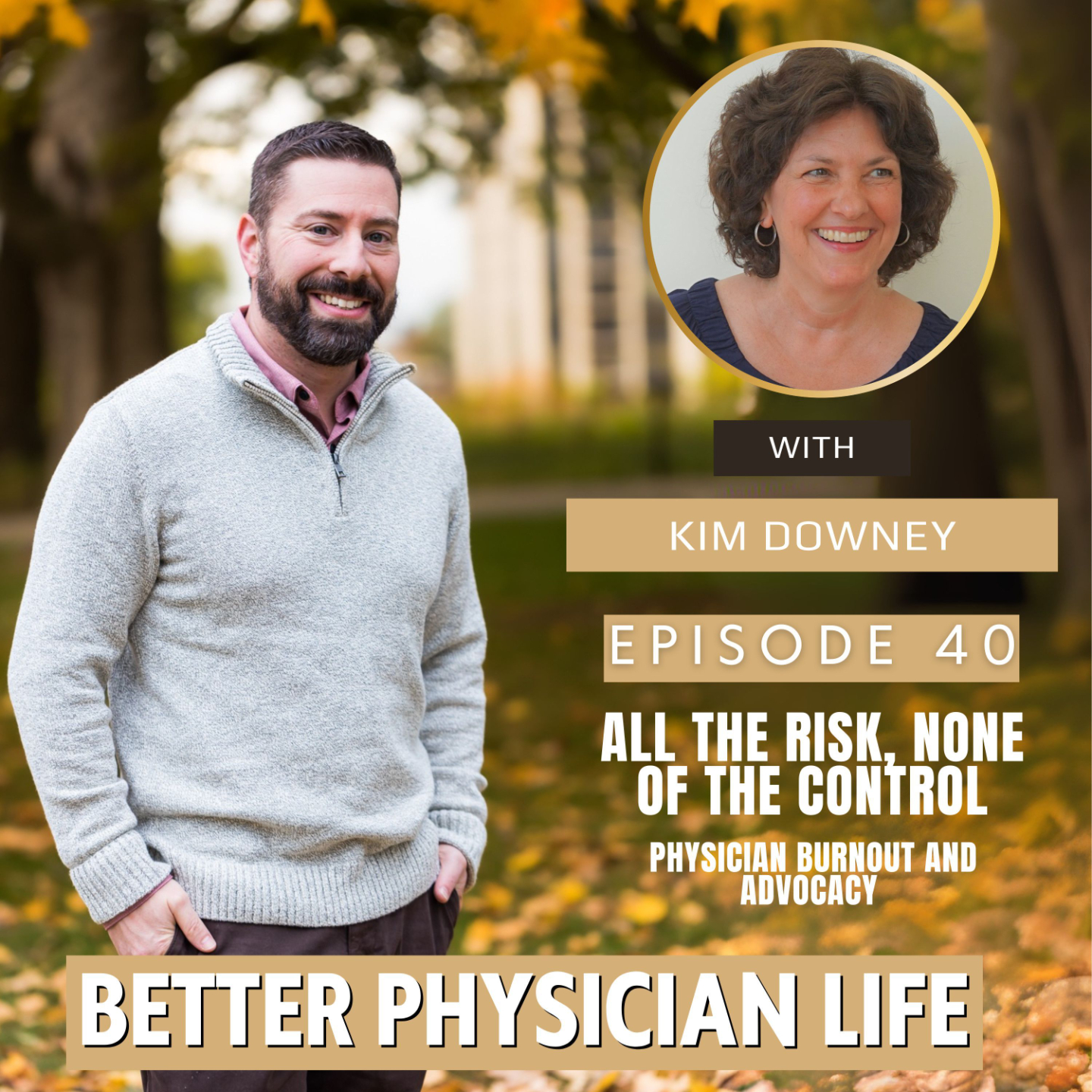
All the Risk, None of the Control: Physician Burnout and Advocacy with Kim Downey | Ep40
What if the real solution for physician well-being isn’t another self-care lecture, but fewer impossible demands and more people who actually understand what you’re carrying?
In this raw and hopeful episode of the Better Physician Life, Dr. Michael Hersh welcomes Kim Downey, founder of Stand Up (for) Doctors. A physical therapist and three-time cancer survivor, Kim’s life changed forever when her trusted physician died by suicide. Since then, she has built a platform that amplifies physician voices and helps patients see the human behind the white coat.Â
Together, they unpack inbox overload, prior-authorization battles, moral injury, and the quiet resignation many doctors feel. They discuss why self-care messages miss the mark, what patients misunderstand about doctors, and the power of storytelling to reduce isolation. Kim shares her two collaborative books and the upcoming physician-only retreat in October 2026 that is creating real community and hope for physicians nationwide.
This conversation is essential for any doctor who is tired of carrying it all alone and ready for realistic change.
About the Show:
Created for physicians who want more than clinical competence, Better Physician Life is a space for honest reflection, reinvention, and reclaiming purpose beyond the pager.
Hosted by Dr. Michael Hersh, each episode dives into the questions we didn’t learn to ask in training, offering tools and conversations to help you live and lead with intention.
Top 3 Takeaways:Â
-
Name the Real Problem: Most physicians don’t need more self-care advice; they need fewer things on their plate that shouldn’t be there. Distinguish burnout from moral injury; the deep frustration of knowing what your patient needs but being blocked by the system. Try this: this week, write down one example of moral injury you or a colleague faced and share it anonymously with a trusted peer.
- Doctors Are Human, Patients Need to See It: Patients often view physicians as superhuman robots who never struggle. Kim’s powerful reminder: behind every white coat are the same life challenges everyone else faces (divorce, grief, illness, parenting). Read one chapter from the White Coats books or share a short story because, every time a doctor speaks up, another doctor feels less alone.
- Start Small, Stay Connected: You don’t have to turn advocacy into a second job. Become an ambassador for the Dr. Lorna Breen Heroes Foundation or Clinician Burnout Foundation, join the monthly newsletter, or register for the October 2026 physician retreat (use code VIP100 for $100 off). Community and shared stories are the antidote to isolation.
Watch Now

If you’ve noticed more of your clinical decisions being shaped by templates, authorizations, or metrics, you’re not alone.
Many physicians are practicing in systems that don’t always leave room for the judgment they trained to use.
A physician coaching session gives you space to step back, think through how this is affecting your day-to-day work, and decide what changes might actually be possible. Use the link below to schedule a call with me.
Book A CallAll the Risk, None of the Control: Physician Burnout and Advocacy with Kim Downey | Ep40
Michael Hersh, MD
[00:00:00]Â
Most physicians don't need another person telling them to prioritize self-care. They need fewer things on their plate. Especially the things that shouldn't be there in the first place. It's not just about the hours, it's about the feeling that you're carrying all the risk without any of the control.
You're measured on productivity. You're pressured on patient access. Your inbox fills way faster than you can clear it. You're graded on patient satisfaction, and you are expected to absorb the fallout when the system makes it harder to practice good medicine. Most people don't see that. Patients don't see the inbox after hours.
They don't see the prior authorization denials. They don't see the staffing struggles. They just see the doctor in the room. But Kim Downey? She sees it. She is someone who spent years navigating the healthcare system as a [00:01:00] patient and whose life changed when a physician she trusted died by suicide.Â
Since then, she's been working to amplify physician voices and help patients understand what doctors are actually facing inside modern healthcare. This conversation is about what physicians are being asked to carry and what it looks like when someone who cares deeply about doctors decides they shouldn't have to carry it alone.
Well, hey everyone, and welcome back to the Better Physician Life Podcast. Thank you so much for being here today. So today I am joined by one of my favorite people, Kim Downey. She is the founder of Standup for Doctors, a platform dedicated to advocating for physician wellbeing and amplifying the voices of doctors across healthcare.
Kim is a physical therapist, a three-time cancer survivor, and a fierce advocate for physician wellbeing. She [00:02:00] serves as an ambassador for the Dr. Lorna Breen Heroes Foundation and the Clinician Burnout Foundation, and as a community ambassador for Medicine Forward.Â
But her advocacy didn't start as a professional mission.
After years of navigating the healthcare system during her own cancer treatments, she arrived for what she thought would be a routine appointment and learned that her trusted physician had died by suicide, and that moment changed the direction of her life. Since then, she's been working to bring attention to what physicians are facing inside modern healthcare. And helping patients better understand the pressure doctors are carrying every single day. Kim, it's so great to see you. Welcome to the show.Â
Thank you, Michael, for this opportunity. It's quite an honor. Yeah. And so, you and I have known each other for such a long time and way before your 20,000 LinkedIn followers and fans.
[00:03:00] I'd love for you to tell the audience about what got you so interested in physician burnout. What were you noticing that led to this advocacy work that you do today?
Yeah, so when I was having all of these doctor appointments, there were a few things that struck me. In contrast, some physicians with other physicians, so there was some physicians where I felt like they were wheeling out before they were wheeling in.
You know, the visits were in 10-minute increments. And I felt they didn't really have time to hear my story or why I was there. And at the time I felt. Like it was me. But then later I realized not to take it personally, that it was just the stress that the doctors were under. And then there was another doctor speaking to you saying that patients don't see their inbox.
There was one physician who actually showed me his inbox. He hadn't [00:04:00] returned a call, and he showed me his 400 messages. So then I realized that was one of the issues that they were facing. And then one physician had shared with me that the internet was slow for the whole system and how that impacted them in the afternoons, especially, and it affected how fast they were able to get orders in for the patients and just the flow of their afternoons. So those were a few things that I noticed during my visits.Â
Yeah. And these are things that come up all the time as I am speaking to physicians. Issues that physicians bring to physician coaching all the time about the patient messages and the in basket, and trying to keep up, wanting to do a great job, wanting to respond in a timely fashion, and wanting to be present.
And it adds so much pressure to our days and navigating the different aspects of the system, and a lot of patients don't understand or realize kind [00:05:00] of what is going on in the background. Talk to me a little bit about the advocacy work that you're doing. You're involved with all of these incredible organizations to help doctors. Take me through a little bit about the work that's being done behind the scenes to support physicians.Â
Sure. Well first I have to thank you because I wouldn't be doing any of this if it wasn't for you. And one thing we'll be speaking about is our books and, in this, our second book collaborative book, White Coats Human Hearts: True Stories of Healing, Belonging, and the Courage to Stay Human in Medicine. I dedicate it to you, and I just wanted to say what I write in the dedication is, you know, to Dr. Michael Hersh with tremendous gratitude for all of your guidance, support, kindness, and friendship. You, too, will always have a special place in my heart.
So I wanted to start with that and to thank you. And it might sound kind of hokey, but you know, that song I was just thinking before we hopped on that Wind [00:06:00] Beneath My Wings and, you know, we started with you coaching me when I was, devastated about the death of my doctor and I didn't really know how to move forward and you helped me with that and you helped me process and accept a lot of things related to my medical journey and I wanted to support doctors.
And, you were the one that connected me on LinkedIn. I didn't even know how to make a connection. And you're like, oh, you clicked the three little dots. You're like, oh, I'll just send you a request. And because you and I were connected and I had been, communicating just a bit with your guests from your other podcast, then those doctors started talking to me and I was having conversations with them because I wanted to know how I could help my own doctors.
And I thought they might have ideas for me. They would tell me things like, I think you're meant to make a bigger impact outside the system. But I didn't want to hear that. I just wanted to help my own doctors. But then I started connecting them and saying, oh, you should talk to so and so. You should talk to so and so.
And now some of your [00:07:00] friends are, people that I got to connect you with. So that, and then by the fall, some people had been telling me I should have a podcast, but I was telling you like, I don't have a website. I don't know how to do a podcast. And then you were like, well, you could just have a YouTube channel.
So I started, within three weeks I was recording my first episode, and now I've recorded 150 episodes and, we keep going and I always have about at least 60 or 70 people waiting to be guests. So we have the YouTube channel, which is now available on Spotify and Apple and Amazon and all of that.
And then I was sending my own doctors a monthly summary of my advocacy efforts so that they had a patient trying to help them. And then in the summer, 2024, that turned into a Substack newsletter. So now I share my monthly advocacy efforts with more people. And then, as you know, a year ago, January, we reached out to the first 15 doctors who were guests on my YouTube channel.
And I believe you have that book behind you as well. [00:08:00] White Coats, Courageous Hearts: True Stories of Doctors Reclaiming their Humanity and a System that Challenges It. And we dedicated it to my doctor. And then you write the forward and one of my favorite chapters in the book, and then there's many more stories to tell.
So we reached out to the next group of people who are guests on my YouTube channel. And as I shared, we just came out with this book. And this one features 11 physicians, two physician spouses, and two patients. Because I think it's really important to share all of those perspectives. And also, we are planning an incredible physician retreat for this fall, October 9th to 12th, for physicians only.
And it's gonna be an incredible event that'll really be so fulfilling for doctors and there's gonna be learning and fun and you're gonna be there and who wouldn't wanna spend the whole weekend with you? So those are some of the things.Â
Amazing. Yeah. and [00:09:00] this isn't just. Any copy of, your book behind me. This is the Kim Downey signed copy that's behind me. And it's really amazing to have watched your trajectory because as you were kind of beginning to highlight, when you first were thinking about physician advocacy, you were thinking about what did physician advocacy look like in your backyard, right?
You were focused on the physicians. You were noticing how kind of hurried and rushed they were, how stressed out they appeared, how they were struggling to keep up with their in baskets. And the initial goal was, how do I help my doctors? And what has grown from that is a passion for advocating for all physicians because as you have had more and more of these conversations, you've recognized that the issues that you're seeing in your backyard are not local issues.
They are really quite prevalent and impacting all physicians. And I'm curious, we hear a lot about the terms like burnout and moral injury, and you [00:10:00] talk to a lot of doctors and I'm curious, what are you noticing in terms of trends in these terms of burnout and moral injury and what doctors are just experiencing in their day-to-day?
Sure. And, one thing I would like to say first is, you know how we just talked about how I did notice certain things with some doctors, but what I have to say is there's a group of my doctors who still manage to be so present and I've left some of my visits once I said. Wow. That was a darn good doctor's visit and it feels sacred and they do take the time and it's made all of the difference to me, and I love my doctors, and it's sometimes I even worry, like for the best ones or the ones who are there for me, like at what cost to them.
So I just wanted to highlight that, that sometimes they are, and I always wonder sometimes, how do they do it? How do they manage to be so present and [00:11:00] walking, keep walking in another room, in another room, in another room, and just being so present and really listening and being there for me. So I know some doctors now don't like the word burnout.
They're saying we shouldn't be calling it burnout because then it feels like uh, physician problem when it's really a system issue and they think it's really we should be using the term moral injury. But they are different and. You know, anyone can be burnout from their job, and healthcare leaders can be burnout, right?
And sometimes you can be burnt out or you can be just burnt out moral injury. It is what they're really talking about on top of that. like when you're prevented from doing or not doing, the things that you really wanna do that you know are in the best interest of your patient.
So like if you know what medication your patient needs right now, right? But then the insurance company makes you order a couple cheaper medications before that. And you might be so frustrated because you're like, you know what your patient [00:12:00] needs and they're gonna suffer longer. Plus you went to medical school and you know, these things and it's demoralizing. So I think a lot of it with prior authorizations, all that stuff, when you're talking to somebody who's either never practiced clinical medicine or hasn't practiced in a long time, or isn't in your specialty and you're trying to explain things to them and it can be surgeries even right?
If, and they might want a patient. To try like physical therapy for six weeks. But there are certain cases where the surgeon knows, in this case they need surgery and they feel bad. And then sometimes it's actually life threatening or life altering, and sometimes patients even die because of these things.
So it's those kind of things that really is the moral injury. That can really weigh on a physician on top of burnout. So you can have burnout or moral injury or both.Â
And I will say what's fascinating because as you and I both speak with lots of [00:13:00] physicians and even though physicians, myself included, really don't like the word burnout, right? Like in general, we don't like it. And we probably don't like it for a number of different reasons, including sometimes how it's used against us. And when physicians are struggling. It actually is the word that we use. You know, we are feeling burned out. And when we are searching online to better understand why we feel the way that we feel.
We use the word burnout, so we may not like it, but we still use it as a term. And I think it's important to notice and to recognize that because just because we don't like the word doesn't mean it's not happening. Doesn't mean we're not feeling it, doesn't mean we're not experiencing it.Â
And that's why I do try to pair it. Like even I think in my, brief bio, I include that I address topics like, burnout, moral injury. So I try to minimize somewhat my use of burnout, but when I use it, I try to pair it with moral injury. So [00:14:00] physicians understand that I know that, and I also try to minimize my use of the word resilience because, they'll say we're some of the most resilient people on the planet but resilience can mean moving through a challenging time and coming out stronger. So while we're waiting for this system to change, there are things that individual doctors can do to shore themselves up and to become more resilient, in the face of their day-to-day life and experiences.
Absolutely. you know, I'm curious, when you talk to physicians now, what do you hear most often, beneath the surface, is it more kind of exhaustion or anger or kind of grief about this wasn't how this was supposed to be, or maybe like a sense of being trapped? What do you think is showing up most for doctors now?Â
I think a lack of control that doctors have so much responsibility and so little control. And even when they get [00:15:00] rated or the online reviews and things like that, and I think I might have even seen this myself, like. Somebody might give them a one-star review because like they couldn't find a space in the parking lot. And I'm like, that's ridiculous. That nothing, or even in the review, like they'll give it one star, but they might say that the receptionist was rude. You know, the doctor was great, but the receptionist was rude.
But they give the doctor a one-star review. They don't get it and it's just through their whole day like. And I also intimately understand it because there was a time when I was working as a physical therapist in the nursing home, and we switched to the EMR and there were so many changes then is I used to be able to decide how long I wanted to see the patient in terms of weeks and in terms of minutes, you know, for each session.
And then one day I walked in and my supervisor handed me the schedule and I thought in my brain and I might even. Said out loud. I don't recall, but at least I was thinking, wait a minute, like you don't tell me [00:16:00] how long I see my patients. I tell you, but that wasn't how it was anymore. But it's like when you know.
You go to school for these things and you know what you wanna do and how long you wanna see the patients and when you either have to spend more or less time than you think is appropriate for that patient. So I think a lot of it just boils down to like, you know, you went to so many years of school and you just wanna practice and be doctors and there's so many things constraining you know, what you can and can't do.
Yeah. Going back to that patient review comment that you were making, I saw a meme online. It was a patient review. The comment was Dr. Saved my life, four stars. And, the physician responded with, well, gee, I just don't know what I could have done to have earned that fifth star, but thank you.
Now you have built. stand up for doctors in a way that includes patients, right? Not just [00:17:00] clinicians, you know? What do you think patients most misunderstand about doctors right now? What do you think it is? Like, you were just talking about those reviews, like what do you think is most misunderstood right now?
Well, I think that. Patients truly don't understand the struggles that physicians have, and that's why we call this book, White Coats, Human Hearts, because doctors really are human. And I feel like it gets down to the humanity of physicians because I feel like sometimes doctors themselves feel like they have to be superhuman or I can do this, or like when you plow through medical training.
It's like sometimes you almost do superhuman thing. Who else doesn't sleep for 30 hours and then has to perform a surgery, right. Or something like that. Like it doesn't make sense. So in, those ways, sometimes it almost feels superhuman, but like it's not. And you are human. And even some people, like I think when they see [00:18:00] doctors, like some of them have even said, oh.
Like they didn't really think of their doctor so much as a person. And, one doctor had shared with me that when she was pregnant one day and her patient hadn't seen her and she was visibly pregnant and the patient actually jokes like, oh, like I forgot the doctors get pregnant and have babies.Â
So because doctors generally oftentimes show up in the white coats, the stethoscope around their neck, like looking professional and what, how they have everything under control. But people don't realize what's behind that, that you have all the same kind of struggles as other people do. Like in, doctors have shared everything for like, some have gone through a divorce, some have lost a parent or a child.
They have health issues themselves. They've had cancer. Family members have. Cancer, they have family members with addiction. They've been abused like anything that, happens to regular people, happens to doctors too because you are people. And I think lots of times patients don't think [00:19:00] of that.
They show up and again, because they're suffering. And it's almost like, I guess they might think of doctors as robots. Well, I'll just tell them this, that, and other, and they'll fix it or they'll fix me. That they aren't really looking at the eyes and heart and soul behind the white coat, although that's not universal.
Yeah, for sure. And I think that sums it up perfectly. Doctors are human, right? Doctors are people. And I think that there is a lot of pressure to treat ourselves as superhuman both internally and from the physicians themselves who continue to show up even when we're struggling. and also from the patient side expecting like, yes, you are a person, but, as you were just noting, the patient is in pain and they're looking for a solution and sometimes it's hard to see that line, that distinction. There's actually a lot of kind of quiet resignation in medicine right now. I talk about it a lot on this podcast. What gives you hope right now in a realistic [00:20:00] way for the future? For doctors and for healthcare and for medicine?Â
I feel like doctors are talking about it a lot more, and I just last week had a conversation with a seasoned psychiatrist and I asked him if this was true and he said yes, because all of this happened to me since the pandemic started, so I wasn't involved in these spaces, but I said, I felt like before the pandemic.
Doctors even more were told, put your head down and just keep going. Or they had to be more stoic or they weren't willing to be vulnerable or any of those things. But when the pandemic was so bad, so many doctors, if they could, they left medicine, or they suffered and struggled. But also some of them, their practices slowed down and they.
Wanted to figure out how to help themselves. And so some of them saw coaching and then, went on to become coaches such as yourself. And then, so all of those physicians who became coaches then are willing to share their stories because they wanna support their [00:21:00] colleagues. And I say all the time that every time a doctor shares their story, another doctor feels less alone.
So even in the past. It's just coming up on three years that I've been active in this space on LinkedIn that I see more and more doctors sharing their story, and that's what I do through the podcast and through the books, is giving physicians a safe place to share their story. So I feel like there's a groundswell of that.
Plus in a week I'm speaking with a few people, a couple physicians and someone else, and we're trying to figure out there's, doctors have the answers to a lot of these things, and they have solutions. So we wanna bring physicians to the table and get physicians together to talk about solutions.
And also simultaneously for physicians who are struggling. How do we support them? Because if you are just trying to keep your head above water, you're not in the thinking space to do innovation and solutions. So it's also critically important, and I'm just trying to [00:22:00] figure out how to make an even bigger impact with both of those things.
Amazing, so there's probably a lot of doctors out there who feel like I can't change the system and I'm tired of carrying all of this. And I'm curious, you are so involved with this advocacy work. Is there anything that you would suggest to those physicians, like a small way that they can begin to engage with advocacy without needing to take it on as another job?
Yeah, there's so many different things that doctors can do. So the organizations that you mentioned in the beginning like Medicine Forward, and then there's also Healthcare Reinvention Collaborative, and the Clinician Burnout Foundation, Dr. Lorna Breen Heroes Foundation, which focuses on mental wellbeing for physicians.
And they've made incredible strides in the past few years as. Far as things like removing intrusive questions on the licensing exam. So anyone can become an ambassador, you can fill out a form, [00:23:00] and there's many doctors on there. It's not solely doctors. We have quarterly calls and the doctors always say they find it so motivating and inspirational to see that there are action steps and there's things being done, and there's even like subgroups that doctors could, agree to join, within that, that if they say, well, I wanna focus on this, or I wanna focus on that. And then also like I said, I'm in contact with doctors who are innovating and they could reach out to me and I would find a space for them.Â
Amazing. You started to mention some of the incredible work that you have been doing.You mentioned the two books that you've published, which just for clarity purposes, these are stories from real physicians navigating lives and careers in healthcare, and I think that they provide such an important piece of normalizing what it is to be a human and a doctor, and [00:24:00] navigating all of the things that come up for all of us.
Talk to us about that, and then I'd love for you to tell everybody more about this retreat that you have coming up in October of 2026.Â
Sure. So about the books, I feel like when doctors read these, and also the people who have endorsed the book, well actually, Heath Joliff had shared in the first book that physicians are speaking up, not because it's easy, but because staying silent costs too much.
And when doctors read these stories, they'll feel less alone. And one doctor told me that when she read this book, she felt like somebody was giving her a big hug. So it just validates all of your experiences. And then the great thing is my website is. Stand up for doctors.org and there's a books tab, and you can see the faces of every physician who wrote chapters in each of these books, including yours, with how our listeners or the readers can get in touch with those doctors.
So if a chapter resonates with you, [00:25:00] you can actually reach out to that doctor. And, in the first book, the chapters are everything from, connection mitigates trauma. When the doctor becomes the patient, we talk about workplace bullying vulnerability in the power of boundaries. Unique challenges of really career physicians, self-compassion, and the power of storytelling.
So any doctor will see themself in some of these stories. Then this book we speak to things like, preserving the physician-patient relationship, processing grief. Am I cut out to be a doctor? rediscovering joy in medicine and reclaiming, ah, supporting yourself outside of medicine to feel better inside of medicine from isolation to be belonging, how to become unburnable and leadership, building trust and positive culture in healthcare.
So I don't think there's any doctor. Who would read this and not see themselves or not feel a little bit better by reading it and hope because [00:26:00] they're messages of hope. And then also hearing stories from physicians, their gratitude to physicians. And then also hearing from a couple physicians spouses, because when it's not only a life of sacrifice for the doctor, it's a life of sacrifice for the physician family.
And not only did. Doctors not often receive the gratitude they should be getting. physician families. Rarely, if ever, do.Â
Yeah. And for those who are listening, the title of the first book was, White Coat's Courageous Hearts. Yes. And the second book, White Coat's Human Hearts. And they're of both available on Amazon and paperback and Kindle. And we would really love reviews, that really helps the books to reach more people.Â
And then tell us about this retreat that you have coming up in October of 2026.Â
Sure. So it is just so exciting, I cannot even wait. And it kind of started, [00:27:00] so Dr. Tamara Beckford and, Dr. Jillian Rigert to shared a little video a couple years ago and they were dancing and I said, oh, you guys have great dance moves.
And then Dr. Tamara Beckford started joking around saying, oh, when are we gonna have a dance party? And she lives in Texas. They both do. And so at first I was kind of laughing about it, but then I was like, well, I've connected so many doctors and you become real friends with some of them. But I'm like, you would never get together because you're different specialties and around the country.
Like there isn't one conference that would draw you all. And I was like, well, I could do it. And I'm turning 60 in October, and I wanna celebrate doctors that are keeping me alive. So I'm inviting my own physicians, and I believe they at least plan on coming to the gratitude dinner on the Saturday night.
And I wanna show them, I'm bringing all these doctors that I've met to them and the first night will be a welcome dinner. And then it's all by doctors and for doctors. So there's gonna be improv for doctors and it's just gonna be [00:28:00] fun icebreakers. And then through the weekend there's gonna be various topics and activities, and the physicians are choosing the topics that they know that their colleagues would want to hear about.
Everything from incorporating trauma-informed leadership for doctors and patients. To boundary setting, reclaiming your time the inner critic, all of those kinds of things. And then we're interspersing that though with activities that bring you into your body that are good for other people and doctors too, because doctors are people.
That'll be everything from, Dr. Beatriz Olsen a functional medicine endocrinologist and an artist, and we're gonna have abstract art, so you don't have to know anything about art and you can participate. And we're gonna have a little line dancing and, why write? And a drum circle and just so many, different activities and everything is optional.
And, one of my favorite parts, I think will be Sunday morning where we're having a physician [00:29:00] advocacy section where the doctors that are there over the weekend will decide what do they wanna talk about. And we'll break into small groups and they'll have time to talk about that. And we'll have a quick break.
So if they wanna switch table. They can or continue on. And then after a couple rounds of that, we'll have a spokesperson from each table, share what they learn, kind of like what should we do in action steps, and we might have some zooms ahead of time. So the retreat won't be the beginning or the end.
It'll be the middle of, again, taking it's me messages of hope and how we can move medicine forward in a way that's sustainable for our physicians. And it's gonna be fun.Â
Incredible. Yeah. And for physicians to know they can use CME funds for this CME will be available. Is that correct?
Absolutely. And I can also offer a secret VIP code that I could either share here or it could be in the show notes.Â
What is the code?Â
VIP100 [00:30:00], all capital letters VIP 100.Â
And what will that do for peopleÂ
That will take a hundred dollars off your registration fee? And we are limited, we have 46 slots.
And at the time of this recording where. About halfway there with formal registrations, and another dozen doctors have said they're gonna register soon. So we don't have a ton of slots left, but we would love to have you join us and highlighting the importance of community. we've spent a long time in this conversation talking about autonomy and burnout and moral injury.
And one of the things that really does help to mitigate all of this. Is community is networking. these are not topics that are taught in medical school. And I know this has been a huge part of my own personal journey in terms of finding community, finding, networking, finding a way to keep me full-time practicing in medicine.
Community and networking has played such a huge [00:31:00] role and. Kim Downey, you have been a huge part of that and so thank you so much. We will link the information for your books and for your upcoming retreat in October of 2026, as well as the VIP code for listeners of the podcast. Thank you so much for being here.
To the listeners, thank you so much for joining us today and, we'll see you next time on the Better Physician Life Podcast.