Better Physician Life coaching

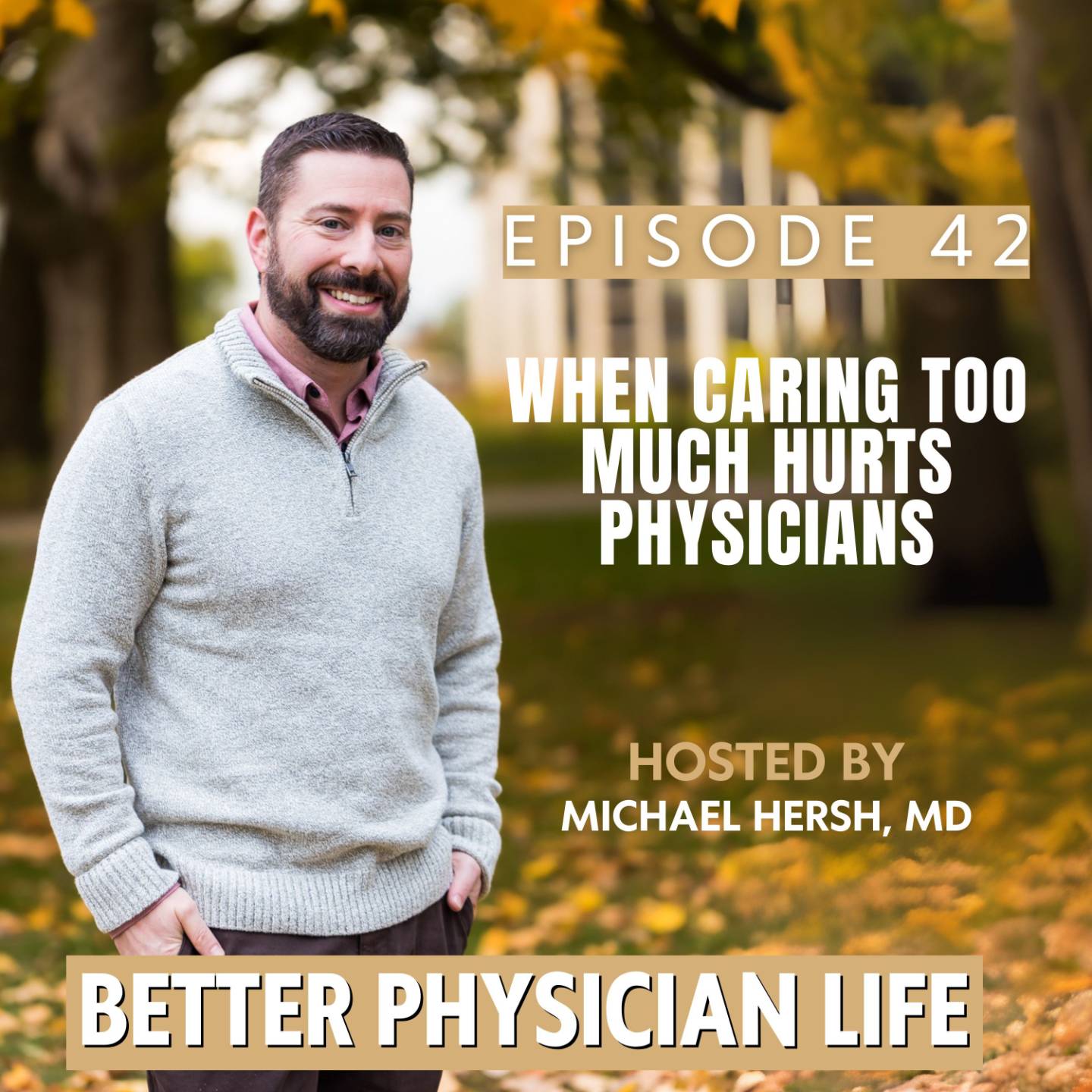
When Caring Too Much Hurts Physicians: The Hidden Cost of Over-Responsibility | Ep42

What if caring deeply didn’t mean carrying everything?

In this episode of Better Physician Life, Dr. Michael Hersh gives physicians permission to care less, not about clinical excellence or patient outcomes you control, but about the extra weight of everything else that lands on you. He shares how accountability for decisions can silently spread to carrying noncompliant patients, system delays, prior authorization denials, complaints, and RVU dips all the way home.

From his own experience, replaying cases at night, checking portals before dinner, and bringing irritation to family dinners didn’t make him a better doctor. It just exhausted him. The turning point was learning to separate what’s truly yours from what isn’t, and giving the workday a defined end. He offers the 5-Minute Commute Reset to help you create a clean transition so you can leave the mental load at work. If everything feels like it’s on you, this episode shows how to care deeply without carrying everything, protecting your peace and presence at home.

🔗 Free 5-Minute Commute Reset for Physicians:  betterphysicianlife.com/commutereset

Watch on YouTube
Listen on Apple
Listen on Spotify

About the Show:

Created for physicians who want more than clinical competence, Better Physician Life is a space for honest reflection, reinvention, and reclaiming purpose beyond the pager.

Hosted by Dr. Michael Hersh, each episode dives into the questions we didn’t learn to ask in training, offering tools and conversations to help you live and lead with intention.

Top 3 Takeaways: 

  1. Accountability versus Over-Responsibility: You are responsible for your clinical decisions, not for patient compliance, system delays, prior-auth denials, or every outcome. At the end of one shift, ask: “Was this my decision or something outside my control?” If it’s the latter, practice letting it stop there.

  2. Carrying It Home Is Not Professionalism: Replaying cases at night, checking portals before dinner, and bringing RVU stress to the table doesn’t make you a better doctor; it just steals your presence at home. Notice one moment when work thoughts follow you through the door and consciously release them.
  3. Create a Clean Ending to Your Day: The transition between clinic and home is everything. Download the free 5-Minute Commute Reset and use it daily; it gives your workday a defined endpoint so you can actually be present with family without lowering your standards.

Watch Now

 

Video Poster Image

If it’s getting harder to feel done at the end of the day, you’re not alone. 

Many physicians gradually take on responsibility for outcomes, metrics, and circumstances they don’t fully control. Over time, that can make even good work feel harder than it should.

A physician coaching session gives you space to step back, look at what you’re holding yourself responsible for that you don’t actually control, and decide what may be worth handling differently. Use the link below to schedule a call with me.

Book A Call
DOWNLOAD TRANSCRIPT

When Caring Too Much Hurts Physicians: The Hidden Cost of Over-Responsibility | Ep42

Michael Hersh, MD

[00:00:00] 

Do you ever notice how everything eventually starts to feel like it's on you? A patient doesn't improve. So you think about it on the drive home, a lab comes back abnormal at 5:12 PM and you refresh the portal before dinner to see if the repeat was drawn. A complaint shows up in your inbox. You read it twice.

Then a third time your RVUs dip. One month you open the dashboard and feel it in your chest before you even look at the numbers. None of this is technically your fault, but it still lands on you. No one tells you to carry it like that. You just do because that's what good doctors do, right? And if someone suggested maybe you don't have to care quite that much, your first reaction probably wouldn't be relief.

It would be resistance because physicians are trained to care deeply, [00:01:00] completely without turning it off. So today I wanna talk about something that might sound wrong at first. You are allowed to care less.

Well, hey everyone, and welcome back to another episode of the Better Physician Life Podcast. Thank you so much for being here today. Okay. Okay, I get it. You heard that last line and thought, what? Is he serious? Yes. And when I say you are allowed to care less, I wanna be really precise.

I'm not talking about not caring it all. I'm not talking about cutting corners. I am not talking about lowering your standards. I'm talking about the difference between being accountable for your decisions and carrying everything that happens after. There was a stretch in my career where I believed the only [00:02:00] way to be a good physician was to make it all my responsibility.

Every outcome, every metric, every Press Ganey score, every portal message that came in at 9:37 PM. If something went wrong, I replayed it in detail. If someone was unhappy, it stayed with me for days, and if my productivity dipped, I recalculated my compensation while finishing charts. At the time, that felt like professionalism.

It felt like ownership and integrity. What I didn't see was how all of it was building in the background. It looked like lying in bed at night, replaying a case that already had a reasonable plan. It looked like checking my inbox one more time before brushing my teeth. It looked like snapping at my kids because I was still mentally in a conversation from 2:15 that [00:03:00] afternoon.

It looked like sitting at dinner and half-listening because I was wondering whether my patient would actually pick up the medication I prescribed. At some point, I had to ask myself why it felt like everything was on me. That's when I saw it. I wasn't just taking responsibility for my decisions. I was taking responsibility for outcomes I didn't fully control.

Noncompliant patients, system delays, prior authorization, denials, staffing shortages, administrative policies. I didn't design. Complications I couldn't have prevented. I treated all of it like it was my responsibility. Medicine trains you to own your work. If your name is on the chart, you are responsible.

If you made the decision, you own it. That's not negotiable, but over time, that ownership [00:04:00] can spread. You start to believe that if something goes poorly somewhere in the chain of events, you should have anticipated it. Prevented it. Absorbed it, and that's where the line blurs. Accountability means you review your decisions, you correct mistakes, and you learn. 

Making everything your responsibility means if something goes wrong anywhere along the line, you take it personally. And here's the uncomfortable part. For a lot of physicians, that extra weight feels like proof. Proof that you care, proof that you're thorough, proof that you are not the kind of doctor who just shrugs things off. If you replay the case at night, that means you're conscientious.

If you feel bad for days after a complication, that means you're committed. And if a one-star review sits in your head all week, that [00:05:00] means you have standards. And there's a part of you that thinks that's what a good doctor does. So if you stop doing that, what does that say about you?

If I don't absorb all of it, am I still a good doctor? Am I still competent? Am I still the kind of physician patients deserve? Over time, I had to separate something. I was responsible for the decision. I wasn't responsible for whether the patient followed through. I was responsible for documenting clearly. 

I wasn't responsible for the prior authorization algorithm. I was responsible for my clinical judgment. I wasn't responsible for complications I couldn't have prevented. That distinction took practice. And for a long time, I struggled to draw that line. 

If a patient didn't improve, I took it home. If a complaint hit my [00:06:00] inbox, I took it home. If my RVUs dipped, I took it home. I told myself that was professionalism, that was ownership. That's what a good doctor does. I thought that was the job, but it didn't make me better. It made me tired. It made me reactive. It made me shorter at home, less patient with my kids, more distracted with my wife, half-listening to a conversation while trying to figure out whether I'd hit my RVU target.

None of that made me a better doctor. It didn't improve any clinical outcomes. It just showed up at my dinner table. There's a difference between caring deeply and carrying everything. One sharpens your judgment. The other just wears you down. So I started asking simple questions at the end of the day: 

Was this my decision? Did I miss something? [00:07:00] Did I make an error in judgment? And if the answer was yes, I fixed it. But if the answer was no, I worked on letting it stop there. That sounds simple. It's not. Because letting it stop there feels wrong at first. It feels like you're lowering the standard. You are not. Caring deeply and carrying everything are not the same thing.

A slow RVU month isn't a verdict on your value. A complaint doesn't define your professionalism. A complication doesn't erase your clinical judgment, but if you treat all of it like it does, everything lands on you. And when everything lands on you, you never really turn it off. You're still thinking about it when the day is technically over. You can sustain that pace for a long time [00:08:00] until you can't.

So what does care less actually mean in practice? It meant noticing when I was worked up at the end of the day when something was still running in the background. Instead of letting it stay there, I'd give myself a few minutes to think about the day on purpose, to check in if I was spinning about something, I'd ask myself a few questions like: 

Why is this bothering me? Was there something that actually went well here? Was there something I could have done differently? And how do I want to handle this next time? And if there was something to change, I changed it. If I needed to take accountability, I took it. And if it wasn't mine to hold, I did my best to let it go. I do not get it right every time, but I do it a lot better than I used to.

And here's what changed. I wasn't replaying the last procedure while tucking my kids into [00:09:00] bed. I wasn't mentally checking my RVUs while sitting at the dinner table. I wasn't lying awake, rerunning a case that already had a good plan. The work stayed at work more often. That didn't happen by accident. It came down to those last few minutes after clinic or procedures.

You finish your last note, you're still thinking about the final case. You glance at tomorrow's schedule in the parking lot, then you walk through the front door still in clinic. All of that carries over. The transition between work and home matters more than we think. So I built something simple for that window between work and home, and I use it every day.

It's called the Five-Minute Commute Reset for Physicians, and it's not to make us care less, it's just designed to give the day a defined endpoint. Five minutes, something you can use on your way home, and you can [00:10:00] download it for free at betterphysicianlife.com/commutereset. And I'll link it in the show notes. 

Because you'll still care, you'll still prepare, you'll still review your decisions. You'll still hold yourself to a high standard. The difference is this, you won't keep running it once you've done what you can, you'll close the day more often, and when you walk through the front door, you'll actually be there. 

Thank you so much for being here, and I'll see you on the next episode of the Better Physician Life Podcast.

Previous Episode
Next Episode