FULL EPISODE TRANSCRIPT
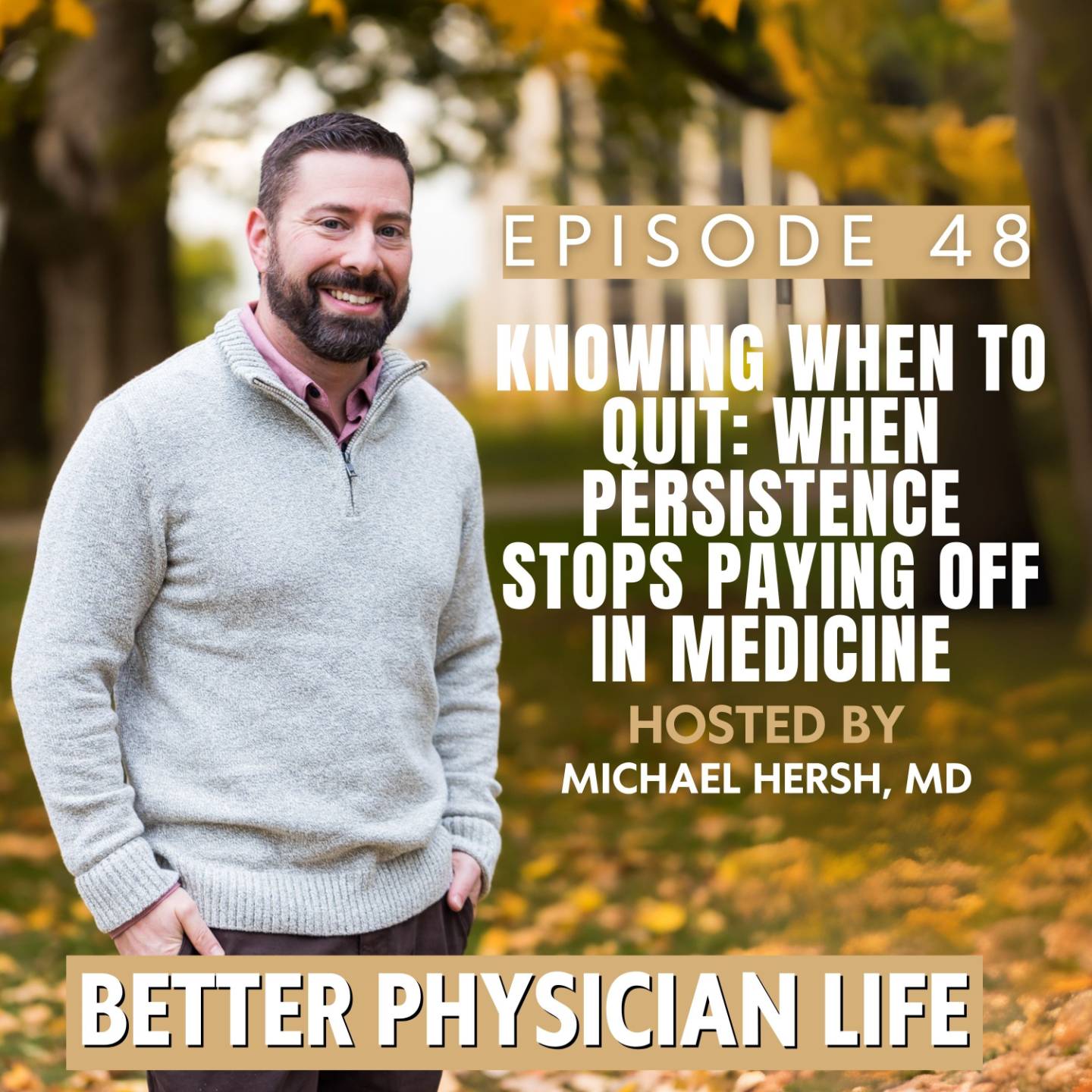
Knowing When to Quit: When Persistence Stops Paying Off in Medicine| Ep48
Join Dr. Michael Hersh as he explores the book Quit: The Power of Knowing When to Walk Away by Annie Duke. In medicine, quitting is rarely seen as an option, even when the day starts to feel heavier and continuing feels more like a habit than a choice.
The strange thing about being a physician is that quitting almost never feels like an option, even when staying stops making sense. We push through training because we are committed. We keep our clinic templates full because access is tight. We pick up the extra shifts because someone has to.
We keep going because that's who we are. Being reliable matters, being competent matters, being someone patients and colleagues can count on matters, and most of the time, continuing is exactly the right decision. Until one day, something starts to feel different, maybe a little heavier than it used to. You open the schedule, and your first reaction isn’t effort. It's hesitation.
You catch yourself hoping for a cancellation. Another administrative email comes through, and you skim it faster than you used to, or maybe even delete it before you read it. Clinic still runs smoothly. Patients still do well. By most measures, everything still looks really good, but then there's a question that shows up: Am I still doing this because I still want to, or because it's just what I've always done?
Well, hey everyone, and welcome back to the Better Physician Life Podcast. Thank you so much for being here today.
So, in the last couple of episodes, I've been doing something a little different: a short series on books that changed how I think about life as a doctor. These aren't medical textbooks. There are books about work or time, money, and some of the questions that show up after you've been in medicine for a while, but that most of us don't talk about. Questions about how long to keep pushing, questions about what enough actually looks like.
Questions about whether continuing to do things the way we've always done them is still necessary. Or is it just still familiar? Now, the book I wanna talk about today is called Quit: The Power of Knowing When to Walk Away, and it's by author Annie Duke.
Now, the word quit is pretty charged in medical culture. There is a ton of judgment associated with that word, and it makes sense. Most of us didn't get here by quitting. We got here by persisting, by staying focused for long periods of time, by tolerating the uncertainty and the fatigue, and tolerating the delayed gratification. We kept going when things were hard because we understood the assignment.
That's what the process requires. And that ability to keep going is one of the defining strengths of being a doctor. But one of the biggest takeaways from this book is that the same persistence that helped us succeed can sometimes make it harder to recognize when a situation no longer makes as much sense as it once did.
Not because the original decision was wrong, because a lot of times the original decision was exactly right. Choosing medicine was right. Choosing your specialty was right. Choosing that first job was right. At the time. Based on the information you had. Based on what mattered at that point in time.
But one thing that often changes over the course of a career is that what made sense before, doesn't always make sense in exactly the same way now. Because circumstances change, financial pressures change, your level of experience changes. Your tolerance for certain parts of the work changes. What you want your time to look like 10 years from now might not look exactly like what you wanted 10 years ago.
But the structure of the work doesn't usually change in the same way. The clinic template rarely shrinks on its own. Call schedules rarely get lighter on their own. Inbox volume certainly doesn't decrease on its own. Most systems are designed to keep adding. More access, more patients, more responsibilities, more documentation, more expectations.
And because physicians are very good at adapting, we make it work. We add one more patient to the template. We say yes to one more committee. We take one more call shift, and none of those decisions seem like a big deal on their own. They make sense at the time. They seem reasonable, temporary, manageable, but temporary changes have a way of becoming permanent parts of the schedule.
Because once something gets added, it usually stays added. One of the ideas in Quit is that we tend to keep going simply because we've already put so much effort into the path we're already on. We've invested time and energy, and maybe most importantly, our identity in our path. You didn't just train in a specialty, you became the person people come to for it.
Colleagues rely on your judgment. Patients are referred specifically to you, and your professional identity is tied to it. Which makes any change feel much bigger than it probably is. Because it starts to feel like you're not just changing a job, you're changing something about who you are. And that can be super uncomfortable. Even when the change makes sense, even when the change might make your day-to-day feel more manageable, even when the change just matches where you are now compared to where you were earlier in your career.
Instead, what many of us do is double down. Work a little harder. Try to become a little more efficient. See if we can make the current structure work just a little bit better. Duke calls this escalation of commitment. When something isn't working as well as we expected, our instinct is usually to invest a little more to make it work.
More effort, more time, more energy, because we want the original decision to work because we've already put so much into it. And physicians are particularly good at this because we are used to things being hard. Hard has always been part of the process. Training was hard. Boards were hard. Getting started in our practices was hard.
So when the day starts to feel a little more draining, the automatic assumption is often, this is just another phase that requires more effort. So we keep pushing, working a little faster, staying a little later, trying to solve structural problems with personal effort. And sometimes it works. Sometimes it just makes the day feel more packed without really fixing the underlying problem.
So we get better at managing the current structure. We become more efficient. We learn the shortcuts, we refine our workflows. We figure out how to move through the day with just a little less friction. And physicians are very good at this, too. We make the system work even when the system isn't working especially well.
But the more we focus on optimizing what's already in front of us, the less often we step back and ask whether the structure itself still makes sense. Duke describes this as the balance between exploiting and exploring. We improve the current role. We make the current schedule work as well as we can. We figure out how to keep the day moving because exploration takes time, and time is usually the one thing that feels the hardest to find, especially when the schedule is already full.
Looking at different practice models, different schedules, different ways of structuring clinical work that takes time, and time is already tight, so most physicians just keep focusing on making the current structure work, even when they're not completely sure it's still the best fit. Not because the situation is terrible, but because it's familiar, predictable.
You already understand where the friction points are, and medicine trains us to value that stability. One of the challenges here is that most physicians never clearly define what would actually prompt a change. We just keep adapting, taking on a little more, adjusting a little more, absorbing a little more.
One of the useful ideas Duke talks about is setting decision criteria in advance. In clinical medicine, we do this all the time. If the patient doesn't respond to the treatment, we adjust it. If the numbers change, we reassess. If the situation evolves, we reconsider the plan.
We define very specific signals that would prompt a change in course, but in our careers, most physicians rarely define what would actually prompt us to reconsider the way we're working. How much call is too much? How much inbox is too much? How much pressure in the day is too much? If we don't define those limits ahead of time, the default is usually just to keep going because physicians aren't very capable of absorbing more. Often more than is actually helpful.
Another challenge is that the trade-offs are hard to see when you're in the middle of the work. Every additional clinic session, every additional responsibility, every additional commitment. Now that time has to come from somewhere else, time with family, time to relax, time to think clearly, time to consider what you might want the next phase of your career to look like.
It's important to remember that exploration. Just looking at options does not mean you have to change anything. Sometimes, looking around just confirms that your current structure still makes sense for right now. Sometimes it highlights small adjustments that could make the day-to-day feel a little more manageable.
Sometimes it just removes the question of whether something better might exist. One of the more uncomfortable parts is that even considering change can feel like letting go of a version of yourself that made sense for a really long time. The version of you who said yes to everything, the version of you who absorbed every increase in workload, the version of you who built your career by always being available. That version of you was useful, maybe even necessary, but it may not be the only version that fits going forward.
Many physicians assume something has to be very wrong before change feels justified. I have to feel burned out, or there has to be significant conflict, or I'm just gonna have to be completely exhausted before I make a change. But often the earlier signals are much more subtle. It can be something like the day takes a little more effort than it used to.
Things that never used to bother. You start to feel more draining. The structure of the work doesn't seem to fit quite as well as it once did. These things are subtle. There are things that can be easy to ignore if you just put your head down because everything still looks good on paper. Nothing is obviously broken, which is exactly why many physicians don't really step back to look at the question closely.
They just keep going because continuing feels responsible. It feels professional, continuing feels consistent with who we've always been, but sometimes the more useful question isn't whether you can keep going. It's whether continuing exactly as you are is still necessary or maybe you're just doing it 'cause it's still familiar.
If some of these questions have been showing up for you, if you've been thinking about these things, it can be helpful to have dedicated space to think them through, not in the five minutes between patients, not late at night when you're already exhausted, not in the middle of slogging through your inbox.
Actual time to step back and look at the whole picture. To decide what still makes sense and what might benefit from another look. Because most physicians are not trying to walk away from their meaningful work. They're just trying to make sure the way they're working still supports the life they want to live, still supports the pace they want to maintain, still supports the kind of physician they want to be 10 years from now.
If it would be helpful to think through those questions in a structured way with someone who understands the reality of medical practice. I work with physicians one-to-one on exactly these decisions, and you can learn more at betterphysicianlife.com .
Because persistence is one of your greatest professional strengths, and the goal is not to lose that strength. It's to make sure the effort you're putting in is still supporting the life you actually want to be living.
Thank you so much for being here today, and I'll see you next time on the Better Physician Life Podcast.