FULL EPISODE TRANSCRIPT
Leading Through Uncertainty: What Teams Need When Nobody Knows What Comes Next | Ep54
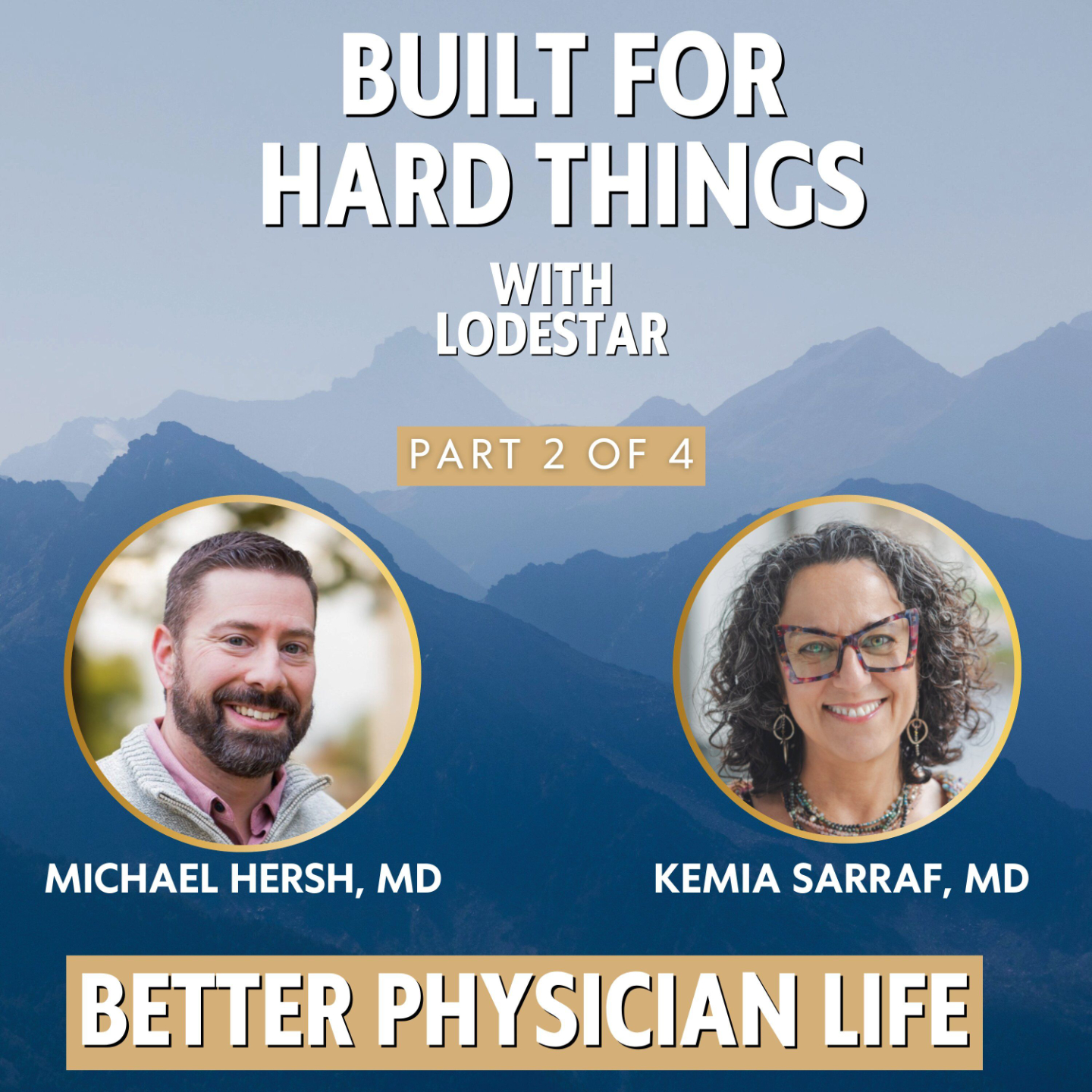
Join Dr. Michael Hersh and Dr. Kemia Sarraf as they continue their discussion to explore the neuroscience of uncertainty, why prolonged ambiguity drains our energy, and how leaders can intentionally build safety, trust, and hope even when the future remains unclear.
Most of us were trained to have the answer, especially in medicine. Patients want answers. Families want answers. Teams want direction, and leaders want a plan. But some of the hardest moments happen when nobody knows exactly what comes next, and that's when things can get really interesting. People get reactive, or they get quiet. They start looking for certainty even when certainty isn't available yet.
Today, Dr. Kemia Sarraf and I are talking about uncertainty. What it does to people, what it does to teams, and what leadership can look like when the answer isn't clear yet.
Well, hey everyone, and welcome to another episode of the Better Physician Life podcast. Thank you so much for being here today. So today is the second episode in our four-part series with Dr. Kemia Sarraf. Kemia is a board-certified internal medicine physician, the founder of Lodestar Consulting and Executive Coaching, and someone I love talking with about medicine, leadership, teams, trauma responsiveness, and what it takes for people to do hard work without losing themselves in the process.
I'm also senior faculty at Lodestar, so this series has been a really nice way to bring together some of the work I do through Better Physician Life with some of the work Kemia and the Lodestar team are doing with leaders, teams, and organizations. Last week, we talked about why soft skills are not soft, and why trust, safety, and connection are part of how good teams do hard things.
If you haven't listened to that episode yet, no worries. This episode stands on its own. But I would definitely go back and listen when you get a chance because it was too good to miss. Today, we're moving into uncertainty, and this is one of those topics that sounds simple until you really start paying attention to what it does to people.
Because uncertainty is not just “we don't know yet.” It can change how we lead, how we listen, how we talk to each other, how much we try to control, and how safe or unsafe the room feels. So Kemia, I'm really glad we get to keep this conversation going.
Yeah. You know, I was listening to the intro and reflecting on our last conversation. We touched on this, and I think it's worth just bringing in right out of the gate, right?
We sort of ended with the idea that these things are not nice to have: safety, connection, and trust. They're not nice to have. They are the prerequisites. They are absolutely essential to high-performing teams and great leadership, and they got labeled as soft skills, and they're not soft. It is actually some of the most strategic work we can do right now.
And as I was listening to you introduce today's episode, it's the when, not if. Safety, trust, connection, they prepare us for when, not if, stuff goes wrong. You know me really well, so I almost inserted some expletives there, 'cause I honestly don't remember if we're PG or not.
But it prepares us for when, not if, things go wrong. That's what safety, trust, and connection builds for us. That's why it's really important that we start there. And it is absolutely essential in times of high uncertainty,
Last time we said, "Everybody sit back and think about what it feels like, what the scanning is when you don't feel safe or when trust is absent. What does that do to your nervous system? How does that change the way you show up? How does that change the metabolic load?"
Because ultimately, all of this comes down to the metabolic load. All of this comes down to the metabolic demand on our system, and it is not infinite. Our ATP is not infinite, and so we're resource allocating all the time.
When safety and trust exist, I can divert resources to other things, to problem-solving, to action, to movement. When trust and safety are absent, I have to resource allocate there.
I think the neuroscience of uncertainty is absolutely fascinating, and I know I sent you, like, a 58-page white paper on this, which I don't expect that you have read because I've sent it several places, and I'm pretty sure no one has read it except possibly my mama, who tells me that I use too many words.
The thing about it, though, that I think is so interesting, is the impact of uncertainty on us over time, right? And the ways in which we are able to study this, and the ways we're able to actually look at what it does. Like fMRI, we can actually look at what this does to the brain, what uncertainty does to the brain real time.
Dr. O'Donovan, who I think is still at UCSF, talks about this. He says that the stress of uncertainty, especially when prolonged, is the most insidious of stressors that we experience. It's insidious because it is a quiet drain most of the time in the background. But the other thing about it is that to be in uncertainty, to navigate uncertainty, to tolerate uncertainty for a prolonged period of time requires that we be able to hold complexity, that we're able to hold nuance, and that is really metabolically expensive.
Complexity, nuance, all of these things, right? Deferment of answers, of solution, all of these things, these are really, really cognitively, and by that I mean metabolically, expensive states to be in. Take any one of us and shove us into very high uncertainty for a prolonged period of time, we're gonna start seeking an either/or.
The brain is gonna drive us to the either/or answer simply because it is metabolically cheap. Which I think to me begins to explain a lot about the polarization that we are seeing. It is metabolically less expensive to plant our flag on an either/or than it is to be in the mess of it all.
I mean, like, when you think about what the last five, 10 years of living in this world has been like, it has been lesson in uncertainty after lesson in uncertainty. And so to your point, it becomes very black or white.
This is right, this is wrong, and we all exist in the messy middle. We are all living in between those extremes. And when you believe that one of those extremes is right or wrong, it creates all of this divisiveness. So this idea of uncertainty, this is also not a nice-to-have. This is something that we are living in every single day, and that the news media is constantly feeding to us.
And so it's so important to have these conversations, because uncertainty is real, and we live in it every single day.
Yes. Absolutely everything that you said. And to add, an extra layer of oomph on this too, because our colleague Colonel Luis Rodriguez would find us remiss if we didn't mention the fact that learning to navigate uncertainty is so incredibly important that the War College teaches a full-year course in how you navigate uncertainty.
What are the challenges, and what are the capacities you have to have as a leader in order to successfully manage and navigate uncertainty? So this is not small potatoes by any stretch of the imagination. I mean, uncertainty is ambiguity, right? And that increases our expenditure of energy, just period.
It increases our energy expenditure because the brain is a predictive machine. The brain... Prediction is fast. The brain predicts what is going to happen next based on what we've experienced previously. And so when there's this mismatch, when there's this ambiguity about what actually is happening, there's no prediction to carry forward.
So uncertainty puts the brain into a state where it is predicting not best-case scenarios, not rainbows and butterflies. It is running every predictive path that is catastrophic because that negativity bias is why our DNA is sitting here today, right? We didn't survive the climb out of the sludge because we predicted that things were gonna be okay.
Our nervous system predicted things would be okay. We survived, our DNA has survived to this point because the predictive path, when there's no certainty to be had, predicts the worst-case scenario. Okay. So threat uncertainty is the very hardest, is the most challenging, is the most metabolically taxing of all the types of uncertainty that we might experience.
Threat uncertainty. So when we teach this in class, right, or with our leaderships, we always say, "So just imagine you're a gazelle," the best way I can think of to talk about threat uncertainty and what it is, you're a gazelle on the savanna in the tall grass, and 360 degrees maybe not underneath you, but, like, all around you and above you, is the potential for predator, 'cause you're a teeny tiny gazelle that could be eaten by some bird of prey too.
I'm making this gazelle up. But because of the tall grass and things, all you can do is scan. You know the apex predator is there. You know the lion is there somewhere. You just can't see it. That's threat uncertainty. So every sound from here, from there, from behind you, from above you, every sound has you scanning.
The threat is there, you're just uncertain about where it's gonna come from, right? Think about how metabolically demanding that is. All right. Let's just think about the last couple of years. I mean, we can go back as far as we want to. COVID was incredible threat uncertainty, especially in that first year.
We didn't know how bad it was gonna be. We didn't know the R0. We didn't know how it spread. Remember when we thought it was spread by fomite? Right? There was so much uncertainty baked into it, especially at that time. You compound this and compound this, and if we look at the level of uncertainty and the intersecting uncertainties that so many people are living with now, right?
Economic uncertainty, political uncertainty, social uncertainty, job insecurity, right? The list goes on and on. And almost every day, there seems to be some new, quote-unquote, "threat" that emerges, whatever that may be, however that may be described. And so there's never an opportunity to really orient oneself and for the nervous system to begin to rest and for decision-making to come fully back online.
Unbelievably ATP expensive, right? And actually, uncertainty is a renowned form of torture, sleep deprivation also for that matter. But this is part of enhanced interrogation techniques across the globe. So we're talking about something that is known, the impact of uncertainty on the human nervous system.
So what does it do, right? Like in layman's terms, what does it do? Well, first and foremost, it erodes our sense of safety, and it's gonna heighten our reactivity. Why? Well, because we're scanning more diligently, right? And when we hear something or see something, we're gonna react to it more quickly.
It lowers our threshold for our activation threshold for reading something as threat and reacting to it as if it is threat, right? Because it is so metabolically taxing, it leads to increased exhaustion and diminished well-being. Right? It starts to disrupt all of our autonomic processes, so again, further metabolically draining us.
It increases the rate and the intensity of our cognitive biases. This is super important, I think, right? Our negativity bias increases, right? So that is a super important thing for us to, remembering. And it increases all of our cognitive distortions around things.
Small things become big things become huge. Huge things that I might have been able to deal with completely and totally flatten me, right? So all of this is really, really important. So threat uncertainty, we don't know the type of threat, we don't know the level of threat, we don't know what is gonna happen, and so then we start having all of these altered anticipatory processes.
Right? It disrupts how we process things. It increases our aversive prediction error signaling, right? So whatever the situation is, it's causing a stronger neural response. There's this bigger discrepancy between what was expected and what actually happened. So the brain registers a bigger surprise.
What happens to us metabolically in that moment? Huge ATP drain. Right? The other thing is that we see that this loss aversion that we begin to see people experiencing. So they feel the pain of losing something at about twice the intensity, all of us, the pressure of gaining something. So we cling more tightly to all of the things we have, which makes us less open to each other, to new learning, and even to what is actually happening in the moment. I think the final nail in this uncertainty coffin, right?
And the way that it impacts us, though, is probably the least understood and maybe one of the most important, because it actually points to the solution, and takes us back to the last episode. And that is not only does the brain it, is this metabolic demand on us enormous; not only are our cognitive biases increasing, not only is all that happening, but prolonged uncertainty actually shuts down our capacity to receive safety signals.
So all of this stuff, I'm scanning more diligently, I'm reacting more often, and having a bigger reactive response to things. We won't even go into the fact that, yes, it's more ATP-dependent, but we also use a different metabolic pathway for ATP production that is less efficient. So we're burning ATP faster, we're producing it less efficiently, but the brain actually stops receiving the signals of safety.
That I find fascinating, for one thing, but I also think it's where the hope lives in this. Because I can't do anything about the level of uncertainty we're experiencing, and neither can you, and if you can, or if any of your listeners can, I hope they reach out and tell us the secret, 'cause man, we could all use it, right?
We can't do anything about that. I cannot say this is gonna happen, and then we're gonna have some restoration of certainty in some areas. I just don't see that right now. I've been around for a lot of decades. I've never experienced the level of uncertainty that we all are experiencing at this time.
Learning how we cue safety becomes really important. Learning how we build trust as a cue of safety, learning how we get explicit about building trust as a cue of safety, learning what are the implicit and explicit cues that we can develop and put on repeat in order to cue safety, drawing people's attention to the fact I'm doing this thing to cue safety right now, this becomes absolutely essential.
And when we know that uncertainty has all of this impact on not just my nervous system, it's yours, and my children's, and my husband's, and my colleagues, and the person sitting in front of me on the plane, right? And the checkout clerk at the grocery store, and it is every single one of us.
We are all wired this way. We are all wired to scan for danger. We are all wired to self-protect when the danger signals are high. So learning to show up as a cue of safety becomes absolutely essential, and it's neurophysiological. And proximity creates protection.
I said this just a couple of days ago to one of the leaders that I'm working with who is, as we all did, right? Sort of got in the habit of not being physically present because it wasn't absolutely essential, right? We found other ways of getting together during COVID, and there's great benefit to that.
You and I wouldn't be doing this today had we not learned and added these ways of being together. And the capacity to co-regulate real time with folks, to see what's going on, to experience tone, tenor, tempo, differently becomes really, really important. So physically, how do we cue safety with each other?
What are the things that we learn to do? What are the things that we learn to notice in ourselves and then in the people around us? And then we begin to think about, all right, so this is the how I show up part of it. Also, how do I plan for how we show up together, right? So we always draw our group's attention to this right out of the start.
When we start a BRAVE leadership training, we say, "Look around the room. What are the things about the setup of the room that are cueing safety to you right now?" And as people look around, you know, there's always this moment of surprise 'cause it's pretty early in the training, which is why we introduce it then, right?
What are the things that you notice have been thought about? Go back three days. Go back three weeks. In the lead-in to this, what are the things that you notice or the things that you think about? The explicitness, the certainty around start and end times, the explicit instructions, the greeting of people as literally as they come through the door, right?
The shepherding to the seats, the physical setup of the room, the provision of food, and the other forms of nourishment, all the way through. And drinks, right? That signal to the nervous system, your basic needs are gonna be taken care of. These aren't nice to have. These are cues that we are giving to the nervous systems that are walking into the room, carrying all the same things we're carrying more than we're carrying oftentimes, right?
These are signals we're giving to those nervous systems that are safety cues, and when we understand the importance of it, and then we start getting explicit about it. There's something about the explicitness, I think, too, that helps to settle the nervous system. That transparency piece is trust-building, and it's just absolutely essential.
Because when our nervous system decides it's not safe, that is a nanosecond-based decision. And what is accessible to us after that is very limited, right? What's accessible is the stuff that keeps us alive, right? Fight, flight, freeze, submit. What's not accessible to us is all of the complexity of the prefrontal cortex, because prefrontal cortex is a greedy part of the brain, right?
And in an apex predator encounter, I don't need any of that. I need my feet and my fists. I do not need complexity and nuance and higher. I'm not gonna reason with the bear. I'm not gonna have a conversation with it, right? I'm gonna fight, I'm gonna flee. I'm gonna try to survive. What's also, I think, especially challenging about this is that most of us are walking around in a state of sort of chronic depletion for one thing, just chronic depletion.
Which narrows our ability and our capacity just in and of itself. But also with this state of sort of chronic low-level activation, this chronic low-level sense of threat. And the more that we can accept that or recognize that or expect that and anticipate that in each other, the better able we are to slow down when we're noticing the activation show up either in ourselves or in the other person.
Because the data on what happens once we are close to or full-blown fight or flight activation, even under the best circumstances, you and I, we're together, you are recognizing what's happening with me, you recognize that I'm activated by something, and you know that I'm safe, and I don't, right? But you're recognizing that something has activated my threat system, and you are responding to me with all of your best Lodestar skills, right?
Like, all of the trauma-responsive engagement skills that we teach. Even under the best circumstances, we're talking 14 to 24-ish minutes for my nervous system to settle enough so you are co-regulating with me. You are not amplifying the situation. You're pausing, you're waiting, you're giving me the space that I need.
You are not posing a direct threat to me further, right? So you're doing everything correctly. Even under that exact circumstance, 14 to 24 minutes on average for me to regain access to my prefrontal cortex. This is not choice. I really, really, really need our colleagues to understand that in a state of activation, we are not in choice.
We are out of our ability, our capacity, our ability to access fully our prefrontal cortex. That is our evolutionary hardwiring. Best circumstances. Well, how often does activation occur under best circumstances with somebody who recognizes what's going on? It's like, "Okay. Yeah, Kemia, I got you. It's okay. I'm just gonna be present with you, and we're gonna give this time," right?
And co-regulates and waits and provides what is needed. Almost never, because almost none of us are trained in this. We don't even recognize it, let alone have the skill to disrupt it when it's happening. And because activation doesn't put its hand up first and say, "Hey, Michael, I'm having a apex predator moment here," right?
"I'm reacting to you as if you are a saber-toothed tiger right now." Because it doesn't do that. It doesn't announce itself. It shows up behaviorally, and those behaviors get misinterpreted, particularly if the behavior is anger or aggression, which, for many of us, that's our first thing that occurs.
That's the first thing that shows up. Then my activation tends to activate yours, and your activation counteracts it. You know? And then we're in this spiral. It's why we don't use the word triggered, right? We say, first of all, it's inaccurate, and accurate words matter, right? Nothing's getting triggered.
Our nervous system is being activated in response to a threat. Real or perceived, it doesn't matter. That's what it's doing. It's going online appropriately to respond to a threat. But also, triggered has become such a punchline, such a way of demeaning and diminishing and devaluing each other. And there is nothing funny about 14 to 24 minutes, in my opinion. 14 to 24 minutes is enough time to burn a career to the ground, and we have stories of people doing that, right? 14 to 24 minutes, you can destroy a decades-old relationship. 14 to 24 minutes when someone is armed, because activation begets activation. That's enough time for a life to be ended, or lives, right?
And so recognizing what is happening with each other, being able to predict based on circumstances what might happen, and therefore build cues of safety before. We can safety plan before, right? Becomes absolutely essential. These are essential prerequisite skills.
I had a physician client not too long ago, talking to me about the anger. They used such a great word, it's not coming to me. But what they were expressing is that patients right now just show up angry.
They're angry before I even step into the room. They're angry, right? And as we began sort teasing that apart, and they're just like I'm on time, I'm this, I'm that. As we started to tease it apart and think about take a step back and into what is the patient experience these days?
What has been the patient experience for the last however long we wanna look back, right? I mean, let's just go to the phone call to get in. and how many clicks and button pushes to a receptionist that takes a message you ask for the doctor, you're still not gonna get the doctor to call back.
So you get a call back from someone, and God forbid you miss that call back, 'cause then you've just reset the clock on the whole thing, right? How long it takes you to get in? "I feel like I'm dying. Something's wrong with me. I'm sure that I have," right?
"Well, we can see you in six to eight or 12 months,” And then you wait, and you wait for that appointment, and then the doctor comes, and we have what? 15 minutes?
This isn't an indictment of us as physicians. This is a moment to step back and say, "Wow, what is the patient walking into the room with?” Then you add on all of the compounders to this, right? The messaging that is out there right now that says physicians are not trustworthy, the healthcare system is not trustworthy.
You can't believe what they're telling you. We're greedy. We're this, we're that. I mean, so that messaging is also not benign. That's all running in the background. The encounters maybe they had with the pharmacy to try and get their medication. I called your med in. I went to get it. It's not there.
947 phone calls later, right? Are we showing up already pre-activated? So knowing what is behind what's happening in the room becomes really essential because then we start to think, how can I show up for this moment a little bit differently? Small moves. Small moves can make a big difference. Totally out of oxygen now.
I think this is such an important point, which is uncertainty is not just about what's happening in this moment. We're bringing all of that uncertainty into every interaction we have. And we just have to know that, you know, we as the physicians, we're feeling the uncertainty in our healthcare systems, and in our jobs, and in our commutes to work every day.
And then the patients have all this uncertainty, as you were just laying out. And so when we think about the trust and safety, bringing this all back to trust and psychological safety, these are the skills that we are building in every interaction so that when somebody is showing up activated, when they can't show up at their best because of what has happened to them, you know, just moments before that we may not even be aware of, that is where the trust and the safety really shines, and why it is so important to plan for that and build toward that.
For their sake and also for our own.
Yes.
I have never once walked away from a encounter where I myself became counter-activated to someone and felt good about that interaction. in the moment you might, right? And you might joke about it, "It's blah, blah, blah."
In retrospect, it puts me out of my integrity. It's not who I'm meant to be. It's not the physician, or the healer, or the mom, or the spouse, the friend, the leader, or the human on this planet that is the best version of me. And I know that it is incredibly challenging to listen to us right now say that these are skills that we teach in three days, and in three days people leave saying I feel better and I know what to do."
But I'm gonna say our hope metric that we track, and we measure, I wanna say something about it, because I think this is really so important. We, in our pre-training surveys, we always ask, "How hopeful do you feel about your professional future?" And very consistently for many years now, that hopefulness score has been in the 30s, low 30s usually, somewhere between 32 and 37 of respondents saying, "I feel somewhat or very hopeful."
At the end of the training, three days, right, we ask the same question, and hope consistently is 85 to 87 hopeful or very hopeful. Now, this is not because we go in and we do three days of sunshine up people's orifices. It's not. It is hard work. People really, they ...
Person's like, "I'm so exhausted," right? They feel more hopeful. They are experiencing hope because they have something that they've experienced that works, right? 'Cause it's not just, "Go do the thing." It's very practical. They're feeling it in the room, but also they're like, "I can do this." They feel skilled to do the thing they wanna do. They feel skilled to show up the way they wanna show up.
Hope requires action, and we're giving them active things to go back and do. It's why I think we've consistently heard two things, right? The person who on, usually at the end of day two is where we hear this at check-out.
The other thing that I really, really love is this usually happens on the morning of day two at check-in. Somebody says, "Oh, The,” one of our tools is called The 5 Ns. Say, "I 5 N’ed my spouse last night, and it was amazing." Right? So when we talk about these are immediately actionable moves. Or when we're working with a group and one of the leaders will pull one of us aside and say, "Hey, I've got this situation."
And we'll push them to think about what are the trust-building things you can do right now, and they go do it, and they come back, and they're bug-eyed because it worked. That restored this relationship that has been fractured and hemorrhaging the company, or hemorrhaging our team for months or years.
And they say, "That worked." That is just absolutely essential.
It is 100% the power of this work, and I think this is a great place for us to pause here. But next week you and I will be together again. We're gonna be talking about the reservoir, which I think is also an incredible tool.
What fills us, what drains us, and why so many capable people don't realize they're running low until they're, as you were saying before, already pretty depleted. And so if today's episode made you think about your team, your leadership group, your organization, I'd really encourage you to take a look at Lodestar and the work they're doing with leaders and teams.
It is such powerful and impactful work. And if you are enjoying these conversations with Kemia, send me a note. Let me know. We are having a lot of fun with this series. We'd love to know if you'd like to hear more. Thank you to Dr. Kemia Sarraf so much for being here. Thank you to the audience, and we will see you on the next episode of Better Physician Life.