FULL EPISODE TRANSCRIPT
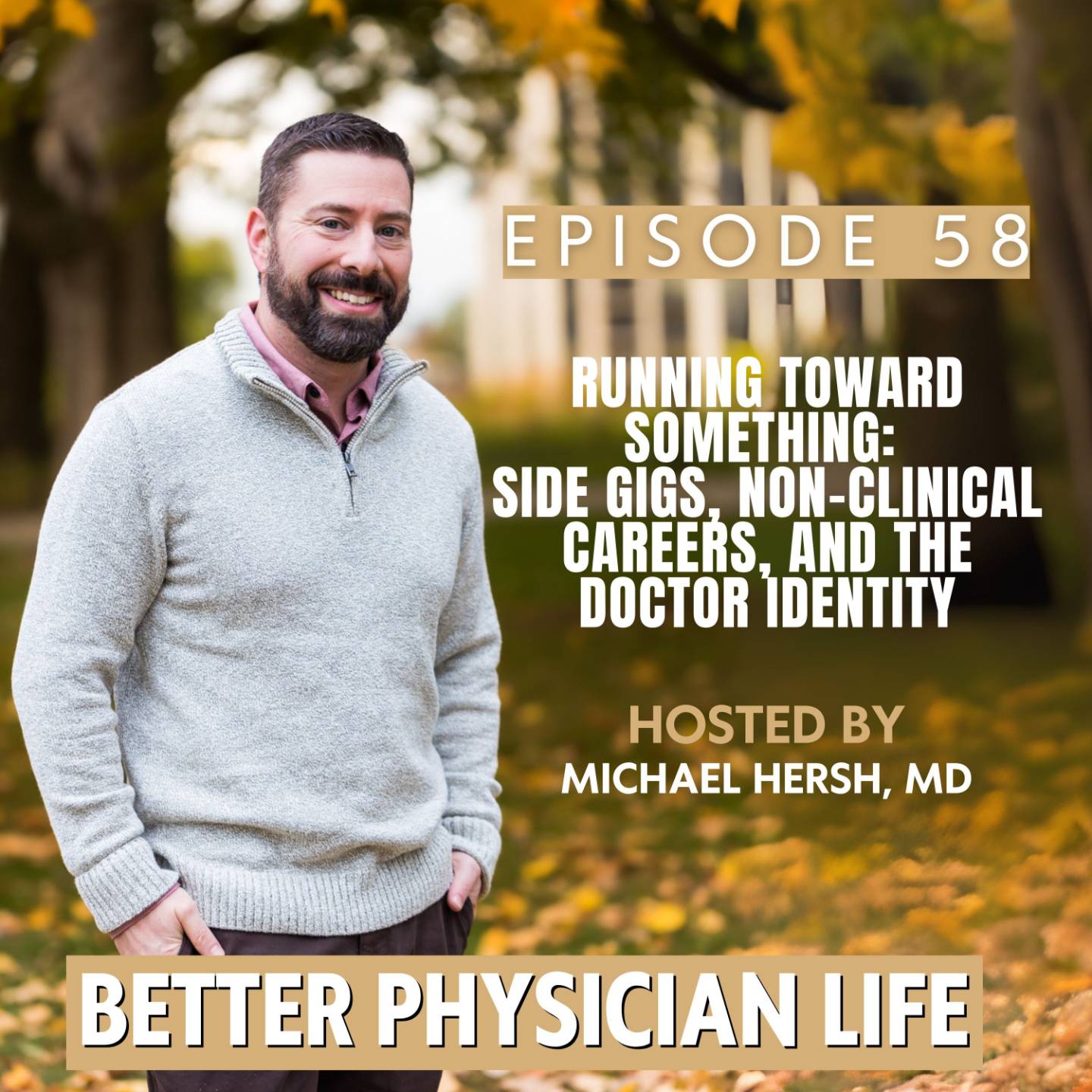
Running Toward Something: Side Gigs, Non-Clinical Careers, and the Doctor Identity | Ep58
This episode examines the emotional side of career transitions, identity, uncertainty, and how to build a meaningful next chapter with confidence.
When you took the job, you thought it was your forever job. Now, you're not so sure. The recruiter emails that used to go straight to the trash suddenly seem worth reading. The physicians talking about locums, telemedicine, and medical directorships have your attention in a way they never did before because you've started paying attention to exits.
And that raises a question you never expected to ask: What changed? Six months ago, you couldn't imagine leaving this job. Now, you're wondering whether you wanna do it for another 20 years. And once that question shows up, it's really hard to make it disappear.
Well, hey everyone, and welcome to another episode of the Better Physician Life podcast. Thank you so much for being here today. Now, for a lot of physicians, there comes a point where you start wondering whetheryou're gonna do this forever. And I think that moment catches a lot of physicians off guard.
Not the recruiter emails, not the job postings, but the fact that you're looking at them at all. Because once you've spent 10 or 20 years building a career, a reputation, and a professional identity, even wondering about something different can feel very uncomfortable. So today, I wanna talk about what it actually feels like to consider doing something different.
The identity piece, the discomfort, the not knowing. And what happens when a physician who has spent an entire career being the expert suddenly finds themselves trying something new and very unfamiliar? Because more physicians than ever are thinking about transitions. Some are building businesses on the side, some are exploring non-clinical careers, some are taking on leadership roles, some are just trying to cut back clinical time, and some are wondering whether they want to do exactly what they're doing right now for another 10 or 20 years.
And the moment that question shows up, the moment you start actually entertaining it, something interesting happens. A lot of physicians immediately go to logistics. How much would I make? How many hours would I work? What certifications do I need? Can I replace my clinical income? That's a big one. And can I afford to cut back?
That's usually not where it starts, though, okay? Before the job boards, before the spreadsheets, before the practical questions, there is usually a moment that looks something like this.
You're sitting at your desk after clinic. You've got three charts left to finish. Your inbox has somewhere north of 40 patient messages waiting. And instead of finishing the notes, you're looking at a medical director posting you have absolutely no intention of applying for. At least that's what you're telling yourself.
Or maybe it's this: You've opened your retirement projection again for the 10th time this month. You're running the numbers, asking yourself how much income you'd need to replace just to get your Fridays back. Not because you hate practicing medicine, but because you're tired of feeling trapped by it. But in my experience, logistics aren't the ones that actually keep people stuck.
The identity questions do. Because when you've spent two decades becoming something, stepping away from it, even partially, is never just a career decision. It's a personal one. Think about what medicine actually gives us, and I don't mean the paycheck. It gives us structure, certainty, competence, status, a very clear answer when someone at a dinner party asks you what you do.
"I'm a physician." Clean, simple, understandable. You've been saying some version of that since your 20s. It's the answer that came with all those years of training, all the sacrifices, all those nights you told yourself it was gonna be worth it. And for a long time, that answer was enough. And I don't think we appreciate how much of ourselves is wrapped up in that answer.
Think about what it meant when you first said it. Medical school, residency, the years of building a practice, a reputation, a patient panel that knows your name. You didn't just become a physician; you became the physician. The one people called, the one they trusted, the one who knew what to do when nobody else did.
That identity didn't show up overnight. It was built slowly, deliberately, and at enormous personal cost. And then one day, a question starts following you around: "What do I call myself if I'm not doing this anymore?" I was speaking recently with a physician who had been practicing for over two decades.
Excellent clinician. The kind of doctor other physicians call when things get complicated. Really great reputation, patients who trusted him completely. And he had reached a point where the environment around the work had become untenable. He was actively exploring what came next. At one point, he said something I've heard in different forms from many physicians navigating this same moment. He said, "When someone asks me what I do, I say I'm a doctor. I've been saying that my whole adult life, and I genuinely don't know what I'd say instead."
Because the answer, "I'm a doctor," isn't just a job title. For most of us, it's the organizing principle of our entire adult identity. It's how we introduce ourselves. It's how we think about our place in a room. It's how we explain decades of choices, the training, the hours, the sacrifices, the trade-offs we made and asked our families to make alongside of us.
When I asked him what he was hoping the transition would give him, he did not talk about money. He didn't talk about hours or flexibility or a better commute. He said he wanted to feel like he belonged somewhere again. Like his presence was welcome. Like his value didn't have to be proven from scratch every single day. That is not a logistics problem.
That's an identity problem, and it does not get solved by updating a resume. Because here's what I've watched happen again and again. Physicians go into a transition with the same expectation they've carried since medical school. If I can just find the right next thing, it'll all work out the way I want it to.
And that's not how it works. We are extraordinarily comfortable with being experts. We've spent our entire lives becoming experts. We know how to study, how to prepare, how to perform. We know what it feels like to walk into a room and know exactly what we're doing. And then we start a business, or a consulting project, or a leadership role, or really anything we've never done before, and suddenly we're asking questions that feel embarrassingly basic.
How do I write a proposal? How do I invoice someone? How do I negotiate a contract I've never seen before? How do I sell an idea to people who don't care about my board certification? The discomfort isn't coming from the work being hard; it's coming from being a novice again, and physicians are not used to being novices.
I remember a physician telling me that managing critically ill patients didn't rattle him at all. He could walk into a code and be completely calm. But trying to build something new, something uncertain, created a level of anxiety he was not prepared for. And that makes complete sense because in medicine, we train for complexity.
We train to eliminate uncertainty, to work through it, around it, over it. What we don't train for is sitting with it. And business is uncertainty. Leadership is uncertainty. Career transitions, you guessed it, are uncertainty. Uncertainty feels very different than complexity. And here's something else I notice.
When physicians talk about wanting a side gig or a non-clinical path, they usually say it's about money. Sometimes it is, but often it's about something else entirely. Optionality, breathing room, another door. Sometimes it looks like bookmarking a locums opportunity you'll never apply for. Sometimes it looks like listening to a podcast about non-clinical careers on the drive home.
Sometimes it looks like wondering whether one day a week is still enough to call yourself a doctor. Not necessarily because those people are ready to walk through a door just yet, but because they want to know it exists. They want to know that if medicine changes, if their health changes, if their family situation changes, there might be another path available.
That's risk assessment. And physicians are actually very good at risk assessment. But there's a question underneath all of this that does not get asked enough. Are you running from something, or are you moving toward something? Because those are not the same thing, and they do not lead to the same place.
Now, I want to be very clear. There are absolutely situations where leaving is the right call. Toxic environments exist. Bad leadership exists. Jobs that are genuinely unsustainable exist. There are circumstances where staying no longer makes sense. But even when leaving is clearly the right move, it is still worth asking, “What am I building?”
“What does the thing I'm moving toward actually look like? What do I want it to give me that this didn't?” Because if all of our energy is focused on escape, we can end up creating another version of the same problem. The details change, the underlying experience doesn't. I've seen physicians move practices, move systems, move states, and discover that some of what was bothering them before…made the trip with them.
That's not a reason not to make a change. It's a reason to understand what you're actually hoping the change will solve. I also think we underestimate the grief that can come with these transitions, even when we're choosing it, even when we're relieved to be leaving.
You can be ready to reduce clinical time and still miss patient care. You can be excited about a new role and still miss the operating room. You can be done with a job and still love parts of medicine. Those things can exist at the same time.
And physicians sometimes believe that if they're dissatisfied, they must hate it. Not necessarily. What a lot of physicians want to leave isn't medicine; it's the inbox, the productivity pressure, the staffing shortages, the endless administrative accumulation that surrounds the work that we are trained to do.
That distinction matters. Because when you understand what you're actually trying to preserve, the transition becomes much easier to navigate. You're not throwing away an identity; you're deciding which parts of it you want to carry forward with you. Maybe that's the real work, not finding the perfect side gig, not finding the perfect non-clinical role, not finding the perfect exit strategy.
Maybe the work is becoming willing to move before you're certain. To tolerate being a beginner again, to gather information instead of demanding guarantees, to build something slowly enough that you can actually tell whether it fits. Because most meaningful transitions aren't leaps. They are a series of small experiments, small conversations, small opportunities.
Someone starts doing a few hours of consulting, someone takes on a committee role, someone starts teaching, someone experiments with something they've never done before, and over time they gather information. They learn what fits, they learn what doesn't. They discover what they actually enjoy doing when nobody is watching their RVUs.
And eventually, one day, you realize you're no longer trying to escape. You're building something. One of the things I've learned from working with physicians in transition is that these conversations are rarely about resumes. They're rarely about LinkedIn. They're rarely about interview skills. Most of the time, we're sorting through uncertainty.
What do I actually want? What am I hoping this next chapter gives me? What parts of medicine am I trying to leave behind? And maybe more importantly, what parts do I still want to keep? These are not physicians in crisis. Most of them are doing really well on paper, and that's exactly why the questions are so hard to sit with.
And that work, the sorting, the clarifying, the figuring out what you're actually moving toward, is genuinely hard to do alone, especially when you've spent a career being the person who figures things out alone. If that's where you are, even a little bit, a physician coaching call is the right next step.
Just a conversation. You describe what's going on, ask whatever you want, and we figure out together whether this is the right fit. You can learn more at betterphysicianlife.com, and there'll be a link in the show notes.
Because the physicians who do this work don't regret it. What they regret is how long they spent circling the same questions, waiting for certainty that was never going to arrive until they started moving.
Thank you so much for being here today, and I'll see you next time on the Better Physician Life podcast