FULL EPISODE TRANSCRIPT
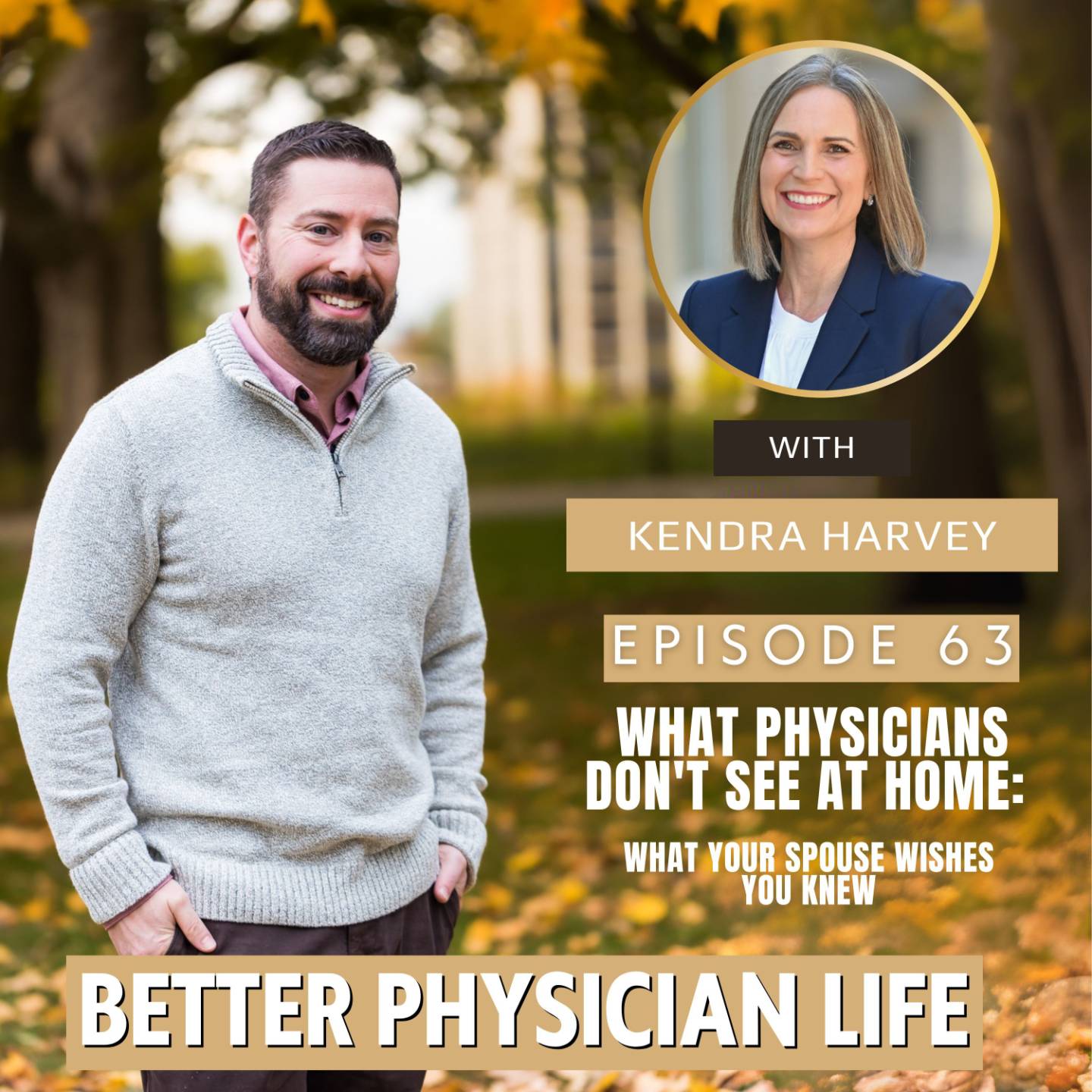
What Physicians Don't See at Home: What Your Spouse Wishes You Knew with Kendra Harvey | Ep63
Explore unspoken expectations, identity shifts, resentment, and practical ways to protect connection in physician marriages and families.
The recital you missed because the page couldn't wait. The birthday dinner that turned into a phone call from the parking garage. The 2:00 AM page that doesn't just interrupt your sleep; it interrupts someone else's night, too. Someone is home when that page comes in. Someone is explaining to a six-year-old again why Dad isn't at the dinner table.
Someone is holding the calendar, the kids, and the logistics of a family while you're holding the pager. We talk a lot about what medicine costs physicians. Burnout, RVUs, inbox volume, staffing shortages, call. We spend a lot less time talking about what the career asks of the people living alongside us.
The nights, the weekends, the holidays, the plans made with the understanding that they might change. That's not separate from the physician experience. It's part of it. Today's guest works with physician spouses, the people who didn't necessarily go through medical training themselves, but whose lives have been shaped by it.
And if you're married and a physician, you already know this career affects your marriage. With the call, and the schedule, and the unpredictability, the parts of work that follow you home. We know what it's like to carry the pager, but today I want to talk about what it's like to live on the other side of it.
Well, hey everyone, and welcome to another episode of the Better Physician Life podcast. Thank you so much for being here today. So my guest today is Kendra Harvey, and Kendra has been living on the other side of the pager for more than two decades. Her husband is a practicing neurosurgeon, and together they've raised five kids through residency, early practice, and all the different ways medicine finds its way into family life.
Back in 2011, Kendra started writing about her own experience because there weren't many places where physician spouses could talk honestly about what this life was like. Over time, that work grew into a much larger conversation about physician marriages and families. And today she works specifically with physician spouses and hosts the Supporting Physician Spouses podcast.
And what I like about Kendra's perspective is that this isn't a conversation about blaming medicine or blaming physicians or pretending there's an easy answer to any of this. It's about taking an honest look at what this career asks of a marriage and a family and what we might do differently once we're willing to talk about it. Kendra, welcome to the Better Physician Life podcast. It's so great to see you.
It's good to be here. Thank you so much, Michael, and thank you for that very generous introduction. That was lovely.
Absolutely. Now, let's jump right in. Now, you- ... have spent years talking to physician spouses. What's one thing you wish physicians understood about what this career feels like from the other side of the pager?
Just one thing? Let's see. Well, there are a lot of things. One of which is I really wish physicians understood that, yes, this life has required a lot of you personally. It's required a lot of your time and energy and sacrifice, and it's required a lot, but it has also required a lot of your family. And there's a good chance that your spouse is experiencing some of the downstream effects of that, but isn't telling you the whole story.
And that happens for a couple of reasons. One being they don't want you to worry because worrying is what they do for you. And so they can't have you being worried about them because does that impact your ability to care for patients? Does that impact your ability to provide for your family? All of those other things we're worried about. And so your spouse is probably carrying a lot that she isn't sharing with you.
Yeah. And what do you think the best way is to go about those conversations? Because I think it's hard at the end of a day to just say, "Hey, what's going on for you today?" How do you, when you're talking to physician spouses, recommend having those conversations, which can be a lot?
Yeah. Well, part of the problem is there's never a really good time to have a deep, meaningful conversation. Do you have it as soon as he gets home? But sometimes that's really late at night. Do you do it on a night before he's going on call? So there's always this, like, mental juggling act of when is the right time to bring something important up.
And so what I do in my own relationship, what I tell others, is we have to have a regular cadence for it, so we aren't waiting for something to blow up or for some crisis before we then try to figure out when we're going to have this. If we're having regular connection points where we have a structure, and we're talking about things, and we know, okay, the next time we're going to have this relationship meeting is on Thursday because we've already checked, the schedule's clear, it's two days removed from call.
We know exactly what the structure of that meeting is. We know that it is going to be contained within a certain amount of time. We're going to give ourselves, you know, 20, 30 minutes, and we're just going to debrief, and we're going to have that time. Because there really is never a good time to either have a hard conversation or to bring up something sensitive when both of you are frazzled and at your wit's end. That doesn't make for a very productive conversation.
Yeah. In talking with physicians and obviously you talk to the spouses, what I notice is that when those conversations are not happening, what's building up in the background is resentment. Yes. And certainly the longer we allow time to go between these conversations, the harder the conversations become and the less likely, I have found maybe even in my own marriage, that those conversations aren’t as productive when they are put off for longer and longer. What's your experience with that?
Yeah. That's exactly right. I think oftentimes something will happen, and if there isn't a time set where we're going to talk about it, it festers for a little bit. Maybe it has a lifespan of two or three days, and then it falls away into the background, and you forget about it until the next thing happens, and then it, like, comes back double.
And then it's like, "Oh yeah, I remember now why I was so upset about something," because now I'm just compounding. And I'll have moments where it kind of drops off, and I don't remember anymore, and then it comes back. And so we have to have a way of regularly dealing with the issues that come up in our relationship so we can be productive, so we can be effective, and so we don't have compounding resentment. We want to be able to take care of things cleanly, and then be able to move on.
Yeah. One of my favorite sayings, and you probably know this one as well from your coach training, is that expectations are premeditated resentments. And so a lot of what goes into sometimes the hard feelings that are happening in marriage is unmet expectations.
And that can happen on both sides of the equation. How do you help physician spouses to think through the expectations and where expectations are being met or unmet?
Yeah. So I have a different take on expectations. Yes, I agree with that interpretation, but in my community, the advice that is most often given to physician spouses is to have no expectations.
And I reject that entirely. The premise being that if you have no expectations, then you will never be disappointed, and this will never be a problem, but it creates disconnection. And so there are definitely some expectations that need to be lowered, and then some expectations that should be held firm, especially when they come to your ability to connect and relate to one another.
We need to protect the things that connect us. We don't need to lower those expectations. So yes, some expectations, but that's a conversation that you actually have to have. First of all, expressing what the expectation is, and then having a conversation about whether or not that expectation is reasonable. But you have to have the conversation first. So I would say, like, unspoken expectations definitely will lead to resentment.
Yeah, I think this is super important, and I definitely want you to say more; what are the expectations that should be very clear and up for discussion in any physician household?
Yeah, so I'll use the example of the expectation that we have dinner together five days a week. Okay, that might be something that I want, but realistically, is that something that I can ask my spouse to do? No. Sometimes he's home at 6:00, and that's great, and sometimes he's home at 8:00, and dinner has passed.
If I'm expecting him to be home for dinner, I'm going to be disappointed. So that is an example of an expectation that we can lower, we can discuss, we can come up with a new baseline. Maybe three times a week is our target expectation for how often our family will have dinner together. An expectation that I wouldn't lower is that we speak to one another with kindness.
We communicate our schedule, like what's going on in our household. We don't want to lower those expectations. We don't want to lower the expectation for, I'm going to be thinking about how I'm going to connect with you; I'm going to be thinking about you throughout the day. Those expectations, again, we don't want those to go away. We don't want to reduce those so low that I expect nothing from you, because it's hard for you to reenter a home where there are no expectations.
Yeah, I think that's incredibly important. I think in thinking about my own experience in my own marriage, one of the things that I had to get much better about was texting my wife when I was leaving work and saying that I was leaving, and then not actually leaving for another hour, right? So I had to get very clear, from an expectation standpoint, that she is going to expect that when I send her a text message that I'm leaving, that I'm actually leaving.
And if I'm going to be in integrity with myself and with her, I have to be honest about, "Okay, I'm walking out the door. Here's my ETA. This is what the Maps app is telling me. I will be walking in the door." And when I can be clearer and more reliable and set those appropriate expectations and not just think I'm leaving, but then handle one more patient message or deal with one more administrative task, then everything is so much easier when I walk in the door, as opposed to if she thinks I'm going to be home an hour before I actually walk in the door because I didn't properly communicate when I was actually leaving.
Yeah, that is so good, and that's something in our community that comes up all the time. It's like, "Oh, when he says five minutes, it's actually two hours," or, "When he says he's in the car, he's not really in the car. He's actually just hanging up his white coat, and who knows what could happen between that moment and the time he gets to the car."
And we know, and you know from experience, lots of things can interrupt. So yes, having that expectation and understanding that when I say this, this is what I mean, this is what you can expect, goes a long way.
And I will offer that sometimes comes in iterations. I still mess this up. I do not always get this right. We all do. Yes, of course. But it does take effort and intentionality, right? It doesn't get better unless you try different things and really figure out, okay, how am I going to communicate this?
Yeah. Well, I love that you said that. Sometimes we mess it up. We are all humans. We're going to mess things up. But there's an integral piece of that, and that is repairing. Like, if we mess it up, do we own that we messed it up, and do we say, "I'm really sorry. That was on me. I did this. I said this. I didn't follow through."
Are we taking responsibility for that? And I know that goes both ways too. Sometimes my husband will be like, “How much longer are you going to be in there?" If I'm finishing up something that I'm really, like, engrossed in, I'll be like, "I'll be in 10 minutes."
And then 45 minutes passes. Am I owning up to the fact that I said it was going to be 10 minutes, and then I got lost in what I was doing, and it was 45 minutes? So can I repair? Can I take responsibility for my part in that? Can I own up to it? And can I say, I'm going to try, I'm going to try to do better.
Either I'm going to be more accurate, like, “No, I'm really engrossed in this, and I'm not going to come to bed until I'm done, and I don't know when that's going to be." So can I be a little bit more honest? Can I take a little bit more responsibility and ownership for the part that I play in that dynamic?
Yeah. And to the point that you were making earlier, this all comes from these ongoing conversations. And you're right, there isn't always a great time to have these.
So being intentional about how you follow up on how life is going and how these kind of little day-by-day things that don't seem big in the moment, but how they compile over time, compound over time, it's so important to set time aside for that. How do you do that, or how do you recommend doing that in your home or to your coaching clients?
So I'll share something that I've shared on social media and with my podcast listeners also, and it's about creating rituals and routines in your life, something to look forward to. So my husband, he likes to run, and he says he always needs to have a race on the calendar to help motivate him to keep working.
Your relationship needs something similar. You need something on the calendar that you're looking forward to. And so there's the 2-2-2 rule. Every two weeks, you need to have a date. It needs to be on the calendar. It needs to be planned. You both have something to look forward to in the short term.
Every two months, if you can swing it, get away for an overnight. Get out of the house. Go somewhere. If it can't be overnight, make it a long, like a full day. Make it substantially longer than just a date. And then every two years, go on vacation with your spouse with no children, no friend couples, no extended family, just you and your spouse, and get away.
So having something, like my husband's races, on the calendar- having something for your relationship that is on the calendar: those date nights, those overnight trips, those vacations together, and those little meetings where you're checking in with each other about logistics and what we're doing well.
What can we do a little bit better? What was hard for you this week? What was hard for me this week? Having those things set up so that they are, like, your call schedule. You aren’t like, "Oh, I don't want to go to call. I don't want to go on call today. I'm just not going to." It's like, no, it's on the calendar.
We honor the calendar, and we look forward to it, and we make the most of that time that we have together. I think too many couples, they don't put anything on the calendar. They're waiting for time to just fall out of the sky. And we know that doesn't happen. Like, you don't get chunks of time that just land in your lap, and then you're ready to go and take action on them. Like, you need to have it on the calendar.
Yeah. And kind of making the implicit explicit here, right? As our lives change and shift, naturally, for a lot of us, the shift becomes... family, right? You have children. The children have a lot of needs.
And no matter how old they are, there's always going to be a need there, and finding ways to prioritize the relationship to ensure that that remains at the forefront of life as well.
So I don't think my husband would mind me sharing this because he's shared it on my podcast before; we were both kind of raised this way. Like, you get married, and then, not that's it, but we weren't really shown how to create a good marriage. It was just, get married and things work out.
And it's like, oh, that's a little more complicated than things just working out. Like, this actually requires a lot of work. And there's a quote by Wayne Sotile that I share all of the time, and he talks specifically, because he works with physician families, is that physicians, you have gained your status and station in life by doing more than other people.
You study more. You work more. All of these things, you do so much more. And if you want to have a marriage that actually looks good, not just on paper, but feels good, you have to do more for your marriage than other people do for theirs. And I have taken that to heart. I've shared that with my husband, and he knows that, too.
It's like, no, actually, you can't take it for granted that it's just going to happen. You have to really work for it. And I think maybe both of us were a little bit surprised at how much work it would actually take with the constraints of his profession. It's like, no, we've gotta really work at this.
Yeah. And you've been with him from the very beginning through his training, early career, and you've seen the changes that he has had to go through identity-wise from student to resident to attending. And to your point, our spouses also go through a number of identity changes alongside of us. Oh, yes. Talk to me a little bit about what that has been like.
Sure. Yeah. Let me correct the record, though. I met my husband when he was in his third year of medical school, so before that he was on his own. He did medical school, you know, undergrad by himself. He did the first two years of medical school by himself.
We met his third year, and we had a rapid courtship, which I'm not recommending necessarily that anybody follow this pattern. But we met and were married and got pregnant all within the same year. And so life for me changed very, very rapidly, and part of that identity that we'll talk about is, you know, I was in my late 20s when we got married.
I had a professional career. I was working. That is where my support system was. That is where my friends were. That is where my life was. And I stopped working on a Friday, and on Monday I had a baby, and that all went away. And so I remember sitting down at my computer, holding my new baby, like feeling like I should be checking emails.
Like, because everything I had done before then was sitting at a computer desk. I was answering emails. I was attending meetings. And now the house was quiet. I had a new baby. I had my computer open, and I had no idea what I was supposed to do. And now I was disconnected from my workplace, so I no longer had the connection.
I no longer had the people at the water cooler that you could bump into and talk to about what is happening in your organization or in the world. There was none of that. It's just me and this baby and occasionally Oprah on the TV. There are some real big identity shifts that happen, and I just did a lot of them real fast.
Single to married, married pregnant, new baby, now I'm not working. And part of my reason for not going back is I didn't have a support system that was in the area that I felt comfortable that I could leave my baby with. I'm like, what am I going to do with this baby? I don't know anybody.
We don't have family that is close enough that could help, and I haven't met anybody outside of work. So everybody that I knew who could, they're at work. They're not at home who could watch this baby, and so that was a really difficult time. And then I knew we were going to be moving for residency, and I thought, "Okay, well, we'll see what happens then."
And then you go to residency, and you find out that this is a different ballgame than medical school entirely, and it's the same type of thing. So, leaving one situation for another when your spouse now has colleagues, your spouse has a very clear purpose. He has a structure for interacting with other people that then the spouse doesn't have.
It's up to her to actually go out and create them. You know, there's library play dates, or there's the gym, there's the church. But it's a lot of extra energy that has to be expended then to create that. And then so much of that identity then gets created around the children. So all of your friends then are people who also have children that you've run into at the library or at the mom's group or at these various locations.
And then there's the issue of maybe you want to work, but the math doesn't make sense. How are we going to afford for you to work unless you're working enough to provide for childcare? And depending on how many children you have, that is also difficult to, make the decision to either, I'm going to work and pay for childcare, but then we won't have any money that comes from my work, or I'm going to work and we're going to have childcare and it's actually going to cost us some, but it's important to me that I work.
Or I'm not going to work, and I'm going to stay home with my kids. And then identity just continues to erode. And what I have seen, again, this is, I'll speak to my lived experience and to the clients that I've worked with; many of them have that same experience where they felt like they didn't have a lot of choice.
So we talk about burnout among physicians, about a lack of autonomy. I want you to see how that happens in your spouse's life also. They didn't get to choose where they moved. They didn't get to choose a lot of the circumstances around their life, and they feel like they don't have a lot of autonomy when it comes to how they spend their time or the amount of resources that are available for them to either pursue work, to pursue education, to pursue a hobby that may not benefit anybody but themselves, but takes time and energy or money.
There's a lot of kind of repressed desire and repressed needs that happen during those training years, and it's just a lot of times, of math and logistics. It's like our job, and our focus right now is getting you to the finish line. Like all of our resources are being devoted to that. But here's the pattern that I see over and over, and this is where it gets structurally a little bit dangerous, especially the longer that training program goes on, the longer this situation lasts, is because patterns don't disappear just when you get a job and you get a paycheck and you move.
Like patterns that have been built over years, and again, my husband did seven years of residency and fellowship. That was a long time. That's a long time for patterns to really solidify, and it's really hard to work your way out of that. And then, like I said, when you do graduate from fellowship or residency, and you get that job, and then the survival instincts that you have to, like, keep everybody alive, to do all the cleaning, to do all those things you realize you can pay somebody else to do, then who are you?
And then what are you supposed to do? So there are some real significant changes that happen. I can speak as a woman married to a male physician, that happen in that life cycle of training that takes a huge toll on her identity, her sense of worth, her sense of value. And I say, you know, everybody does need a coach.
Everybody needs somebody to talk to about what that process is like for them, because too many people are going through that alone, thinking that there is something wrong with them. Thinking that, "I should be so happy, and I should be so grateful right now, and why am I not? What is wrong with me?" It's like, no, you are stuck in some patterns that have outlived their usefulness, and you just need help getting out of them.
Yeah. And you know, I met my wife when I was a second-year fellow, and I will say that all those patterns that you just described, they just shifted. Yeah. The timeframe shifted. We met later, and even as an early-career attending, you're starting in a new practice, you're trying to make a name for yourself, so it's very easy.
We have these very, as you were describing, patterns that we are just used to; this is how we show up at work. And so this has the potential to impact our families in lots of different ways, and again, to your point, requires a lot of intentionality to recognize.
Okay, how am I showing up at work, but also how am I showing up at home, and how am I understanding that the schedule, the impact on my spouse, on my family, all of these things? Because there are ways that we can show up differently, and it's not always easy. It takes a lot of work and intentionality.
Yeah. So in what I just described, and what you've described, when we're talking about two people who are essentially burned out in the same relationship, you are going to have problems, and you're going to think it's a relationship problem, and it's not.
These are two individual problems. We have a physician who is burned out. We have a spouse who is burned out, and we're expecting them to feel connected and to enjoy their life together. No, there's going to be some friction. There's going to be some moments of hostility. Like, how can we deal with these two separate areas so we can come together and we can have a home that is a respite for both of us, that isn't just, you know, for one person?
How can this be something that both people enjoy and get fuel from so they can go and be the kind of parent they want to be, so they can be the kind of doctor they want to be, so they can have the relationship that they want to have? Absolutely. And for physicians that are listening, you know, if they wanted to do something, even a small change to make life even 10% better for their spouse, like, what would you tell them? What recommendation would you have?
I would tell them it's not very difficult. It's probably not grand gestures. We're talking about small things. You know, find out what is your wife interested in, and in the structure of her life, in the structure of your life together, is there time for her to be able to do that?
Does she have protected time the way that maybe you have protected time to do the things that you enjoy? Is she getting enough of that protected time? Are you participating in that so that you are taking some of the burden off for either taking care of the household, taking care of the kids, managing something else, so she has time to go do something?
Or is the entire family revolved around the physician? Brené Brown talks about different types of families, how we have parent-centered families, we have kid-centered families, and then we have family-centered families. And what you want is a family-centered family, where everybody in the family is working together for the benefit of every member of the family.
Whereas in children-centered families, everybody's focused on what's best for the kids and making sure the kids have what they need. In parent-centered families, and we see this a lot in physician families, the other spouse and the children are focused on the parent who is the physician.
We're making their life as easy and as smooth as possible, but we need to be thinking about the entire family. And so maybe that's readjusting some things. Maybe that's changing some things in the budget. Maybe that's changing some things on the calendar to make sure that every person in that family has what they need.
And if they don't have what they need, that we're making at least an attempt and a conversation around how we're going to make that possible. What are we going to do to make that possible in the future? What does that look like?
Yeah. We were talking about this offline before we recorded. I had an opportunity to listen to your Father's Day podcast episode with your husband and your kids. Your kids shared messages about what it was like growing up with a physician dad. And I think personally, and a lot of the physicians I speak to, we're so concerned about how this career is impacting our families. We're doing all of this for our families, to provide for our families, and there are potentially downstream consequences of our availability, and what are we there for, and what's getting interrupted by our lack of presence.
And there was such a message of hope. That here you have these five children who have been raised in a household with a very busy neurosurgeon dad. Tell me a little bit about what it was like recording that, because listening to it, they were all like, "Yeah, Dad's busy, but he was there for all the important stuff." And it really was such a meaningful episode for me to listen to as a dad who's going through all of this.
Yeah, so I'll say a couple of things about that. One is I did not know what they were going to say ahead of time, and so I was hearing it for the first time as well, because that's just not conversations that we've had.
And the second thing I will say is that we were very intentional about the things that our children would do that would take away time from the family. And so, to give you just an example, we homeschooled our kids for seven years. My son went back to school his freshman year of high school.
We stopped homeschooling about five years ago. They all went back to school. But there was a period of time where that just made the most sense. If we were going to protect time together as a family, we needed to have a little bit more flexibility in our schedule to be like, "Oh, look, Dad got off early, so guess what? We're going. We don't have to pull kids out of school."
That's one thing that we did early. Later, as our kids started getting involved in dance and, you know, various activities, we narrowed that down really fast because we looked around at other families that we saw that were just completely overscheduled and decided that is not the way that we wanted to run our family.
We tried for a little bit, but it was really, really hard on me, and this is where we go back to kid-centered families versus family-centered families. It was hard on me. I was doing lots of things, and then I was driving all evening, and we were missing time together as a family, and it was like, "This isn't actually worth it for us."
And so when COVID came, and that kind of put a natural end to a lot of things, we just chose not to pick a lot of it back up. So no. Are my kids star athletes? No. Are they star musicians? No. Are they great kids? Yes. They're great kids. And at the end of the day, that's what we decided mattered for us.
And so when our kids say, you know, "He was there for all the important things," it's because we didn't jam a whole bunch of things that were all super important that he would have to miss. And so we really did; we capitalized on vacations, and you heard my husband talk about that. Like, he loves to plan vacations for our family.
That brings him such a sense of joy, and so he's in charge of all of that. The planning is part of the excitement for him, and he loves being able to spend that time with our kids away from the house, you know, get on a plane and go somewhere and be together. He loves that more than anything else.
We like to go out to dinner together. We'll find any reason to celebrate to go out to dinner because when you're not in your house, but you're all together somewhere else, you have the opportunity to talk and connect in ways with fewer distractions. And now we've got adult children and teenagers and elementary school-aged kids.
So it's really the only time we're ever all together, because nobody's ever doing the same thing at the same time. And so again, I think being really careful about how you're going to structure your life and what is most important to you, because the things that are important to you show up in a couple of places.
They show up on your calendar, and they show up in your bank account. So where are those resources being spent? And if you're not sure, go take a look. Look at your calendar. See, where does your family show up? Where are you setting aside time for them? Look at your bank account. Are you valuing things that don't actually line up with your internal values, but they say they do on a spreadsheet or in your bank account?
So I would just say, at least for us, that is what has worked is really trying to keep life simple and balanced and family-focused.
Love it. I think this is such an important conversation, and one that we as physicians don't have enough of. And I am sure that the audience is going to want to hear more from you and learn more about your work. Can you tell everybody where they can find you?
Absolutely. As you mentioned earlier, I do have a podcast. It's called Supporting Physician Spouses, and we started our podcast about the same time, so I feel like we're babies together.
But that has been a great place to have these conversations with other physician spouses and to kind of riff on some things that come up frequently in my community, so you can listen to the podcast. I also have a website. It's called It Gets Better Now, and lots of free resources on there as well.
And then on social media, you can find me at Supporting Physician Spouses or at Kendra_ItGetsBetterNow. I would love to connect with any of your listeners.
Amazing. Well, again, I have loved this conversation so much. Kendra Harvey, thank you so much for being here today. To the listeners, thank you also so much for being here today.
We'll see you next time on the Better Physician Life podcast.