FULL EPISODE TRANSCRIPT
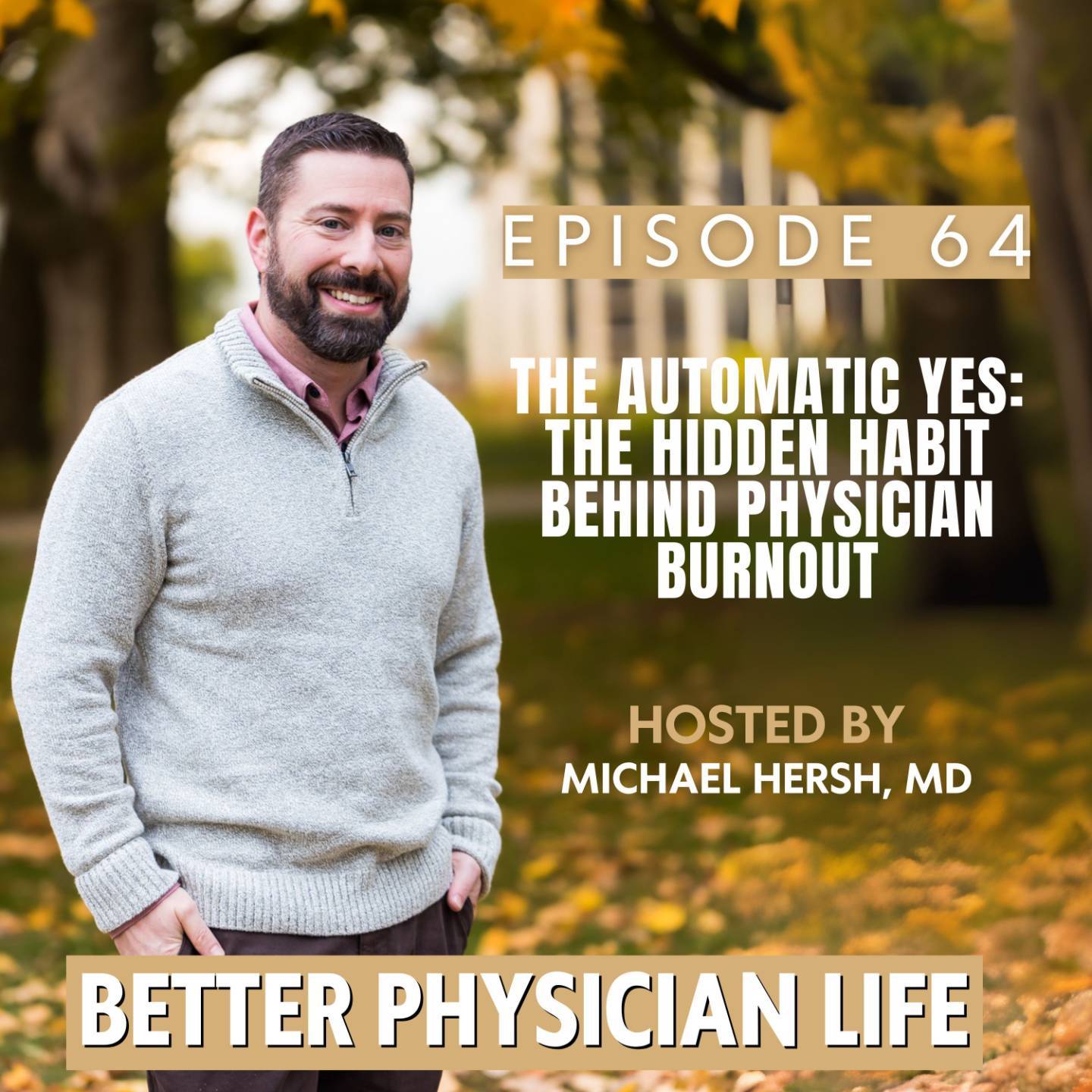
The Automatic Yes: The Hidden Habit Behind Physician Burnout | Ep64
Learn how to notice it, interrupt it, and start asking the question that actually matters: What is this costing me?
You told yourself this month was going to be different. Not because you were changing jobs, not because you were cutting back to four days a week. You just wanted to leave on time for once, get home before everyone else had already eaten, maybe get through one weekend without looking at Monday's schedule.
Then your MA called in sick. Your patient needed to be squeezed in. Your nurse caught you before you walked out with one more question. You opened the productivity dashboard to see where you stood for the month. Your spouse texted asking when you'd be home, and you replied, "Almost done." An hour later, you were still there.
I've lost count of how many times this has happened to me. After enough years, that's what this job can do. You stop noticing you're making a choice and just respond to the very next thing. You see an opening and fill it. You answer one more message. You stay another 30 minutes because leaving feels harder than staying.
At some point, it doesn't even feel like saying yes anymore. It just feels like doing your job
Well, hey, everyone, and welcome to another episode of the Better Physician Life podcast. Thank you so much for being here today. Now, as I coach physicians, there is one topic that comes up over and over again: work-life balance. And I totally get it. One of the biggest struggles of my adult life has been this elusive idea of work-life balance.
It seems like such a simple concept. First, you determine your priorities, then you live your life aligned with those priorities. Super straightforward. But somehow, any time I've ever tried to make that work, things do not go according to plan. Because real life, and especially medicine, doesn't work quite that neatly.
The sad truth is that just because something is a priority does not mean you can give it all of your time. Now, this has been such a recurrent theme in my own life that it was one of the first topics I covered here on the Better Physician Life podcast. It was episode three, and I even went so far as to call it Work-Life Balance is a Myth, because in a lot of ways, it is.
One of the things that has helped me make the most sense of work-life balance has been the chocolate milk metaphor I made up a few years ago. Think of your life as a glass of milk. Then medical school and training come along, and medicine gets poured into your life like chocolate syrup, and once it's mixed in, you can't really separate it back out.
Great. Chocolate milk is delicious, but what do you do with it? How do you want to pour it out? That's the part we didn't fully explore in episode three. Knowing the milk is mixed is one thing. Figuring out what to do with it every single day, that's a different problem entirely. So, that's what I want to dig into today.
Now, you've probably already heard the advice: protect your time, set boundaries, learn to say no. Of course, none of that is wrong. I've said versions of that myself, including here on this podcast. But if it was that simple, we'd just be doing it, and the hard truth is that most of us are not doing it. So maybe the problem isn't that we don't know the advice.
Maybe the problem is we keep breaking our own rules over and over, even after we've told ourselves we wouldn't. I don't think that's a discipline problem. I don't think we just suddenly stopped caring about our lives. I think it's something else. Medicine slowly changes what feels normal to us, not overnight, over years.
Until one day, we're just responding to something before we've even realized we made a decision. Here's the thing: medicine rewards us for being responsive, and for good reason. Our patients benefit from a doctor who answers, who stays late, who covers for a colleague when they need it. Nothing wrong with any of that on its own.
But somewhere along the way, being dependable stops being something we do and it starts becoming who we are. And nobody tells us when that happens. It just feels like we're becoming a better doctor, more reliable, more efficient, more available. Those are qualities we're proud of.
Until one day, they're not qualities anymore. They're expectations we've placed on ourselves. And once that happens, every request starts to look the same. A portal message, an add-on, a committee meeting, one more inbox message. They all show up wearing the same disguise: responsibility. And then we stop asking the question that actually matters: What is this costing me?
Instead, we just try to figure out, can I make this work? Those questions sound similar. They're not. Not even close. And I've got a name for that moment, the one where you just try to figure out the logistics without ever actually deciding. I call it the automatic yes. It's not a decision. It's a reflex. One you've practiced so many times, it doesn't even feel like a choice anymore.
Here's how that happens. You're good at this job. That's not the problem. The problem is what being good at it starts to cost you. You're capable, so people ask. You're responsible, so you say yes. One of the bigger shifts for me wasn't cutting back my hours. It was noticing how often I was volunteering before anyone had even asked.
Someone mentions a staffing issue, and I'm already solving it in my head. An email comes in from administration, and I immediately start figuring out how I'll adjust. A non-urgent portal message comes in, and I answer it before I even stop to ask whether it could wait until tomorrow. Nobody asked me to do any of that.
I just did it automatically. And none of this stays at work. It follows you home, too. You're at your kid's soccer game. Someone scores, everyone's cheering, and for a second, you realize you've spent the last five minutes doing math in your head. Panel size, coverage, who's retiring next year?
You're at dinner. Someone asks how your day was, and you say, "Fine," but your head is still in that staffing conversation from earlier in the day.
You're lying in bed, tired enough to fall asleep in seconds. Instead, your brain starts organizing tomorrow's clinic before your eyes are even closed. That's exactly why it's all so easy to miss.
I kept looking for a better way to describe it. Then, a physician coach I know said something that really stuck with me. She wasn't talking about her patients. She was talking about herself. Diastole is not optional. Even if you're not a cardiologist, you know how the heart works. Systole: the heart contracts. Diastole: the heart relaxes and fills.
And if the heart never rests, it never fills. Everything backs up. Eventually, the whole system fails, not because it worked too hard, but because it never got the chance to rest. Most of us assume rest will eventually show up on its own, a reward for all of our hard work and finishing everything else.
But it doesn't. The heart isn't productive first and then allowed to fill. Filling is just a part of the cycle. I've watched physicians do everything right and still miss this. I think about a physician who signed up for coaching with me. He'd already done all the things: cut back clinically, reduced call, took the pay cut that came with all of it, and he was still exhausted.
As we talked, he realized something. He wasn't logging fifty extra hours of work. He was logging fifty extra moments of attention. He was checking tomorrow's schedule before bed, replaying an encounter that had actually gone fine, opening the inbox on Sunday afternoon to be sure his week could start off on the right foot, answering a portal message because it would only take 30 seconds.
None of those moments were big on their own, but when he stepped back and looked at all those, quote unquote, "little moments," they were taking up a lot more space than he had realized. When he was off, he was never actually off, even during the hours that were supposed to be his. That's a heart that looks relatively fine on the monitor and isn't actually filling. Fewer hours isn't the same thing as more rest.
His own family had a name for what they got on nights like that: the leftovers. So here's what actually helped. Not a bigger schedule change. It was actually something way smaller. Start noticing the automatic yes. The moment your answer is already forming before you've actually looked at the question.
And when you catch it, ask yourself the one question that actually matters: What is this costing me? Not the logistics, not whether you can actually make it work, but what it's actually costing you. One physician I coached spent years treating every no like she was letting someone down. A patient, a colleague, herself.
Then she realized she'd been answering the wrong question the whole time. And she didn't get there by simply reminding herself to set better boundaries. She got there by having someone keep asking her the same question, "What is this costing you?" Until eventually, she couldn't just move past it. She assumed saying no would come with a cost: guilt, disappointing someone, letting a patient down.
But what surprised her was what she got back. She told me she could finally be home when she was home. And I think that's what she had misunderstood about boundaries. They weren't walls. They just gave her a way to stop automatically saying yes to one thing at the expense of something else. And that's the part that can be hard to see on your own because the automatic yes doesn't feel like a problem while you're in it.
It feels like reliability, like you're just doing what needs to be done. It doesn't announce itself. It just happens one yes at a time until eventually you stop noticing that you're saying yes at all. And part of the problem is that medicine gives us plenty of ways to measure what we're doing, but almost none for what we're giving up.
There's no number for that, only for what you're still producing. The dashboard can tell you exactly where you stand on RVUs. It can't tell you what all those automatic yeses have taken from somewhere else. So ask yourself something the dashboard can't answer. What have you started calling normal that wouldn't have seemed normal ten years ago?
Checking the inbox during your kid's game, reviewing tomorrow's clinic on the couch, answering messages from bed, assuming vacation means bringing your laptop along. None of that happened all at once. It happened one automatic yes at a time, until it stopped feeling like an accommodation and just started feeling like medicine.
And that's why I don't think balance was ever really the goal. Being home when your home is. Having a day off that actually feels like a day off. Going to your kid's game without checking the inbox between innings. Going on vacation without bringing the laptop just in case.
Not spending Sunday afternoon mentally preparing for Monday. Those are the things we're actually trying to get back. And sometimes it's hard to see what's getting in the way when all those automatic yeses have started to feel normal. And that's where I've seen physician coaching help. Not by handing you more time, not by telling you to work less, and not by giving you another productivity system.
It's having someone outside your day help you look at where you're saying yes automatically, what those yeses are taking from somewhere else, and which ones you actually want to keep saying yes to.
Because this isn't about blowing up your career or walking away from medicine; it's about having a little more choice over what you agree to before the decision gets made for you.
If you've been noticing some of this in your own life, I'd love to talk with you. You can head over to betterphysicianlife.com and schedule a physician coaching consultation. We'll spend some time looking at where the automatic yes has become your default, what it's taking from somewhere else, and what you might want to do differently.
And in the meantime, just start noticing it. The next time someone asks you for something, or you catch yourself volunteering before they even ask, don't worry about immediately saying no. Just notice how quickly the yes shows up. And before you answer, ask yourself, "What is this costing me?" Sometimes the answer will be, "Not much," and the answer may still be yes. But at least this time, you actually decided.
Thank you so much for being here today, and I'll see you next time on the Better Physician Life Podcast.