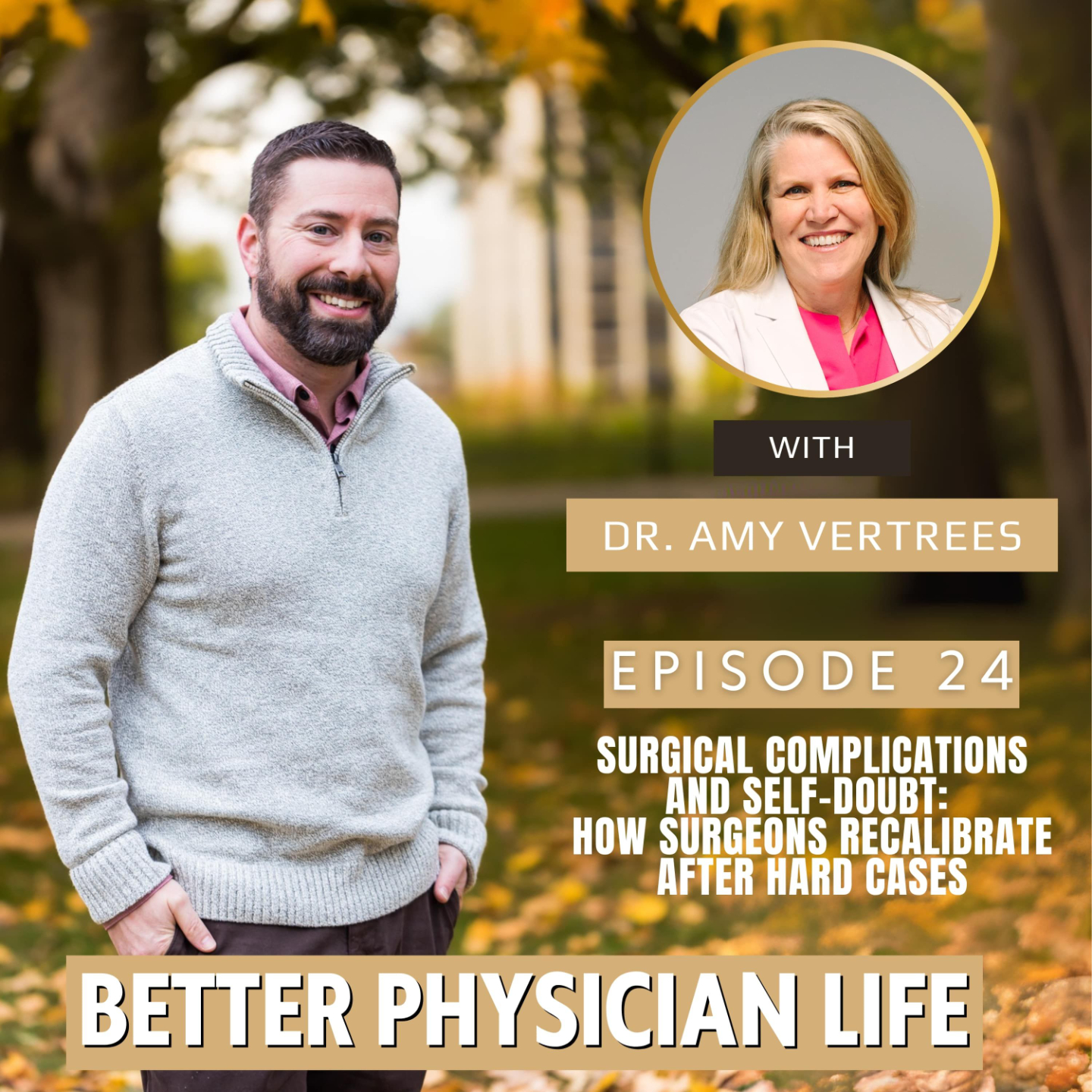
Surgical Complications and Self-Doubt: How Surgeons Recalibrate After Hard Cases with Dr. Amy Vertrees | Ep 24
What if the hardest part of being a surgeon isn’t the case in front of you… But the one still living in your head at 2 a.m.?
In this powerful episode of Better Physician Life, board-certified general surgeon, Lieutenant Colonel (ret.), and physician coach Dr. Amy Vertrees gets brutally honest about the part of surgery no one teaches: how to handle complications without destroying yourself.
From deploying to Afghanistan to building her own private practice, Amy has spent years studying failure, shame, and emotional capacity. She shares her 3-step post-complication debrief (What went well, What I wish went differently, Next best step), why surgeons must give themselves informed consent for risk, how to stop arguing with reality, and why remembering your original “why” is the ultimate antidote to burnout.
If you’ve ever lain awake replaying a case, this conversation will give you permission to be human and tools to come back stronger.
About the Show:
Created for physicians who want more than clinical competence, Better Physician Life is a space for honest reflection, reinvention, and reclaiming purpose beyond the pager.
Hosted by Dr. Michael Hersh, each episode dives into the questions we didn’t learn to ask in training, offering tools and conversations to help you live and lead with intention
Top 3 Takeaways:Â
- Reframe Complications as Failure You Can Actually Use: Stop arguing with reality (this shouldn’t have happened). Accept it, then run Amy’s 3-step debrief: 3 things that went well, 3 things I wish went differently, and 1 next best step. This expands emotional capacity instead of contracting it with shame.
- Give Yourself Informed Consent: Before every case, ask: “Do I consent to the risk of bleeding, perforation, or even death?” We make patients consent, why don’t we consent ourselves? Owning the real risks up front reduces denial and post-op self-blame.
- Look at the Gain, Not Just the Gap: Perfection is impossible. Focus on the 97% you nailed instead of beating yourself up over the 3% gap. Pair this with fierce self-compassion (mindfulness, self-talk, and common humanity), and you’ll carry the hard days without letting them crush you.
Watch Now

After a hard case, you don’t need thicker skin. You need a way to review it clearly. Complications demand review, not rumination.
One focused physician coaching call can help you sort out what was in your control, extract the lesson, and stop carrying the mental noise into the next case.
If you want to show up ready for the next case without being weighed down by the last one, the link below is the next step.
Book A CallSurgical Complications and Self-Doubt: How Surgeons Recalibrate After Hard Cases with Dr. Amy Vertrees | Ep24
Michael Hersh, MD
[00:00:00]Â
What if the hardest part of your job isn't the work you do with your hands, but the pressure you take home in your head? Today's guest is a surgeon who understands complications, negotiations, and the parts of our jobs that no one trains us for. And she talks about all of it with a level of practical clarity that most of us wish we had heard much earlier in our careers.
Stick around because the conversation you're about to hear might just give you something you haven't had in a while. A little more room to breathe and a better way forward.
Well, hey everyone, and welcome back to another episode of the Better Physician Life Podcast. So today I'm talking with a surgeon who understands exactly what this job takes from you and what it can give back. When you start running it on your own terms, she brings a kind of clarity that cuts through the noise.
It makes you really think about how you're showing up in your own career. Dr. Amy Vertrees is a board-certified general surgeon, an [00:01:00] army veteran and a certified physician coach. She spent 17 years in uniform, deployed three times to Afghanistan and Iraq, and rose to the rank of Lieutenant Colonel.
After leaving the military, she rebuilt her career in civilian practice and eventually founded Columbia Surgical Partners, the private practice, general surgery group she leads today. Amy noticed the same gap. A lot of us run into our training, teaches us how to practice medicine and in her case, how to operate.
But it doesn't teach us how to build a career that actually works. It doesn't cover negotiating our value, managing complications without getting knocked sideways, or handling the parts of the job that no one prepares us for. So she built it. She created the Boss Business of Surgery series, which includes her coaching programs, a podcast and her book, Become the Boss MD.
All focused on the real skills surgeons need to stay sharp, stay [00:02:00] steady, and stay in the game. I'm so looking forward to this conversation. Welcome to the show, Dr. Amy Vertrees. How are you? I'm great. Thank you so much, Michael. You know, of course , we have gotten along famously because we have the same mission, which is to help other people and learn these lessons that were not taught in residency, and so I'm really so honored to be here.
Thank you so much for the invite. Absolutely, and we always have so much fun chatting and so I'm glad to bring other people. We've just been laughing for the last 10 to 15 minutes about all the things that went wrong before we hit the record button, and so I think we're in the perfect mindset to talk about complications because I think when.
We do the things that we do as physicians, the complex nature of our jobs, even when we are incredibly well trained, even when we know exactly what we can and should be doing. Things happen, things go awry, things don't happen the way we intended. I'm sure you hear about this all the time when you are coaching surgeons, and I'd [00:03:00] love to get some insight to you on what do you think about complications just as a topic.
We get all these ideas that will help you all along. I mean, if you look, everyone is offering us such important and helpful advice, but the main question is like, why doesn't it land? And you and I both, in the coaching journey realize that. advice doesn't always work. So people offer us thoughts, but unless we really internalize them, it's not gonna work.
And what a complication is, like we wanted an outcome from a surgery and it didn't work. So that is essentially a failure and. It comes into like, how do you define failure and what do you do when it feels like a failure? And then it's the ability to look at, I intended this for, to happen.
And it didn't, you know, just like, a lot of the things we just had with the recording things like, you expect to hit a button and things start working and then it doesn't. Now we chose amusement because why not? Like no one's life is at stake, things like that. But. It becomes [00:04:00] different when the outcome that you want doesn't happen and someone could potentially become harmed from that.
So, I definitely think the complication in surgery is, and you know, any medical, professional decision that we make that doesn't give us the result that we were anticipating is a complication. It is a failure. And so our ability to manage and understand failure is something that I've studied now for years, is how do we overcome from this inevitable?
We're gonna fall short from a perfectionist goal. That's really where all my work's been the last few years. Yeah. And kind of following that thread a little bit, I think part of the issue isn't necessarily the complication or the adverse event. It's how we interpret it and what we make it mean about ourselves.
Exactly. How do you approach that topic when you are speaking with other surgeons? I read a book called The Perfectionist Guide to Losing Control and that really helped clarify some things. And, [00:05:00] you know, a lot of different concepts kind of melded together for me to understand. A useful way to look at this.
And there is the idea of your perfect outcome, like a hundred percent achieved goal. And that's what we all strive for. We strive for a perfect outcome and. It's near impossible to get a perfect outcome. So typically we fall short to some degree. Some days it may be like, 97% we've achieved our objective goal, and it could be 85%, but usually it's like a high percentage that we're doing in this work we have because of the skills and knowledge that we have.
But the problem is that we don't often look at the 87, 97%, we look at the 3% or the 12%. so we look at the gap and not the gain. What happens is if you don't have that balance, then you will only be looking at the gap. And so all of your effort will be in bridging the gap from whatever percentage to 100%.
And the problem is, that that gap never really closes. [00:06:00] So a lot of your effort is spent on discounting the positives of what you have done. Focusing on the negative, which goes into another thing that I've been very interested in lately, which is, emotional capacity. And our emotional capacity is our ability to manage our feelings, both about the gain that we've done, all the things we've done and also how we manage the gap.
Like how do we treat ourselves, how do we treat other people? And that is something that was not taught to us. We were taught skills. We were taught knowledge, we were not taught emotional capacity. And that's really where I think we can be very lucky and people offer us a lot of support and we feel a certain way.
But I think a lot of us, because they can bring up shame and a lot of negative emotions we tend to contract. So emotional capacity decreases over time. So this is one thing in our career that actually diminishes if we're not careful. And I think this is what surprises people. Yeah I think any [00:07:00] proceduralist or any surgeon that has experienced this before, knows exactly what you're saying.
So a complication happens and we can spin in that complication, right? We start to ruminate on it. We're thinking about it, you know, what happened, what did I do? What could I have done differently? And, it doesn't move us forward. And I think that is a hundred percent where that contraction in emotional capacity happens because those questions, I like to say anxiety lives in the questions, right?
And so does overwhelm, and the antidote is in the answer. And so when you're asking yourself what could have gone differently. Take a moment to answer that because to your point, that's where you actually can grow your emotional capacity. And sometimes there is something that we could have done differently and other times there really isn't.
You know, I have done tens of [00:08:00] thousands of colonoscopies And each one is a little bit different. And even when I've done everything the same, everything correctly, everything that I've been trained to do, sometimes something happens that was unexpected or unintended. And if I just allow myself to sit in, why did this happen?
How did this happen, and question my ability and my skill, then I never grow from that. And that I think is to your point of over time, that is something that we need to continue to develop and grow. Because we weren't trained to do that Exactly. And so I've been trying to find simple, easy ways to explain some of these things.
And. many different ideas that have come together into a very simple formula of, you know, how do you address the gain and the gap? Because our brain wants to like bridge the gap. We want to have a perfect outcome, but, our brain will happy to offer us negative things, you know, happy to offer us this because, a negative [00:09:00] emotion is a pretty effective tool.
It's a pretty effective tool to bridge you from less capable to more capable. So you can choose shame and, horror and embarrassment and get to a more skilled state, but it's a very expensive fuel to use. So stepping back and saying okay, I do wanna go from. Like less skilled now to more skilled.
 I do want to get better tomorrow. How can I choose an emotional fuel that's helpful? And first is to look at the gain first. Like, our brain is not going to look at the positive thing first because it feels like it's not gonna do anything for us. However, it's really a key to expanding our emotional capacity.
Like we have to really understand why we do something in the first place. So we do things like any procedure. Whether it's a colonoscopy or an appendectomy or whatever, we do this from a positive emotion of the fact of we feel motivated, we feel inspired, we feel capable. we feel a lot of really good things.
That's why we put ourself in harm's way. Essentially. We know we're [00:10:00] balancing the risk of guilt and shame and worry and regret and all these things that we feel. So to be able to, create a formula. To both assess and move forward can be helpful. And it's very simply first starting with a positive.
What are three things that went well? Because we're not necessarily gonna think of the things that went well. We wanna think of the things that, keep us from harm's way which is usually fear-based. And then that's how we want to avoid the fear . So we think of three things that went well, and that puts us in a frame of mind of, I'm okay, this is safe.
I remind myself why I do this. And then we think of the three things we want to be different. And there's just magic in words. So if you choose the right words, it can be very helpful. If I say, you know, I'm gonna pick three things that went wrong, then you've already adding a layer of heaviness to it that you don't need to.
These are things I wish had gone differently to get the outcome I wanted. So what went well? Setting a positive frame of mind. And the second is. What did I want to do [00:11:00] different? And that is basically addressing the gain and the gap. And then the third is practical. What's my next best step?
So you've created safety and understanding of why you do this. You expand your positive emotional capacity. You understand the things that are causing some constriction, the regret, the worry, the things that you wanted differently, and then you create a practical strategy of what's my next best step now?
But using it from a balance of gap and gain and rather than just something that is punishing ourselves. Yeah, to your point, the intentionality of focusing on the positive because that is not how our brains function, right? We are not always looking at everything that is going well, and so it does take.
Effort to focus on that and you can develop a practice. I have developed a practice of what do I need to do so that my mind is not always veering off into the negativity. And because that is the general direction that our brains want to go focus. [00:12:00] on the things that didn't go well. And so how do you retrain yourself?
Do you have tips or suggestions on what physicians or surgeons can do to help direct their brains toward the positive? Yes. You know, the simple steps that I mentioned before, just the three steps, what went well. I wish it had gone differently. Next best step addresses gap gain in practicality, because I mean, we're really smart.
I mean, I can't just tell you like, oh, just, you know, think of the positive because like, whatever, that's not gonna help. You know, you have to also recognize that we're also very smart and we need to be able to have some reason and some understanding of this. So you can't just dismiss it with.
Some of the thoughts that are helpful and I think do have a place which is everybody has complications and, all these things like, if you do enough operations, then you're gonna have a complication. And, we've heard these things over and over again, and it's all true. However, if we do not have a practical aspect, if we don't have a specificity of it, you know, we know that that's not gonna land.
So sometimes it lands and sometimes it [00:13:00] doesn't. We have to understand why it doesn't land for us. I mean, these are things that are actually true, right? We have to understand the facts of the situation. It is true that the more you do something, you'll have complications. Fine. That's true. It is true that maybe today I was not at my best.
You know, that's where realizing the truth is our best varies every day, some days we're not gonna be as capable. And then also there's one thing that can be very helpful is how we treat ourselves after something has happened. The first is arguing with reality, like it shouldn't have happened.
Well, good luck with that one 'cause it has happened. So the first step I tell people is stop arguing with reality. You had a complication, you did not achieve a stated outcome. So when you start from that place. You drop a lot of the resistance or whether it should have happened, you drop a lot of the, worry and regret.
And a lot of things that don't necessarily add anything to it is to say very practically, this is what has happened. [00:14:00] I don't have to argue whether it should have happened because I had the best that I could on that day. That's what happened. And we accept the fact that we're not perfect,Â
Because it also allows us to give ourself credit for it. Because when we're in this regret and, frustration and things like that, we do want to find some accountability to it. So first is recognizing, not arguing through reality. Recognize we want accountability. That's why we do have to address the gap.
We cannot just. throw a positive thing and address the gain. We can't really just go the gap because then it's just harm and there's no benefit. So again, it is the balance of that I find is really helpful. The second thing that's very helpful is specificity. And I have a podcast episode from a few months ago talking about, are you a slow surgeon? And I had a desire to get a little bit faster in a case that I was learning. A little slow to adapt to robotic surgery. I did A few years ago, and I wanted to get a little bit better at this technology, a little bit [00:15:00] better at the cases. And so I broke it down into steps because I wanted to see what is the step that is causing me to be slow.
So the whole purpose of that podcast was how to get faster. But then I started realizing when you break a procedure down to steps, you can start to realize like. There's actually only one step in this case that is slowing me down. There's only one step in this case that I don't really feel comfortable with.
And that's not usually how we think of things at the end of the case. We're like, how did the whole case go? I was slower than I thought, so therefore I'm terrible. versus. I can do everything, like every step of this with like 90, 95% effectiveness, except for this one step, I might be at like a 60% and that's what drug my whole feeling about a case down.
So I started realizing that skill to get faster. That was my goal initially, was also a way for me to understand what went wrong in a complication is can I go through the steps and. [00:16:00] Initially I was thinking of skills and knowledge, but then I started, also thinking where did my emotions derail?
Like where was I, my emotional capacity diminished. And so when you think of the skills and knowledge and emotional capacity or whatever emotion we are at the moment, if you break. A procedure down into steps and ask myself, how would I assess my skills? How would I assess my knowledge? How is my, assessment, my ability to tolerate feeling slow, feeling insecure, feeling hesitant?
And that's when you take an entire case or a tire procedure and you're like, actually, all I have to do is just focus on this one thing. So then instead of spending a lot of time poring over every aspect, I just look at a video for this particular thing over and over again, and I develop that skills, knowledge, and then emotional capacity is the ability to do it again.
Like I feel fear, but I'm gonna do it again. Developing courage, things like that. So that's where, I think the two main [00:17:00] strategies that I have is. Don't argue with whether it happened or not and certainly don't go back and judge yourself with new information because I mean, obviously you made the best decision with what you had at the time.
And then the next is being very specific about it and approaching it in a logical, analytical way that gives both credit to the gap in the game that we will have and expanding our emotional capacity rather than allowing that negative emotion to contract it. Yeah. And there's a piece here that is a little bit of, stopping the hemorrhage, right?
We're talking about the work that you do after the complication, right? And the emotional capacity and your mindset every time you enter the procedural room or the, OR really does come into play as well, because where you are before can really determine how that case goes. And how you treat yourself after, like you were just speaking to.
And so, this is some of the work that does need to [00:18:00] continue. So you've brought up these essential questions that you can ask yourself after an event and how to prepare yourself for ongoing. But I know that a lot of times. After a complication, there can be a lot of anxiety that comes up even as you're preparing for the day.
I've heard it said before, trauma doesn't come back as a memory. It comes back as a response, right? Mm-hmm. And so as you are, coming back to the OR after a complication, it is very common to be hesitant, to be anxious, to wonder like, how am I gonna control everything today? And that is where a lot of the work that you're speaking to comes in.
And if you can do this work ahead of time, it really does help you to process things well after the event as well. I'd love to hear your thoughts on that and how to prepare yourself for these types of situations. Well, I have good news and bad news. So, I mean, I, love that this idea.
 If [00:19:00] I just prepare more, I won't feel worried. If I just ask everybody, I won't be afraid. And that's just not how it works. We're going to walk into a procedure, having a feeling with us. We're carrying it with us. The main thing is like, are you carrying it in your hand and under control, and therefore acting, despite having fear.
Because fear plus action is courage. So we forget the courage. Usually has an ingredient of fear to it, so we're not getting rid of these negative emotions, you have to expand your capacity to hold it and have the capacity to balance it with the reason why you're doing that in the first place.
So it's not the elimination of a negative feeling that you're going to have. It is, how do I. Manage this. How do I surround this with love and support for myself and make it okay that it's possible that this may not go as well as I would like it to go. That, you know, can we accept the fact that we are imperfect and we accept the [00:20:00] fact there may be something we're missing and accept the fact that someone may be harmed in this.
How do we minimize the amount of harm that happens with this? So it's the ability to not eliminate a negative emotion. It's to realize and recognize that it's there and take ownership of it and balance it with support for yourself and saying, regardless of whatever happens in this case, I'm not gonna go back in time and hurt myself or hurt other people because this is what we are accepting.
As we go into these cases, and, I joke about this all the time, it's like, this idea of informed consent. You know, we ask the patient, do you accept the fact that you have the risks of these things? And we list all of them. And so I ask my fellow surgeons, did you consent to this?
Did you consent to the risk of bleeding? Did you consent to the risk of death or stroke, or things like that? And, it's funny because if we are arguing with whether it's gonna happen or not we have not consented to this procedure. And if we were the patient, we would not proceed.[00:21:00]Â
So you have to consent yourself for the risk. Of what you're walking into. And that's one thing I think that we miss and our patients afterwards say, you said this, what happened? And this is when it really, that principle was nailed into my head. When I talked to someone I was like, I'm really sorry this happened.
And they told me. You said this might happen, which means I was accepting the reality initially, but I forgot that. And then realizing it was in denial that this was a risk. And I think that we do that as an adaptation so we can put ourself in harm's way. You know, it's not like you wanna forward focus and think of that.
But we do need to make sure that we're consenting for the potential harm that could be caused. I love that. I think that is such an important point. I am a complete and total stickler during the consenting process. The room has to be like, there can't be movement there. LikeÂ
All of the attention has to be on the patient at [00:22:00] that point in time, and I do meticulously go through that. But I never asked myself if I consent to all of those risks of the procedure that I'm about to perform. And I think that is really a total mindset shift. Mm-hmm. Of, you know, the patient is accepting the risks.
I need to be aware that these are the inherent risks of the thing I'm about to do. And yes, fundamentally we know these things because we do these procedures, we do these surgeries and we know that they're possible. And do you really believe it? And it's like, am I just saying the words or do I really understand that these are genuinely the risks every single time I do this?
 And I think that is such a shift for us to remember. Can you imagine, Dr. Hersh, your colonoscopy is ready? Do you consent for a one in a thousand risk of perforation? And do you consent to the fact that you could cause bleeding from this poly up that it may require another procedure single.
A hundred percent. And we are not trained to think that [00:23:00] way. Right? Like all of the focus is on the patient. And I think that is what coaching has brought back for me, is bringing myself back into focus in this scenario. Because yes, the patient is the primary focus, and we have to remember that there has to be a focus there as well, because we have to continue to take care of ourselves.
Because there's another patient waiting. Exactly right. Yeah. the compartmentalization is, a great adaptive mechanism that we have the ability to take a negative emotion and compartmentalize it into a place that's tucked away onto a shelf so we can have the emotional capacity to deal with the next patient.
The problem is, this is why emotional capacity can diminish over time, it’s that if you take every negative emotion you have and you compartmentalize it, and you put it on a shelf. And you never look at that shelf and you never address it. What happens is that the burden and the weight of the negative things on the shelf that you have not processed, that you've not [00:24:00] looked at, is going to weigh you down over time.
So our ability to put it on the shelf. Helps us move on, our ability to go back to that shelf and understand it and process it and not cause harm in us in processing it. And a lot of times we don't do that because of fear of what we may think about ourself if we look too closely at these negative feelings.
And that goes to another thing that's interesting that, we get the same information all the time. But we are different people when we look at it again. And what I mean by that is, Atul Gawande wrote a book called Complications and I read it as I think an intern or something like that. And the first chapter where he feels guilt and regret because he didn't check a lab before he did a central line and caused, potential harm was really remarkable to me at the time.
'cause that's where I was at. But. Each chapter hits a different area of the career. And he actually says a concept which I heard later as if it was the first time I'd ever heard it. But he mentions that, you [00:25:00] know, there is a difference between shame of there's something wrong with me. Guilt is that, you know, something happened and I didn't want that, wrong thing to happen.
So like he was saying that we internalize this as a personal fault and not as I feel bad that this happened. You know, I see the gap and I feel bad that I could not bridge the gap this day, versus I am not someone who can bridge that gap. The idea of an identity versus an idea. So, the reason I say this is that these ideas are everywhere we hear them, and I think it's important for people who are mentoring other people is you think, you say the concept because it rings true for you, and you'll tell someone about this, but it doesn't land with them.
And so. I think that we all know the concepts that have helped us and what I've learned through coaching is that you have to find a way to say it in a way that that concept lands with the other person. And that's where I think the big difference is why advice doesn't work and coaching sometimes does, is that we bring [00:26:00] out the thoughts that someone has and allows them the ability to sort their own thoughts out, versus me just telling you what mine are and hoping for the best.
Yeah, because this isn't a one-size-fits-all process, right? Like sometimes you gotta try something on and see if it makes sense for you, if it resonates, if that is where your belief lives. And you know, I think we all know. Fundamentally that if there is a complication, we are showing up wholeheartedly for the patient to do everything we can to support them, to make sure that they get the best possible care.
And we're doing that all along the way, but particularly in the setting of a complication. And again, to your point, how do you show up for yourself? And for me that has largely come from this coaching experience, like you were saying, because nobody trained me to process these things.
You know, the compartmentalization, the putting on a shelf, the this thing exists here and over time it works, right? It works for a while, [00:27:00] but over time it does take a toll. And when you are looking at, you know, the burnout rates and moral injury and all of the things that physicians and surgeons are currently experiencing, it comes because that shelf, it's getting pretty weighed down.
And how do you start taking things off the shelf and processing them and figuring out if I'm going to make this career sustainable, if I am going to continue on in this work. That is so important to me that I spent half of my life training for. Like, what do I need to do? Yeah. And that shows up in different ways for different people and finding the way that works for you really can be transformative.
Completely agree. And there are two more books that I'll offer and also offer very, very simple things to take away from that. The first is, Brene's Brown's, idea of shame, resilience. It's Daring Greatly. So number one is reach out to a trusted source. And that's what a lot of us do.
We reach out to a colleague, we reach out to a friend, reach out to a trusted source, and the second is to talk kindly to yourself. And third is, [00:28:00] own the story. So you can own the ending. And I think a lot of us don't know that last one. So talking to a trusted source is your community and talking kindly to yourself is compassion.
Owning the story so you can own. The ending is courage, and this is when you go and face that patient that had a complication at your hands and you go to that patient, and you own the fact that this happened and the courage is really what makes the difference. If we do not go to that step and own the story, then we don't get the opportunity to feel courageous.
That is when you miss an emotional capacity expansion that can happen after a complication, because if you give into shame, you will contract. You will be less emotionally capable of doing something before, so you can expand your skills and your knowledge, but if your emotional capacity diminishes, you are going to be less able to do that next case.Â
So that was one concept. The other concept was [00:29:00] Kristin Neff's idea of fierce self-compassion. She too had three very simple steps, very similar too, which is one is mindfulness to be present, to your suffering, to be able to take that emotion and name it. The second is to talk kindly to yourself.
And that's a common theme is never to go back in time and hurt yourself because there's no benefit to anyone. And, the third is the common humanity. And compassion comes from the idea of like, I'm suffering. That, the idea of performing procedures, there's a commonality to this.
There is a degree of suffering, and that is some motivation to improve suffering can potentially have a benefit. because it's not like we don't want to feel guilty. We don't want to not feel guilty, but we can probably avoid the shame and so. Understanding that there is the guilt when we do hard things is something that is common in the humanity, and it gives us a perspective [00:30:00] on where we fit in the world, that we're okay.
And then also, you know, how we can find ways to support ourself and allow other people to support us too. Yeah. And circling back to kind of what we were talking about earlier, that doing this work processing, finding self-compassion, doing all of this stuff in advance is what allows you to show up at work with a little less anxiety, scrub into a procedure, not wondering, what's gonna go wrong.
It doesn't fix all of that, right as you were alluding to earlier. Anxiety, it's normal, right? It's going to show up as we are doing these challenging tasks and when you can be kind to yourself and process and do all of that work ahead of time, when the complications happen, when they show up, you know how you're gonna treat yourself.
You're a lot less afraid of how you are going to show up. In an unkind way to yourself, you know [00:31:00] how you're gonna manage it afterwards, and I think that's a vital skill. Well completely agree. And I always recommend this episode for people who are suffering and burnout. And that was, why we became surgeons.
I think it was like my second or third episode, you know, and we're over like 200 now. But I refer people back to that because I posed in groups and I said, Why did you become a surgeon? And I'm starting to realize why that is helpful in burnout is to remember why we did this in the first place because.
Tapping into the idea of joy and wonder and inspiration and, motivation and just really like the privilege that we have of doing this really hard profession. If you remember why we did this in the first place, that joy, that appreciation, that gratitude, that wonder, that is what allows us to expand our emotional capacity so we can carry the weight.
Of regret and worry and fear and, you know, all these things that feel really heavy is our ability to focus [00:32:00] on why we did this in the first place is really what allows us to carry it. Amazing. Well, Dr. Amy Vertrees, this has been amazing. You mentioned your podcast. I'd love for you to tell the audience how they can hear more from you and where they can learn about your program.
Absolutely. So I'm the host of the Boss Business of Surgery Series where we talk about lessons not taught in residency, which includes all the things that make life a little harder. Difficult colleagues and complications and, negotiating and advocating for yourself and running efficient clinics and delegating and managing and being the CEO of our career.
That's really what my mission is. And I do that with a podcast that's free for everyone. And I also do this through a group coaching program for surgeons. you can find that at bosssurgery.com. And I also do one-on-one coaching for anyone, honestly. Amazing. Again, Dr. Amy Vertrees. Loved having this conversation with you.
Likewise, thank you for all of the laughs. I appreciate you and to the audience. Thank you so much for being here with us today, and we'll see you on the next episode of [00:33:00] the Better Physician Life Podcast. Take care.