Better Physician Life coaching

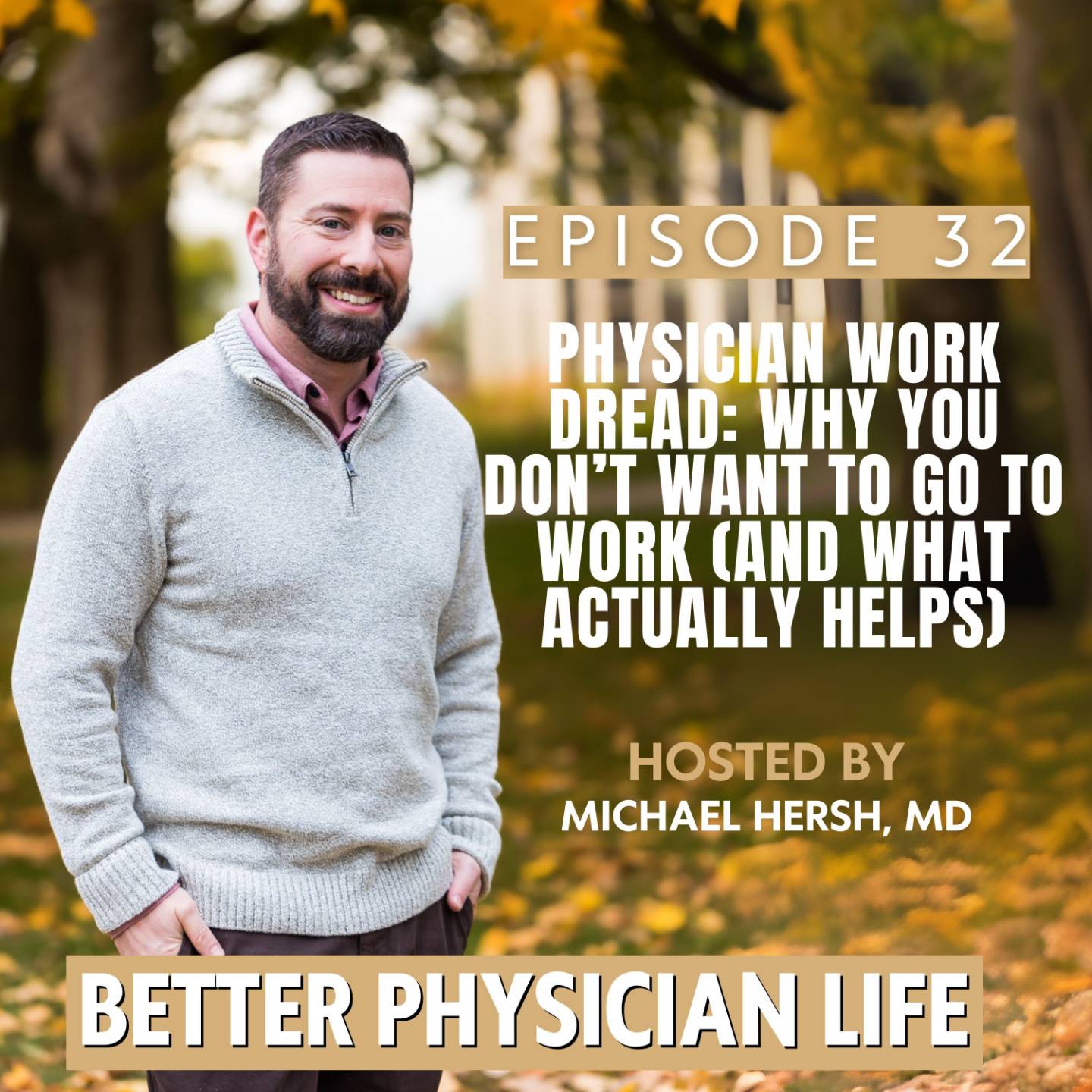
Physician Work Dread: Why You Don’t Want to Go to Work (And What Actually Helps) | Ep32

Do you know that heaviness in your chest on Sunday afternoon, or the moment you sit in the parking lot, unable to get out of the car, even though you're not burned out or ready to quit? What if that 'work dread' isn't telling you to leave medicine, but to look more closely at what's really weighing you down?

In this episode of Better Physician Life, host Dr. Michael Hersh dives into "work dread", the chest-tightening resistance, parking-lot hesitation, and mental preoccupation that hits before patients arrive or the week begins. Drawing from his own years of dreading Mondays, sitting in the car scrolling, and fantasizing about retirement as escape, he explains why this feeling is so common for physicians and rarely means you need to blow up your career.

Instead of vague dread signaling "something's wrong with me or my job," it's often information about specific frustrations buried under administrative burdens, inefficiencies, and the habit of delaying relief. Dr. Hersh shares how naming the exact triggers (overwhelm, skipped meals, dreaded tasks) shrinks the feeling, opens small solvable shifts, like insisting on a lunch break, and helps separate real annoyances from the story that "life only gets better once this is over." 

He introduces the free Five Minute Commute Reset, a guided audio and worksheet to interrupt automatic bracing and create space before/after work. This episode is for any physician who's physically present but mentally already dreading the next shift, offering clarity, compassion, and practical steps without forcing positivity or major life changes.


Free 5-Minute Commute Reset for Physicians:  betterphysicianlife.com/commutereset

Watch on YouTube
Listen on Apple
Listen on Spotify

About the Show:

Created for physicians who want more than clinical competence, Better Physician Life is a space for honest reflection, reinvention, and reclaiming purpose beyond the pager.

Hosted by Dr. Michael Hersh, each episode dives into the questions we didn’t learn to ask in training, offering tools and conversations to help you live and lead with intention

Top 3 Takeaways: 

  1. Name It to Tame It: Vague dread feels overwhelming and final—"I don't want to do this anymore"—but getting specific—"What exactly am I dreading today?"—reveals targeted issues like overwhelm, skipped lunch, or frustrating admin tasks. Naming shrinks the heaviness, turns it into solvable problems, and stops it from collapsing the whole job into "the problem."

  2. Stop Arguing with Reality: Physicians are conditioned to delay gratification, "once I get through this phase...", so dread often comes from bracing ahead of time or telling yourself relief is only post-retirement. Reframing work as something to show up for—not just endure—frees mental energy and reduces the weight of unhelpful stories about the day.
  3. Small Shifts Create Big Relief: Push for tiny, realistic changes like scheduling a protected lunch on busy days despite pushback, rather than waiting for the perfect job or exit. These build evidence that you can influence your day without dramatic overhauls, while tools like the Five Minute Commute Reset interrupt the pre-work dread cycle.

Watch Now

 

Video Poster Image

If the parking lot pause, the Sunday afternoon heaviness, or that low-grade resistance before work sounds familiar, you’re not alone.

Most physicians deal with this longer than they need to.

One physician coaching session can help you get clear on what your dread is actually about, what’s worth adjusting (and what isn’t), so it doesn’t spill into the rest of your day. Use the link below to schedule a call with me. 

Book A Call
DOWNLOAD TRANSCRIPT


Physician Work Dread: Why You Don’t Want to Go to Work (And What Actually Helps) | Ep32

Michael Hersh, MD

[00:00:00] 

Work dread. You know the feeling, even if you've never had a name for it, that heaviness in your chest, the tightness in your stomach, that quiet resistance when you realize the workday is coming. Or even worse, the work week. Sometimes it shows up on Sunday afternoon. Right when you're supposed to be enjoying time with your family.

Other times, it waits until you hit the parking lot at work. You're literally there, but you can't muster the energy or the motivation to even get out of your car. You sit. You finish the podcast. You scroll on your phone. You give yourself a few more minutes before you commit to starting your day. It's not that you don't care. It's definitely not that you're lazy. It's just that part of you doesn't wanna do this again.

If that sounds familiar, you're definitely not alone, and [00:01:00] that's what we're talking about today.

Well, hey everyone, and welcome back to the Better Physician Life Podcast. Thank you so much for being here today. Okay, so today we're talking about physician work dread. It's not necessarily burnout or hating medicine or wanting to quit, just that feeling of dread that shows up while you anticipate the work that's waiting for you.

The resistance. The heaviness. The weight of the workday, and it all happens before the first patient even walks through the door. Work dread is incredibly common for doctors, and most of us completely misunderstand what that dread is trying to tell us. Most of us assume it means something is wrong with us, with our jobs, with our career choices.

But most of the time, it's not a sign that you [00:02:00] need to blow up your life. It's a sign that you need to look a little closer at exactly what's going on. I know this because I spent years living this exact life. I didn't get it at all. I wasted my Sundays, dreading Monday. I was physically home, but my mind was already in clinic, managing the barrage of patients and portal messages, and all the demands of my time, my effort, and my energy.

I was physically present with my family, but mentally running through the week ahead, the patience, the schedule, the charting, the things I didn't want to deal with. Some mornings I'd get to work, park the car, and just sit there, not necessarily exhausted or panicked, just resisting all of it. At the time, I didn't call it work dread.

I just [00:03:00] assumed it meant I needed out. So I started daydreaming about retirement as this sort of fantasy of what life might look like when medicine wasn't there anymore. I'd imagine a quiet beach somewhere. There was a hammock and a pina colada. No prior authorizations, no patient satisfaction scores. No peer-to-peers, no in-basket messages.

Just space and stillness and relief. And for a while, that fantasy felt like the only thing keeping me going. Like, if I could just get out, everything would finally be okay. What I didn't realize at the time was that this was actually making things worse because the more I focused on getting out, the harder it was to be all in at work.

The more I daydreamed about retirement, the heavier my work days [00:04:00] felt. Not because the work itself had changed, but because I was telling myself over and over again that life would only feel better once this part was over. And when you start living that way, every day turns into something you just have to get through, not something you get to show up for.

I didn't see it as a story I was telling myself. It just felt true. Work became the problem, retirement became the solution. And once I framed it that way, dread made perfect sense. That's the conditioning medicine trains us to delay relief, to push through to tolerate discomfort. Now for payoff later, college medical school, residency, fellowship, attending life.

It's always, once I get through this, it'll be better, and sometimes it is, but [00:05:00] frequently the finish line just keeps moving. And over time, our nervous systems adapt to that pace. The constant motion starts to feel normal. Pressure starts to feel familiar. So when things finally slow down on a Sunday afternoon or in the quiet before a workday, you just can't relax.

Your body is scanning, bracing, preparing, and if your brain is still waiting for the moment when things finally feel good, the dread is just what makes sense. Of course, you don't wanna start another day if you believe the good part is always somewhere else. And what shifted for me wasn't quitting medicine.

It wasn't finding the perfect job. It was recognizing that I was arguing with reality. Every single day, as my first physician coach explained to me, I was punching myself in the face and then complaining that it hurt. [00:06:00] Yeah, that one really stung because I was focusing almost exclusively on the parts of my work that frustrated me.

The prior authorizations, the inefficiencies, the interruptions, the lack of time to eat or even use the bathroom. And every time I did that, I reinforced the story that this day was something to get through, not something to be in. That doesn't mean that those frustrations weren't real. They were, and guess what?

They still are. But most physicians I know don't actually hate working. We don't despise being doctors. We don't dislike helping people, solving problems, or being needed. We love challenging, meaningful work, and we love doing hard things that actually matter. What wears us down isn't effort. It's the weight of the work.

When the meaning starts [00:07:00] getting buried underneath all the frustrating tasks we prefer not to be doing. When enough of your day is spent there, your brain starts to label the whole thing as the problem. Not because it's true, but because it's easier than sorting through the different parts. So dread shows up as kind of a shortcut, a signal that something feels off without any detail attached.

And if you don't slow down enough to get specific, it all collapses into one thought. I don't want to do this anymore. But that thought doesn't mean you need to leave medicine. Most of the time, it means there are parts of your day that need to be seen a little more clearly. For me, that's where things actually started to change, not when I tried to feel better about work, not when I forced myself to be more positive, but when I started asking better questions like, what exactly am I dreading [00:08:00] today?

And questions like that started to shift everything way more than I expected. Because when I slowed down enough to ask, the dread stopped feeling so big, so overwhelming, and so final. It wasn't that I dreaded the entire day or the entire job. It was usually one or two very specific things. Sometimes it was overwhelm, too much coming at me at once.

Too many loose ends, not enough space to catch my breath. Other times, it was frustration. Something I knew wasn't gonna go smoothly, a conversation. I didn't want to have a task that felt completely opposite to the work I actually cared about. And sometimes it was simpler than that. Sometimes it was hunger, knowing I didn't even have 10 minutes to eat lunch on a busy procedure day. And once I could see it, once I could name those things very specifically. [00:09:00] Something shifted. Not because the problems disappeared, but because it stopped being vague, it stopped feeling out of my control. When your dread is vague, it feels heavy and big, and when you can get very specific with your dread, it feels like a problem you get to solve when you know what you're actually reacting to.

You have more options, not necessarily big dramatic options. Frequently, it's just a small shift that changes everything. And for me, one of those shifts was scheduling lunch on busy procedure days. I realized I wasn't dreading the work itself. I was dreading the fact that I wasn't even gonna have 10 minutes to eat.

So I insisted on one small change. I requested adding a 30-minute lunch break into those days to eat and to catch up with myself. And I'll add [00:10:00] here that I received a ton of administrative pushback on this request. Comments about patient flow and staff breaks and how it wasn't gonna work, but it meant enough to me to keep pushing, and eventually I got what I needed.

That lunch break didn't fix everything, but it took a surprising amount of weight off of my day, and it also showed me something important. Once I started getting really specific, those small shifts started to change other parts of my day too. Sometimes it meant adjusting my expectations for how the day was gonna go.

Sometimes it meant deciding how much energy I was willing to give something. Sometimes it meant accepting that part of my day was gonna feel uncomfortable or frustrating, and just letting that be okay. And sometimes, honestly, it just meant noticing. This is the part I don't like without turning that into a story about my job or my [00:11:00] work.

None of this makes work perfect. It certainly does not make all of the frustrations go away, but it helped me see something I hadn't noticed before. My dread wasn't coming from the work itself. It was coming from how much of my day was getting decided before it even started. I was bracing for things that hadn't even happened yet, and that's incredibly common for doctors.

The heaviness doesn't wait until the day is already underway. It shows up ahead of time. And so if that is something that you noticed for you, I created the 5-minute Commute Reset for physicians. Not to fix your job, not to make you feel better about medicine, just to help you stop carrying the whole day with you before it even starts or after it's already over.

It's a short five-minute guided audio and a simple worksheet, a way to interrupt that automatic bracing and [00:12:00] clear some space before you walk into work, or through the door at home. It's just a small intentional pause built into a part of your day that already exists, not perfectly, just consistently.

And you can download it for free at betterphysicianlife.com/commutereset . And I'll link it in the show notes. So let's come back to where we started work. Dread that heaviness before the day begins. The pause in the parking lot, the resistance that shows up before you've even opened the door.

It doesn't mean you're not strong enough. It doesn't mean you chose wrong, and it definitely doesn't mean you need to escape your life. Most of the time, it means you've been carrying too much for too long without any real pause, and that's not something to judge. It's something you can work with. You don't have to love every part of medicine.

You don't have to eliminate every frustration, and you don't have to [00:13:00] wait for retirement to feel okay. You can feel resistance and still do meaningful work. You can feel frustrated and still care deeply about your patients. Those things can exist at the same time. It's not either or work dread isn't a verdict. It's information. Something worth paying attention to, not something you need to outrun. 

Thank you so much for listening, and I'll see you next time on the Better Physician Life Podcast.


Previous Episode
Next Episode