FULL EPISODE TRANSCRIPT
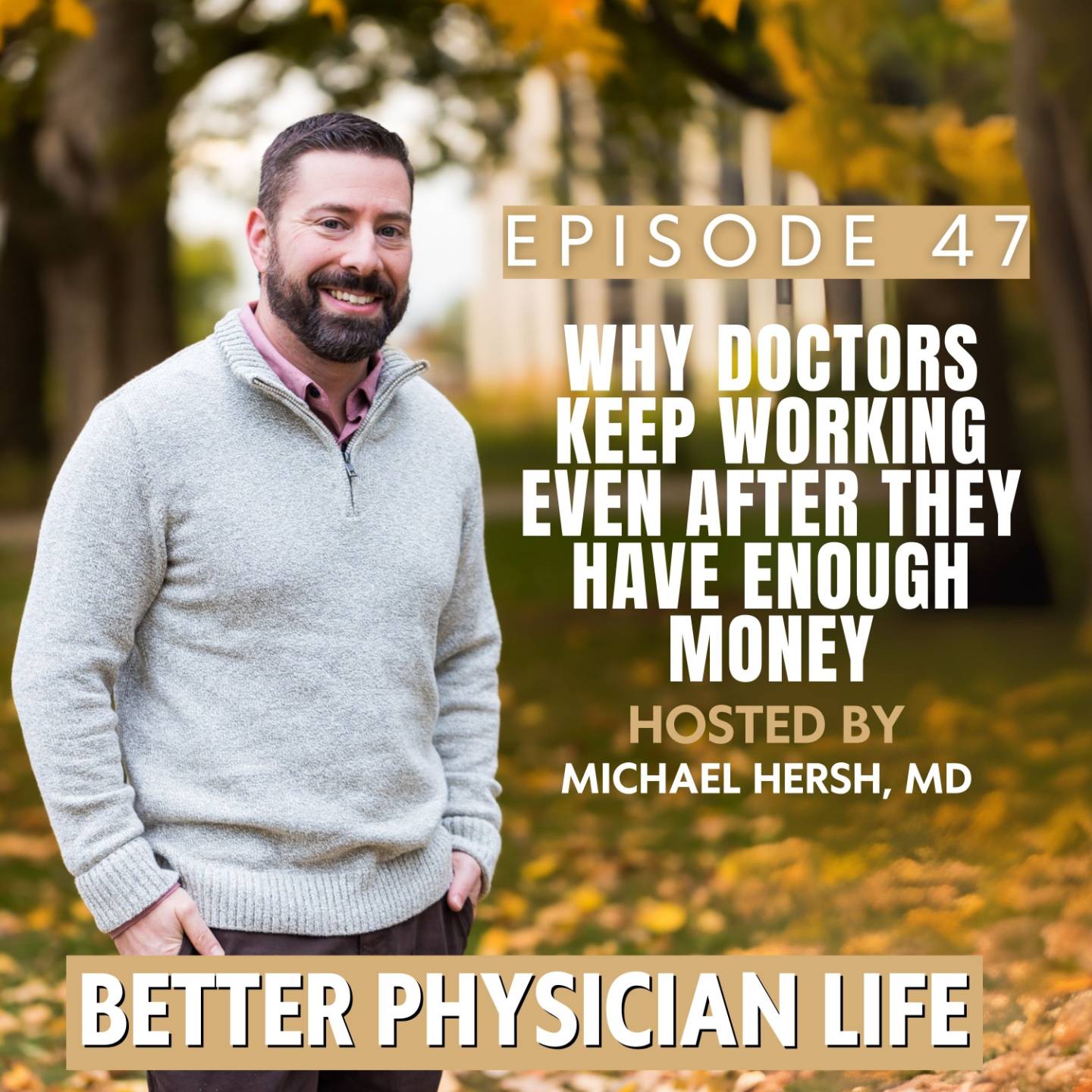
Why Doctors Keep Working Even After They Have Enough Money | Ep47
On this episode of the Better Physician Life Podcast, Dr. Michael Hersh explores the hidden transition many physicians face mid-career. Inspired by Arthur C. Brooks's From Strength to Strength, this episode unpacks why achievement can stop feeling fulfilling, the shift from fluid to crystallized intelligence, and how to rethink purpose, relationships, and career direction in the second half of life.
You log into your retirement account on a random Tuesday night. The kids are in bed, the house is quiet. The day is finally settling down. The numbers, they look pretty good. The student loans are getting paid down or gone. Retirement accounts are larger than they used to be despite whatever happens to be happening in the market that week.
The financial plan you've been building, is actually working. And for a moment you think: If things keep going like this, I might actually have enough, and then a second thought shows up right behind it. If I'm already on track, why am I still working this hard?
Why am I still picking up extra shifts? Still saying yes when they ask for extra help. Still letting my clinic schedule expand whenever access becomes an issue. Still organizing my entire life around maximizing my income. And maybe the most uncomfortable question: If I'm not careful, will I just keep working like this indefinitely?
Because continuing is easy, adjusting is much harder,
Well, hey everyone, and welcome back to another episode of the Better Physician Life Podcast. Thank you so much for being here today. So in the last episode, I started something a little different, a short series on a couple of books that really changed how I think about life as a physician.
Now we're not talking about medical textbooks. These are books about work, time, money, and some of the questions that show up after you've been in medicine for a while, but that we don't always talk about. Questions about how long to keep pushing, questions about what enough actually looks like, questions about what the work is for once your finances start to settle in a bit and you're not just trying to catch up anymore.
So the book I wanna talk about today is Die With Zero by Bill Perkins. Now that title can sound a little extreme if you take it literally. This book is not arguing that physicians should suddenly start spending aggressively or abandon all financial discipline.
What it does highlight is something many physicians eventually notice, but do not always stop to look at. So at some point, the financial plan we are putting in place starts to work. Your accounts are on autopilot. The retirement projections start to look a little reassuring. But your work schedule looks exactly the same.
The clinic template is still just as full. The inbox is full, the call schedule is full, and the pressure to produce hasn't really budged, even though the financial urgency is starting to ease up a little bit. And something about that starts to feel a little off because frequently the pace doesn't change even when the math starts to look better.
So what Die With Zero looks at is something simple, but again, it's something that's very easy to overlook. Money is not the only thing that changes over the course of our careers. Time changes and our health changes, and those variables do not move in the same direction or even at the same pace.
Money can compound and build over time. Time cannot, health cannot. Once a season of life passes, it doesn't usually come back later when our schedules finally free up a little bit. Now, physicians understand delayed gratification better than most professions. We literally spend our entire twenties in training.
We accept delayed income, we accept delayed autonomy. We accept delayed flexibility because we expect those things will arrive later. And eventually they do. Our incomes eventually catch up, but time and health do not catch up in the same way. And sometimes the habits we build during the years of financial pressure continue even after the pressure is no longer what it used to be.
So in medicine, we become very good at continuing, continuing the same clinic schedule, continuing the same number of shifts, continuing the same call frequency, continuing the same productivity targets. You see this when physicians keep trying to increase their RVUs long after their retirement projections already look secure, when additional patient slots keep getting added because access is tight.
Even when the schedule is already packed, you see it when someone checks their net worth, feels briefly reassured, and then opens the productivity dashboard the next morning and feels the pressure all over again. You see it when the inbox volume becomes the metronome of the day, when finishing notes before dinner feels like an accomplishment, when the clinic schedule expands by one patient slot and then stays that way forever.
Now, the system rarely tells us to slow down because access is always needed. Coverage is always needed. The inbox is always waiting. And because we are trained to be responsible, continuing often feels like the safer decision. It's the safer financial decision, the safer professional decision, the safer reputational decision.
But something subtle starts to happen once that financial plan begins to work, the additional income starts to matter less than it used to. While the time required to earn it starts to feel a lot more expensive. The extra shift is no longer coming from excess capacity. It's coming from somewhere else.
Sometimes it comes from free time that used to feel protected, a Saturday that used to feel open, a free evening that used to feel like time off, a vacation that becomes shorter than you wanted, or maybe even easier to cancel. Sometimes it comes from noticing things take a little longer than they used to.
Finishing clinic and realizing the notes take longer than expected. Opening the inbox after dinner and noticing the messages take more effort than they did five years ago. Looking at the calendar and realizing the next truly unscheduled stretch of time is a lot further away than you thought. It doesn't always feel like a big deal in the moment.
It just feels like the normal progression of a busy career, but something else is changing at the same time. Earlier in our careers, working more clearly improved financial stability; the extra shift mattered. The additional clinic sessions mattered, the RVUs mattered, but later the connection becomes less obvious.
The cost of continuing starts to show up in places we don't always notice right away. There are seasons when time is easier to move around and seasons when it isn't. There is a window when your kids want to spend the entire day with you without needing a reason. There's a window when they want to tell you about their day.
There's a window when taking a full week off away from work still feels easy to coordinate. And those windows change gradually and frequently without a lot of notice. Clinic schedules do not automatically adjust when those windows are open. Call schedules do not automatically adjust. Inbox volume does not automatically adjust, so the default pace continues, and sometimes the change only becomes obvious looking backward. Realizing how quickly certain periods of life passed.
Realizing how fully the schedule stayed filled during those same years. Realizing how often continuing to work more felt reasonable at the time. None of those individual decisions feels big or even like a decision at all. They just feel like the right thing to do. It's practical and temporary, but temporary decisions have a way of becoming permanent parts of the schedule.
Because once something is on the calendar, it tends to stay there, and eventually the question starts to change. Not whether working more is possible, but whether continuing to work this way is still necessary, because at some point the main constraint is no longer financial. It becomes whether the schedule leaves space for anything else.
Some parts of life are easier to postpone than others. There is a period of time when your kids want to spend time with you simply because you are there. When being available still feels natural to them. When taking a few days away from work does not require coordinating multiple calendars, and then gradually the schedules become more independent.
School commitments, activities, friends, responsibilities that don't move so easily. Later is still possible, but later is also different. Physicians see some version of this with our patients all the time. Plans postponed until a time that was expected to be more flexible. Trips delayed until retirement, only to find that health issues get in the way.
Experiences deferred until work is less busy. Only to find out that life never really slows down. None of this means something has gone wrong. It's just how time tends to work. Our energy changes, our ability to recover changes, logistics change, priorities change, and most of those changes happen gradually enough that they're easy to underestimate or maybe even completely miss while they're happening.
Especially when work continues to provide clear reinforcement. RVUs accumulate, accounts grow, professional opportunities expand. The signals that encourage our continued effort are so easy to see, but time, time rarely announces itself. It usually just becomes obvious looking backward, realizing how quickly a particular phase of family life just moved.
Realizing how consistently the schedule stayed filled during those same years, realizing how often continuing to work more felt completely reasonable at the time. Because it usually did feel reasonable. It's how we are trained. Be available, be reliable, be responsible, keep things moving. And those instincts build strong careers.
They create stability and security, but they can make it easy to assume that time will be there when we're ready for it. And that assumption is not always accurate. Eventually, the question becomes a little different, not simply how much is enough. But enough for what? Enough to stop needing every additional shift.
Enough to allow some time to stay protected for life outside of work. Because continuing to add more work eventually leaves less room for other things that also matter. Time with family, time with friends, time to travel while you still have the energy. Time that is not organized entirely around clinic schedules and inbox volume.
Most physicians are not looking to stop working. They're looking for more control over how their time is spent, more ability to decide when to take on more and when to leave things as they are. Changing that schedule is not always simple. There are coverage expectations, patient access expectations, call responsibility, partner expectations, unspoken assumptions about availability, and very little guidance on how to adjust all of this when the urgency to maximize income is no longer the same.
So, many physicians just continue working at a pace that once made perfect sense without fully evaluating whether that pace is still necessary now. Medicine rarely creates a natural point where you are expected to step back and ask these questions, and without a clear reason to reassess, continuing is usually the default. Part of what makes this difficult is the assumption that time will be just as flexible later, that most things can simply be shifted forward to a future season that feels less busy.
But one of the observations in Die With Zero is that life unfolds across decades that are not interchangeable. There are periods when certain experiences are easier. And periods where those same experiences require a lot more effort. More coordination or more energy than we expected. Travel feels different at different ages.
Schedules feel different at different stages of family life. Energy feels different across different decades of a career. None of this is surprising. Physicians see these changes in our patients every day. The 85-year-old version of life is not simply the 65-year-old version with more free time. Capacity changes, priorities change, constraints change, and yet many physicians plan as if most of these experiences can simply be shifted later without much consequence.
Work now, time later, effort now, life later. That approach makes sense during training. It makes sense early in a career when financial stability is still developing, but sometimes the pattern continues way longer than it needs to because continuing feels responsible, continuing feels productive, continuing feels familiar.
And often, nothing forces the question of whether the timing of work still matches the timing of life. Because medicine rewards consistency, but the same consistency that builds a strong career can also make it harder to notice when the pace no longer needs to be quite as high, when working more no longer meaningfully changes the long-term projections, but still takes the same time.
And still takes the same energy. This doesn't mean something drastic has to happen. Most physicians are not trying to stop working. They are trying to understand how hard they actually need to keep pushing. What pace still makes sense now? What pace simply carried over from an earlier phase of the career. And which trade-offs may simply be continuing out of habit? Because the goal is not simply to accumulate the largest possible account balance.
The goal is to reach later decades of life with financial stability and a life full of lived experiences, time with family, time with friends, experiences that become shared memories, conversations that only happen because there was space for them to happen. Physicians understand compounding better than most.
Small, consistent actions produce meaningful long-term effects. Experiences accumulate in a similar way, not financially, but personally in our relationships and how they develop over time. A week spent fully present with family does not just exist for that week. It continues to show up in conversations later as jokes, and stories, and laughter.
The same is true in the opposite direction. Periods of life that were consistently crowded by work often feel that way looking back. Years pass either way. Work continues either way. The question is not whether work matters because it does. The question is, how much of each season of life did you give yourself a chance to experience outside of work?
Because eventually the metrics stop mattering. The RVU totals stop changing. The reports stop coming, but how those years were lived is already set. And those years are shaped not only by financial stability, but by how time was actually spent. While health and energy were still good by whether there was space for relationships to develop outside of work, by whether you lived every moment to the fullest.
By whether your time felt like it was actually yours. If this is something you have been thinking about recently, you are not alone. Many physicians reach this stage at some point in their career, often while everything still looks good on paper, the income is strong, the trajectory is strong, the plan is working, but the question of pace becomes less obvious than it once was.
Because money can continue to accumulate indefinitely, but the time available to spend with the people who matter most does not accumulate in the same way. And our health does not accumulate in the same way. And many physicians eventually begin to notice that continuing to push for more income does not always meaningfully change the long-term financial picture.
But it can reduce our time with family during years when that time is still easy to spend together. Years when your kids still want to spend time with you. Years when being together is still relatively easy to arrange, years when you still have the energy to do all the things. Those years do not last. Now, if it would be helpful for you to think through your own situation, like how hard you actually need to keep pushing and how much additional work truly changes the long-term picture.
I work with physicians one-to-one on exactly these decisions, and you can learn more at betterphysicianlife.com . Because once the financial plan is working, the question often shifts from how much more you can earn to whether the current pace is allowing you to use the years that matter most in the way you actually want to use them.
Thank you so much for being here today and I will see you next time on the Better Physician Life Podcast.