FULL EPISODE TRANSCRIPT
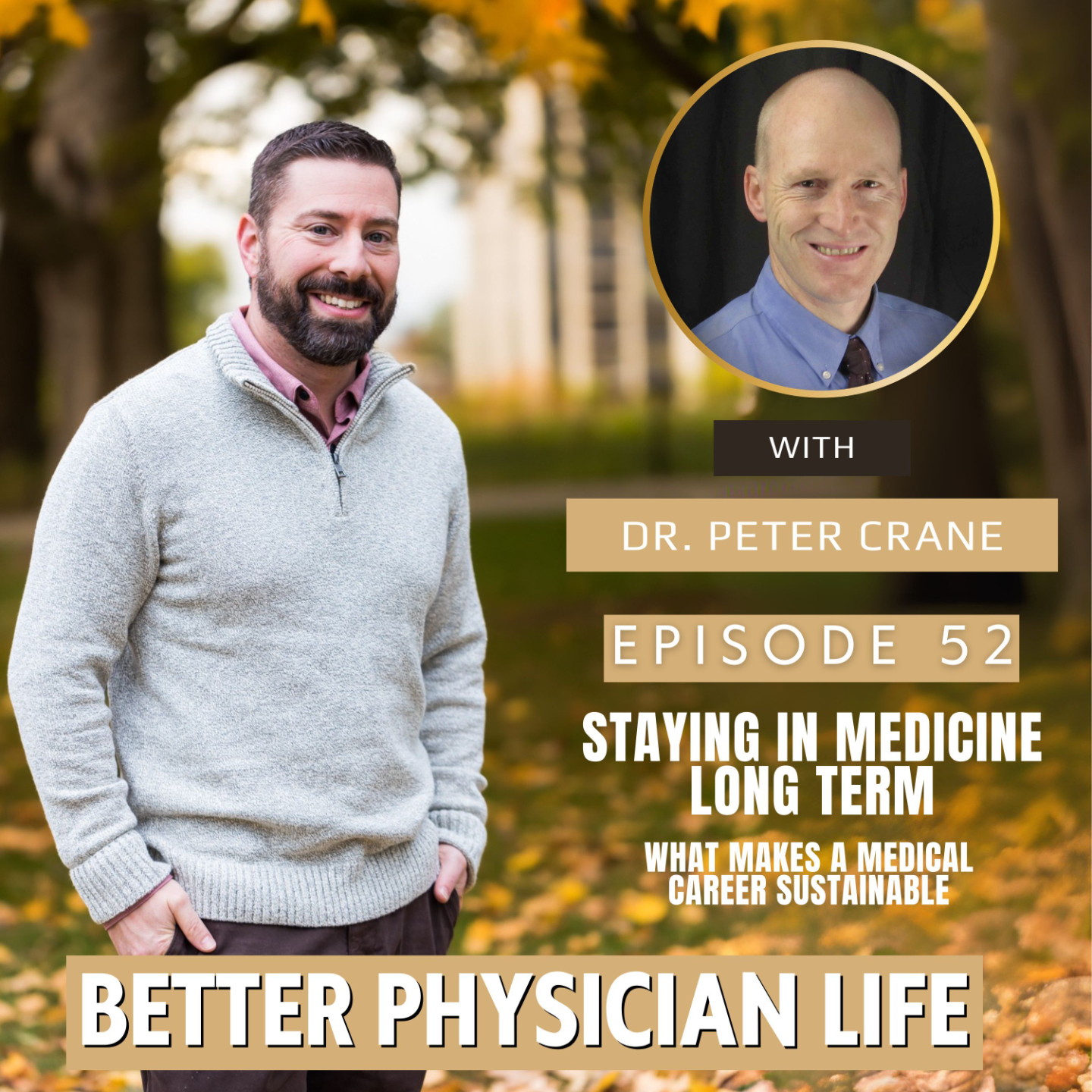
Staying in Medicine Long Term: What Makes a Medical Career Sustainable with Dr. Peter Crane | Ep52
Dr. Michael Hersh sits with Dr. Peter Crane to explore how a life-changing cancer diagnosis reshaped one physician’s relationship with medicine, the power of gratitude, and practical strategies for building a sustainable, joyful career in healthcare.
Most physicians don't spend much time thinking about the meaning of the work. We're busy. Clinic is full. The inbox keeps refilling. There's always another result to review or another patient waiting, and we just kinda keep moving through the day. But when something forces you to experience medicine from the other side of the chart, it can completely change what feels important, what matters, and maybe more importantly, what doesn't. And whether the way you've been practicing now is something you'd actually choose again.
Well, hey, everyone, and welcome to another episode of the Better Physician Life podcast. Thank you so much for being here today. Now, I'm really happy to be joined by Dr. Peter Crane today. Peter is a family physician practicing full-spectrum care in rural Idaho, where he has spent years working across clinics, hospitals, and emergency settings.
He is also living with metastatic cancer, which has completely changed how he thinks about what makes a medical career sustainable. Peter hosts the Doctors Making a Difference podcast, where he talks with physicians who are finding ways to keep medicine workable, whether that's through leadership, entrepreneurship, advocacy, or reshaping how they practice.
Peter, welcome to the show.
Thank you so much for having me. I'm delighted to be here and join you on your excellent podcast. I'm actually a fan and have enjoyed listening to your podcast as well, so I feel pretty honored to be here.
That means so much to me. Thank you so much for saying that. Your story is incredible.
I'd love for you to start by just telling us a little bit about how you got here and how you decided to focus on doctors making a difference.
So I guess I'll try to make it a long story short, but I guess just imagine for a second, you can kind of put yourself in my shoes. I had just had my birthday.
I turned 43, and my wife and I had gone on a trip with some of her family to Italy, and so we came back, and it was great. I'd had just a teeny bit of swelling in my legs after the long flight, and I thought, "Well, that's weird. I don't usually get swelling in my legs." And you know, but I had been feeling well.
I'd been exercising and running and doing all the things. I'd lost about 10 pounds that year, thinking like, "All right, this is great. Just remain healthy and just turned 43, and this is gonna be great, a great decade of life." And anyway, I was jet lagged, laying in bed one morning about 4:30, you know, just wide awake 'cause I was on the wrong time zone back home, and I had my hand on my stomach for some reason.
I don't know why I hadn't ever bothered to feel my own stomach, but you know, we palpate a lot of abdomens in medicine, but I just never palpated my own, I guess. So I felt a large mass on the left side of my abdomen. That was it. I'm like laying there in the dark in bed, like, "What's that? Is my spleen enlarged or something?"
It sounds crazy, but true. But I had been feeling well, but I was concerned enough about it that when I got to work, I pulled my practice partner aside and said, "Hey, do you have a second?" So I went in and had him do an exam and look at it. And he was concerned, so we did a CT scan.
I mean, I can tell this now because it's been a couple of years, and it's been about three years since this, and it's still kind of surreal. But as I initially saw the scan, and it looked like there was something abnormal, like a big mass on the left side of my abdomen.
But I was scheduled to work in the ER that night, and I just had glanced at it like, "Oh no, there's something there." But I'm like, "Well, I've gotta go back to work," 'cause we're doctors, right? We just show up and work. And so I did, and I was seeing patients. And anyway, I pulled up the PAC system to view another patient's stuff.
And there, lo and behold, was my full scan and the interpretation of the scan, and it said, "26 centimeter likely sarcoma." And it was a bad moment. Like, I was still working in the ER shift. I just couldn't resist clicking that button to look at my own report, and that was a life-changing moment that evening to realize, like, wow, not only is there a mass of some kind, it was huge, and it occupied the entire left side of my abdomen, and the radiologist thought it was a sarcoma.
So I don't know. That was the beginning of the story. Do you have any questions so far there?
I'll just say I can't even imagine. There have been so many times where I've run through these worst-case scenarios. You feel something, you make a big deal about it in your head, and then it turns out to be nothing, and I just will say I can't even imagine what that felt like.
And the fact that you're at work and you just have to keep going, what did you do?
I didn't know what to do. Like, you know, we're doctors, right? You're supposed to help the patients. And it was really weird. I just felt almost guilty. Like, well, I shouldn't be the one needing help.
I didn't want anybody to know. Like, well, let's just get back to work. I've got this patient that needs to be seen, but in the back of my mind is, "What does this mean? How do I tell my wife? What's gonna happen?" But then I just kind of went back and stitched somebody up or helped, set a fracture or whatever we were doing in the ER that evening, just again and again.
But it was a long night, contemplating my own very serious health problem. I was definitely sicker from a prognostic standpoint than anybody that showed up in the ER that night. And I think we've probably all worked sometimes when we're probably too sick to work, but this was a major mental load.
And I don't know. I just kind of powered through that shift that night. Post call the next morning, tried to process and think a little bit, talked to my wife about it, and it was pretty hard to process 'cause there's so many unknowns. 26-centimeter sarcomas don't usually end well, and I knew that, but there's just a whole pile of uncertainty, and I guess I just never expected something like that at such a young age, you know, relatively speaking.
So you said it's been three years. How did you navigate all of this? I guess that's the one advantage you have as being a doctor, is that we know lots of doctors. So called up my friendly neighborhood oncologist, and I have a friend who's an interventional radiologist. And so we were able to pretty quickly arrange to have an oncology consult and get a biopsy arranged. And so my friend in a town about an hour and a half from where I'm at, 'cause I'm in a rural place.
So I went there, and he did the CT-guided biopsy. actually ultrasound. It was so huge he didn't really need CT. He could see it really easily. He was able to obtain a biopsy, and then I was able to get the results back and, you know, it showed something called solitary fibrous tumor.
And so just for a second, maybe I'll tell what that is. A lot of people may not be familiar with that one. It's a rare type of sarcoma. Most sarcomas are a little bit rare. Solitary fibrous tumor makes up about 1 or 2% of sarcomas. There's about 300 people diagnosed in the United States each year with solitary fibrous tumors, so a rare type of tumor.
But like my surgeon said, we have a very small sample of a very large specimen, so you couldn't really know. And so she suggested that I go through radiation to try to shrink the blood supply and then after kinda healing from the radiation, go through surgery. And Michael, this is kind of important because it frames why I started this podcast and all this stuff. Later, I realized that during those times, like I had to have help and more so than any time in my life, 'cause I realized this could be deadly.
I mean, this is huge. And so I counted on the people, my friends and colleagues, and people I knew, and the other doctors in my network. I mean, I just felt tremendously grateful for those professionals showing up. And I actually went back to, do this big surgery at a cancer center associated with the University of Utah called Huntsman Cancer Hospital.
And the doctor that did the surgery for me was actually our surgery clerkship preceptor when I was in medical school. So it was kind of a full circle moment. I went back to her because I knew she was an excellent surgeon. I'd sent a few patients to her over the years for various things. But I went to her 'cause I trusted her 100%.
And that's how it unfolded. Radiation was terrible. I felt okay, but after six weeks of that, you feel pretty down. But then I was able to recover, and then I had a big, long surgery and lost a lot of blood and did all the things that you go through with surgery and had a long recovery.
And, I'll just tell you, as I was laying there recovering, not knowing what the future held, 'cause you can't know what does this look like on the pathology specimen. I had a nerve injury after the surgery because it arose off the psoas muscle, so it's a big retroperitoneal surgery, and somehow some of the nerves were, at least temporarily, damaged, so I couldn't really walk without a walker without collapsing.
And I was just laying there thinking, "I don't know what comes next in my life." But I just had this profound, let's just call it inspiration. I just like, if I got to do it again, if I really got to go have a job again, I would want to be a doctor. I would want to be a part of this group of healers that dedicate their life and have spent tens of thousands of hours so that when it's your moment of need, you're there.
And I was just so amazed by that. And when you realize it might be taken away from you as a physician, it just felt like, man, this precious thing could be taken away. And I just had this profound sense of gratitude. And so that's when I decided I have got to talk more to doctors and talk about what we do, and not just talk about burnout and how terrible EMRs are and how much insurance is a pain to deal with.
We've got to talk about the tremendous difference that we make with our patients. Anyway, I know I'm waxing on long, but it's a horrible experience. I don't wish it on my worst enemy, but a very deeply moving experience to realize what those doctors had done for me.
Yeah, you make some excellent points. And it's a conversation that you and I have had before because we get so lost in our day-to-day, right? It's so easy to get sucked up into the EMR and the administration issues and insurance and prior authorizations and all of the things that make our days challenging.
And what would 18-year-old me think of 48-year-old me complaining when this was the only thing I ever wanted to do? And as you were just saying, when you can refind the things that inspired you to go into medicine in the first place, it completely transforms how you experience your days.
Yeah. I guess just a renewed sense of what a powerful thing you got to do. And like you said, 18-year-old you thinks like, "Man, those doctors walk on water. They have this amazing skill set. I've yearned to have that." I mean, like I say, kind of this horrible experience to go through, but to realize I wanted to rejoin that group, and I want it to be on my terms.
I wanted to be able to not get so bogged down on all the things that drag us down as a profession, but I wanted to help people. And I spent the next six months doing rehab 'cause I really couldn't walk. My quadricep on my left leg just would not fire. But thankfully, slowly the nerve injury recovered and lots of physical therapy, and I was able to run again.
I can hike, I can run. I still have some unfortunate metastases, so I still have to take chemotherapy and stuff every couple of weeks. But I'm doing okay, and so far it's holding it at bay, and I feel really blessed. I mean, it's really hard, but I feel really blessed to be able to live the life I've been given.
That's amazing, and I speak for everybody when I'm so glad to hear that's how the story went, right? I mean, that's incredible, and I'm very happy. Thank you. How has all of this shaped what you think about sustainability in medicine, right? Like you found this newfound invigoration and love of medicine, but what do you think about sustainability in general for doctors ?
I think that really played into why I was thinking that. It sounds cheesy, corny to be like, "Oh, I wanted to be a doctor if I could do it again," but, like, really, it was just such a profound thought. And specifically, we have to not just talk about the negative. If all we do is talk about negative and everybody leaves medicine to become a real estate investor and yada, yada, you know, people get tired of it, we lose out on a tremendous group of professionals.
And sustainability is everything. If we don't approach medicine with sustainability in mind, then we will get to mid-career and say, "I've gotta do something else," and leave it. But if you can say, "No, I have my financial ducks in a row. I know how to balance the time a little bit so I can be present at work when I'm there, I can be present at home when I'm there," it really does help you to say, "Okay, this is something I can do long-term."
And, you'll certainly be happier and be able to make more money and all the things that you ever wanna do if you can stay in medicine for a longer period of time on your terms, rather than just trying to feel like you're on somebody else's terms and you're just a cog in somebody else's wheel.
So we have to kind of regain and retake our power, otherwise it's not sustainable.
Yeah, I think that's a super important point. I think a lot of physicians just assume that they can keep practicing the same way indefinitely. And for a lot of physicians, you hit a point where you start to be curious about whether or not the current version of your career or your job still fits.
What suggestions do you have for physicians about when is it a good time to take a step back and reassess?
So I think people just need permission. I would say the first seven or eight years, it's a big climb, and you need to find a job that you like, a lot of people kind of change jobs once or twice in that first couple of years to find something that works.
And then really knuckle down and get really good at your profession and lay the groundwork financially. Don't go buy the big house and the boat and the car and all the fancy stuff early on. Spend about eight or 10 years putting your ducks in a row, like I said. I'll tell you when I found that sarcoma, you realize in that moment you'll never qualify for disability insurance ever again, and
That kind of went through my mind. I had thankfully had a personally underwritten disability plan that I had purchased about 10 years prior and just kept paying on it, and in that moment, I'm like, "I'm so thankful for that." I don't know if I'll ever go back to work. It certainly would not replace my income, but it would keep us so that we could continue to live some reasonable lifestyle if we had it.
So I think we have to take stock early on in the career and say, "What can I do so that when I need to make a different choice, I can do it?" I would say somewhere around year 10 or year 12, most people need to do an assessment and say, "Where am I? What does this look like?
You know, like I'm good at my job now, but who has power over me? And I want to be able to regain that so that I am in charge, and I'm coming here because I want to be." And when you approach it saying, "I want to be here. Nobody's making me be here. I love it, and I love my patients." You can find joy in it.
And you can also say no when somebody asks you to do something ridiculous.
I love that, and I live by that. Yeah. You know, to your point, as you were talking about, it's so easy. We were talking earlier about focusing on the negative things, and it really does take some intentionality to sit down and figure out what are the things I actually like about my day?
It's so easy to just, you know, feel like today was a waste and I didn't really do anything, and when we take a moment to step back from the day and really think through, like, "Who were the patients that I saw today? Who did I help? Who were the people that came in because they really needed me today?"
It really does change everything. And so, as you were saying, stepping back and taking a moment to really evaluate what do I like, what don't I like, who are the people that are above me that are sending things down that I need to be doing? What do I enjoy? All of those things it's so important, and most people never take the time to take stock of what their day is.
I think you're exactly right. Like, one of the ways I think about it is if it was my business alone and I got to choose, what I did with my day, is this what I would do? Is this how I would treat this patient? Is this the treatment pathway we would do? Is this the hours I would work?
And like I say, in those first five to eight years, seven, eight years when people really need to pay off some student loans, and you feel like you're just kinda getting your feet under you, it's harder to make these decisions. But as you get to year 12 to 15, almost everybody needs to reevaluate and make a decision.
And like I said earlier, the power to say no to something, and it's not to be obstinate or bad or something like that. It is simply to say, "This is not in the best interest of the patients. It's also not in the best interest of your physicians; therefore, this is not something we're going to do."
And you don't have that financial backing or power maybe early on, but that's really important to gain that because, for me, that allows me to have intentionality. So I'm showing up because I wanna help my patients. I'm showing up because I desire to be here. And if I want to take time off or something, or if I dislike the job and had to leave and find another job, okay.
Permission granted. Do it if you need to. You don't have to stay in something forever if you hate it.
So true. And, you know, the interesting thing about no is that no doesn't just keep the bad out, it keeps the good in. Because when we say yes to things that we don't really wanna do, we're still saying no, it's just, again, when we're saying yes to something we never wanted to do in the first place, the person that we're saying no to is ourselves.
Right. And so it's so important to think, some physicians think when I say no, they're gonna think I'm difficult. They're gonna talk about me as not being a team player. And it's really important to protect ourselves so that we can keep showing up and create sustainable careers .
I don't think anybody knows what's better for patients and doctors than doctors. 'Cause a lot of times the decision-makers in organizations are non-physicians or have never had a clinical role, and they are not there at 2:00 in the morning when somebody's going through something chaotic.
And we all deal with this. I don't care what your specialty is. Everybody gets the 2:00 or 3:00 in the morning patient in a low-resource environment, and you're like, "Okay, this is the one, and we have to take care of it." We need people that oversee the finances and the administration, and I'm not naysaying the importance of having some of that stuff in a hospital administration, but we have to regain that power 'cause physicians need to be in the driver's seat.
And that applies to us personally. You know, how do we maintain our wellbeing and that of our colleagues, but also of the patients? Nobody knows what's better for patients than the direct hands-on caregivers, whether it be nurses, doctors, or people that are directly involved.
Couldn't agree more. When physicians think about longevity in medicine, most of the time their focus goes to reducing hours. Have you found that there are other levers that can matter just as much as reducing hours? You've kind of been hinting at some of them, but I'd love to explore that a little bit more.
I'm sure I don't have it 100% figured out, but I'll tell you a couple of things that have helped me, like I said, I was able to return to medicine, and I consider it a privilege, you know, and an honor to be able to help my patients.
But like I said, the ability to say no is a big one. I feel like that financial, preparation, you know, nobody goes into medicine hopefully to just become wealthy, but you do need to be financially secure so that you can say, "Well, if this job doesn't work and I need to be off for six months," or if you've entered into some sort of ridiculous non-compete contract you need to be able to say, "I can retool. I'll be okay.”
Those are two really important things. And I would say the other one is when it comes to hours, I think it's really important to, once in a while, step back and say, What does my week look like? What do I want it to look like? If you know, what does it look like now?
What does it look like in the future?" And it's not because you want to just to do nothing. I don't think productive people like physicians are gonna be happy just sitting around, just watching the grass grow. But what does it look like? How do I fit in exercise, sleep, and lunch? You know, there's just so many important things that we have to do to care for ourselves, and even just regaining the control over those aspects of our lives, I feel like it really helps me a lot, and I suspect it would help others as well.
Yeah. I know you, and I share lunch as one of those things that is a longevity measure. We've talked about that before. Yeah. About how just introducing a lunch break to my days has made such a difference in how I experience a workday, and I know you shared the same experience as well.
You know, the other one that I've discovered, maybe more recently, is like I've shared, broadly on my podcast, I still have to take chemotherapy. Nobody likes chemotherapy. I take it one week on and one week off. And like again, I feel really blessed. I mean, I'm still able to work.
I've been on it for a year. It seems to be doing the trick. It doesn't get rid of the metastases, but it holds them at bay, and I hope it'll keep working for a long, long time. But with that has come a renewed need to just make sure I have to sleep. I have to get enough hours of sleep. And I don't think that's just because of the medication.
Like all of us, we don't feel well as human beings if we don't get enough sleep. You can do it once or twice, but if it's every night, you're operating on four or five hours of sleep and just running on empty. After a while, you feel like you're just, like almost just like a zombie or a robot going through it, and that's not very fulfilling as a human, much less a physician.
And so it's hard to show up and be a healer to somebody else when you're just running on fumes all the time. So I do think those things are more important than we give them credibility, and it's not part of our training. People don't talk about it. It's like, mission above all. Stay up all night and see the patient through to their utmost.
But we have to regain that control of our schedule and our lives for sure.
Yeah, that definitely speaks to the sustainability. If it's not sustainable for us, then it's becomes even more challenging to stay in our careers now. Absolutely. You have this incredible podcast, "Doctors Making a Difference," where you speak with physicians who are really taking control and shaping how they practice medicine.
Have you noticed any patterns among those doctors about how they're staying engaged in the work long-term?
Oh, yeah. I have loved it. It's just been so fun to meet doctors all over the place, what they're doing. And in each case, the people that I've been able to interview... I mean, we called it "Doctors Making a Difference," and that's what it is.
Like it's not just some like hurrah sort of statement. It's individuals who've said, "I have this unique privilege to be a physician in 2026. I have this unique time of life where I have this fund of knowledge, and I'm put in a position of authority that I can order the tests and I can figure this out on your behalf for a patient, or I can do international medical work, or I can go serve the underserved, or I can start a business, or I can reframe the leadership within my state."
People that have just done incredible things with their skill set. And I still think being a physician is this incredible opportunity to join the ranks of healers. I'm a farm kid. We grew up in a single-wide trailer house. It wasn't like a financially great.
I grew up in a wonderful family. But I think about the privileges that are given to me as a physician to show up and be the voice of reason in a storm when somebody's going through something chaotic, or help them figure out what's going on with their health, or hold their hand when a loved one is dying or delivering a new baby.
I mean, those are incredible, wonderful experiences beyond what I ever imagined as a kid. I knew doctors had a cool job. We do have the most unique, cool job in the world, for sure.
I could not agree more with you. And that doesn't mean that there aren't challenging days. It doesn't mean there aren't frustrations.
And being able to focus on how cool the stuff we do every day is, it really makes such a big difference.
Well, yeah. Think about what you do. It's incredible. Every day you get to do something that is unique. Nobody else around you gets to do it. Sometimes it's unpleasant, and sometimes you have to deal with things that are crazy.
And we take it for routine. We make the emergencies like, "Oh yeah, here comes another person that needs this crazy procedure that nobody else in my area can do, but I can do it." And so it's a position of great privilege, I would say, to be a physician. So we need to honor that. And really, for longevity, like you talked about for sustainability, we have to take care of ourselves, 'cause first and foremost, we signed up to be healers.
If you're gonna be a healer, like I said, you have to be able to show up whole yourself. And if you aren't, boy, like I say, fix it. If you needed permission to fix it, granted, fix it. We need you to stay in medicine. And if you feel broken inside with what you're doing, find a way to fix it.
And it doesn't mean you have to just quit your job today, but retool and recalibrate and say, "I'll bet there's a way that I can get involved and find something that's really meaningful to me." And then, like I think it was Dave Ramsey that quoted this and said, "If you do a really good job, people will give you lots of pictures of George Washington to say thank you." You'll be financially okay.
Absolutely. Yeah, and I love that. Here we are giving you permission to fix it, to figure it out, to be intentional, to be happy, to enjoy your careers, because we all worked so hard to be here, so why not enjoy it?
Absolutely.
This has been amazing. I love chatting with you. Please tell everybody where they can hear more of Dr. Peter Crane.
I'd be honored if you would listen to the podcast. It's "Doctors Making a Difference." You can search it on any podcast player, or there's a YouTube channel that goes along with it. There's a website: doctorsmakingadifference.com.
So please tune in. Check it out. If you feel like you're someone that is part of that, or do you know someone that is really impacting your life, get ahold of me. send an email. Go to the website. Send an email to me, and I'd love to meet them. I think it's really important to highlight people that are doing amazing stuff.
Couldn't agree more. Dr. Peter Crane, Doctors Making a Difference. Thank you so much for being here today. To the audience, thank you so much for listening, and I'll see you on the next episode of the Better Physician Life podcast. Take care.