FULL EPISODE TRANSCRIPT
Why Soft Skills Are Not Soft: The Hidden Foundation of High-Performing Teams | Ep53
Dr. Michael Hersh and Dr. Kemia Sarraf explore why trust, psychological safety, and connection are not soft skills but essential foundations for high-performing teams, resilient leaders, and sustainable careers in medicine.
You've probably been in this room before. Everyone is smart, everyone is capable, everyone knows their job, and somehow the team still doesn't really work. People hold back. They don't ask the obvious question. They don't say what they're worried about. They don't challenge the plan even when something feels off.
A lot of people would call that a soft skills problem, but trust, safety, and connection are not soft. They're often the difference between a team that looks good on paper and a team that can actually handle pressure. Today, Dr. Kemia Sarraf and I are talking about why these so-called soft skills are not soft at all.
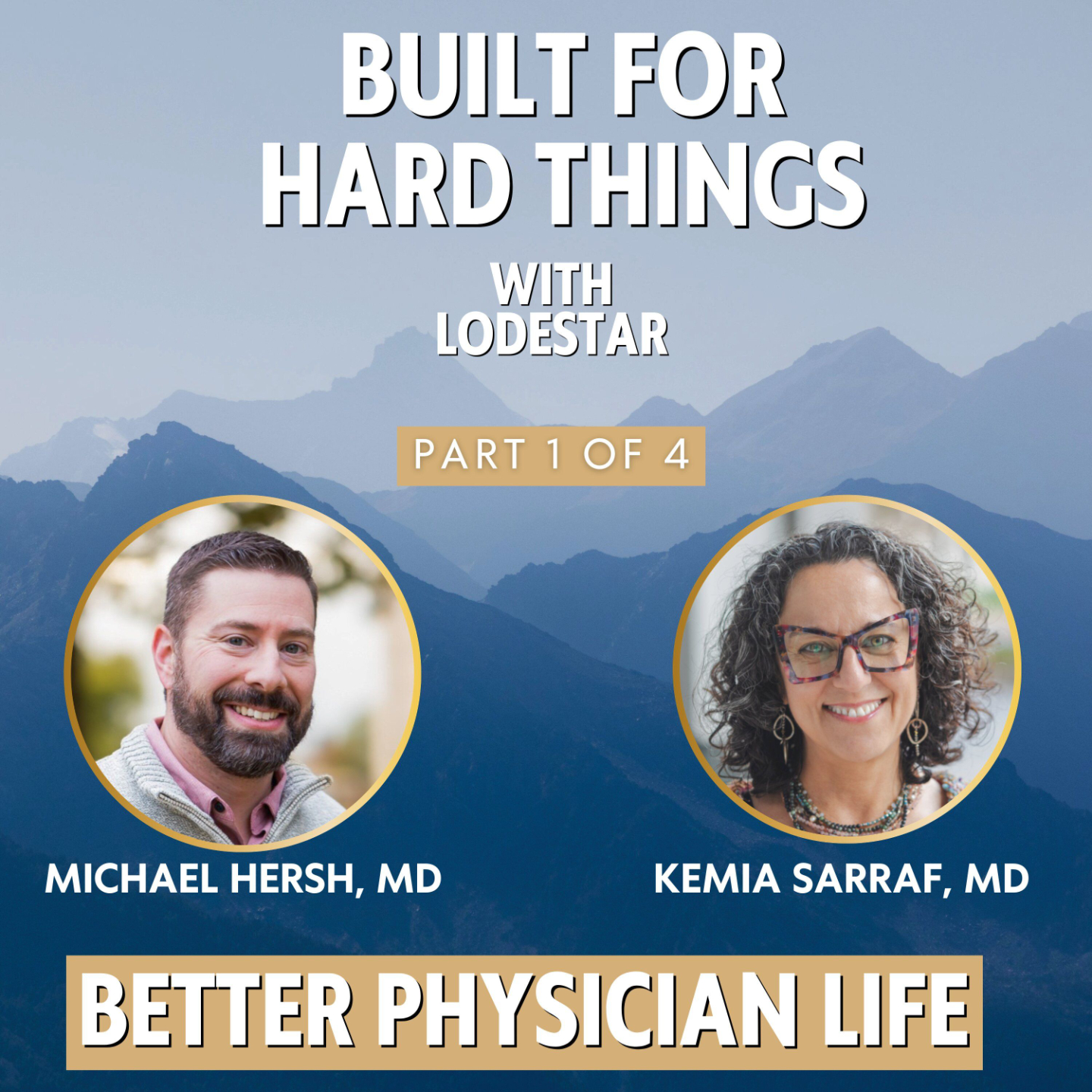
Well, hey everyone, and welcome to another episode of the Better Physician Life podcast. Thank you so much for being here today. So I'm really excited for this one. This is the first episode in a four-part series with Dr. Kemia Sarraf. Kemia is a board-certified internal medicine physician and the founder of Lodestar Consulting and Executive Coaching.
Her work focuses on physicians, leaders, teams, and organizations, and how people can do hard, meaningful work without losing themselves or each other in the process. Kemia was also the very first guest on the Better Physician Life podcast, which makes this feel like a really fun full-circle moment. And in addition to my work through Better Physician Life, I also serve as senior faculty at Lodestar.
So I've had the chance to see this work from a few different angles, as a physician, as a coach, and as someone who cares a lot about how we build healthier teams and healthier lives. Over these four episodes, Kemia and I are gonna talk about some of the things that sit underneath burnout, leadership, team culture, and the way people show up when the pressure is high.
Today, we're starting with something that often gets dismissed as soft skills, but trust, safety, and connection are not extra. They're not just nice things to have if there's time left over. They're an essential part of how good teams do hard things. And because Kemia thinks about this through the lens of medicine, leadership, trauma responsiveness, and neurobiology, she is exactly the person I wanna have this conversation with.
Now, after that really long introduction, Kemia, welcome back to the podcast.
Oh, Michael, I am so excited to be here with you. And you know, you left off the most important thing of the work that we do together, which is we also are friends.
Most importantly.
We'll caveat for the audience that we may get a little goofy here as we go through this, because we've been working together for quite a while now. and, the respect is high, the trust is high, right? And the friendship is foundational. So thanks for having me back.
Oh, I'm so glad to have you here.
And yes, we probably spent more time chatting before we hit the record than we will spend recording this episode, which is amazing.
I noticed exactly the same thing. But you know what? That is the perfect intro, actually, because that's the stuff. The chatting before, the getting to know each other, the small things that we do consistently every single time, that allow the trust to build over time, that allows the safety to be created over time, that helps us to understand and correctly read, and then interpret cues rather than misread and misinterpret cues.
And so that actually is the foundational stuff for everything else that happens. And I heard you say, these aren't nice to have, these aren't afterthoughts. And culturally, if you look at what we've built together in Lodestar, right? you, me, and the larger team, right? Cause we've got 40 faculty, right?
When we look at what's been created there, that's always first. We never open a meeting without that first. We never open a session or a presentation or anything that we're doing without going there first. It's not an afterthought. It's not nice to have. It is the essential.
Absolutely, completely agree.
But it's interesting how people do think of these as soft skills, right? Like, people sometimes will completely dismiss these things as, you know, “trust and safety, yeah, if we have time” ... you know, but we have this agenda, and we have to work on these things. Why do you think that happens?
What do you think those people are missing?
Well, I think it's a lot of things all at the same time. I think some of this is just the tyranny of the urgent. We have so many things coming at us so many things happening that it is very easy, even for me, it is very easy to fall back to, I really don't have time for anything but the doing of the thing right now.
And we forget that the relational component of everything we do is part of doing the thing. Well, I was gonna say I'm not sure that there's anywhere that this is more true than in medicine, but that's just a lie, right? Because it's actually also equally true in the practice of law.
It's in public service, in law enforcement, it really is in everything. So I think that's one reason. I think that the urgency of everything makes it easy to deprioritize the things that don't actively look like they're on fire. My relationship with Michael doesn't look like it's actively on fire, right?
Our collegialness is fine, let's just skip it and move to the thing.
The challenge is that in the same way that we talk about relationships and consistency being the small things done consistently over time, right? That builds that safety, that builds that trust, that allows for things to evolve in a way that is healthy and sustainable. When you remove those consistently, slowly over time, there's this erosion.
So I don't think that anyone in any industry wakes up and says, "Well, we're done with the relational aspect of our company." What happens is there's this drift, and we've had a long stretch of a lot of drift. That's a piece of it. I think the other thing is equally, if not more true, and probably more sort of insidiously in the back of our brains, which is that term you used that I absolutely revile, soft, right?
These are soft skills. And I've been thinking about this for a while. Like, first of all, who came up with that idea of building safety, building trust, building relationships as soft? I don't know, I haven't actually researched it, but someone at some point labeled the interpersonal components of this, the safety building components, the trust building components as soft.
And when you do something like that, you relegate it just with the words themselves, you relegate it into less important.
I can think of a lot of reasons that would've been done.
None of them are very kind. So I'll leave that alone for the moment. But here is what the data actually say, right? Data on high-performing teams, and this is qualitative data, this is quantitative data- this is Google's data, right? Project Aristotle data. So you're talking about tens and tens of thousands of data points on all of this.
Looking at what are the consistent components of every high-performing team, because high-performing teams create high-performing organizations, right? Six things consistently show up. Now the first three are gonna make sense to all of us, right? They are high autonomy, right? High-performing teams have high autonomy, high sense of purpose, right, and high competence.
All right, well, no duh. I could've told you that without a study. Although I will say, I think that the loss of autonomy in medicine is part of the problem that we're seeing in the deterioration of teams, okay? So those three make sense.
The other three, right? High safety, named as high psychological safety, high trust, and high connection. If any of the six components are missing it doesn't rise to the level of a high-performing team. Safety, trust, and connection. Okay. Scientifically, how do you build or screen for safety, trust, and connection, right?
How do you teach safety, trust, and connection? That I think is part of why they are labeled as soft and dismissed over and over again because in my opinion, prior to the approach that we have developed and we are taking with leaders when we teach this, we haven't shown a durable, reliable, immediately actionable, consistent way of teaching people how to do that, right?
There's a lot of theory that goes into building safety, trust, right? There's a lot of psychology, and please, psychologists out there, don't come for me; I am not dissing or diminishing the field of psychology. The challenge, though, when you try to teach how to build safety, trust, or connection from a purely psychological model or psychological models, is that there's a pretty infinite variety even between two people when it comes to what goes into the formation of our psychology, right?
And so from a psychological model, trying to apply that to how to consistently build safety, trust, right, and connection, that can be really, really challenging. You have to know a lot of things, and you have to pull from and apply the right thing every single time. What we have successfully created when it comes to teaching leaders or anyone, really, how to build safety, trust, and connection, how to approach it differently, is that we are approaching it from a neurophysiological basis.
That's the foundation to our model. The variety that can exist between two humans neurophysiologically is pretty narrow, right? We just took infinity down to 10. I'm making up a number here but, you're following theoretically what I'm talking about, because if you get to 11, one of the two of us is dead.
There's just not enough range that can exist between us neurophysiologically. So when we learn the moves that settle the nervous system, that tend to the nervous system first every time, consistently, every time, it holds across industries. You know, one of the questions that we get all the time is like, "Okay. Well, that's nice for medicine," or, "That's nice for social workers," right?
We've taught this in law enforcement. We've taught this in the legal profession. We've taught this in the military. We've taught this across a massive variety of educators, a massive variety of sorts of personality types that might be in the room with us.
The model holds. The cynicism with which they come in may vary, but the model holds. And it holds because the neurophysiology is the same. And so when we understand, right, tend to the state of the nervous system first, right?
When we begin to really recognize that what we have to pay attention to is: what is the metabolic demand of what's happening right now in the room? And what are the things that I can do as a leader that are going to increase what's metabolically available to my team so that they can show up better, right? What is metabolically available to me so that I can show up better?
When I start to really understand that, then I apply these tools more and more consistently. So none of this stuff is nice to have. And in fact, I think it's Stephen Covey wrote a book called The Speed of Trust, which I haven't read in full disclosure.
The title, though, I agree with. I don't know if I agree with the rest of the book, but the title, right, The Speed of Trust, things move faster. You have to put the effort in ahead of time. But at the end of the day, you don't have to do all of the recovery work because the trust already exists. And when you have a team, and you really are under the gun, boy, you want 'em to run when you say run. You don't wanna have to go 40 rounds about why we're running. That's what you're earning by building this first.
It's fascinating because, as we were leading off with, so often it's thought that there's no time for this. There's no time for the safety, there's no time for the trust. And to your point, when there is a high level of safety and trust, things move more quickly, particularly when the pressure is high, when you need for things to move quickly, as opposed to when there is a low trust environment, and somebody asks you to do something, and you're not fully present for it.
And I think one other thing that I have learned in my time with Lodestar is how immediately actionable trust can be. Now, if you had asked me years ago, just based on my experience in healthcare about how trust has to be built and earned, the first time I heard that trust is immediately actionable, I balked at it, and then I watched it happen in real time.
Talk to us a little bit about how in the world can trust be immediately actionable?
It's really a great question. You know, it's one of those things that again, it's viewed as something that's a bit amorphic, like, oh, trust. Well, you know, you have to be around someone forever, and you have to watch them forever, and you have to do...
Trust has been studied. And it's been studied for decades, right? And because of all of this research, we know what are the foundations, right? The four pillars, we call them, that have to exist in order for trust to be built or for trust to be restored, right? And when you know what you're supposed to do, then you can begin doing it.
When it's sort of over here in this, gray amorphic blob of like how you build trust, how do you establish trust? There's some uncertainty about like what do I have to do in order to create this? So we talk about this in some really important ways. First, we explicitly name the four pillars, right?
Sincerity and authenticity, reliability and accountability, right? Compassion and concern and care for the other person. And I've just lost the fourth pillar from my brain. It'll come to me in about three seconds here. But as we are moving through and, like, explicitly naming the four pillars that you have to have, oh, competence, fourth pillar, right?
You know that you have the competence, the thing that you say you're gonna do, that you know how to do it. So, as we name these pillars and we say, "Okay, this is what has to exist in order to begin to build trust, to restore trust for a trusting relationship to exist in a team or between two people."
All right. Then we say, and every single one of us has an area where this gets a little wonky, right? Where we tend to fall short. We either fall short because it's not an area that naturally is available to us. We fall short because it is the area that when we are maxed out, falls off first. Doctors Frey and Morris call it a trust wobble, right?
They are trust researchers, and they refer to this as a trust wobble, and I think it's a really important thing to normalize. Every single one of us has a place where when we are maxed out, our trust gets a little wobbly. That doesn't make us bad. It makes us human, and it becomes a place that we start to tend to, right?
We say, "Oh, if this is where my trust wobble lives," if my trust wobble is in reliability, for example, and it shows up when I am maxed out as I'm approaching maxed out, that is gonna be a place that I set up compensatory mechanisms, or I'm transparent with my team and say, "Hey, I'm really maxed out. You know this is my wobble. Please help me to ensure that I am reliable on these things. Hold me accountable in these ways."
We have people who will honestly admit, "When I'm maxed out, my compassion goes out the door," right? Okay, that doesn't make you bad. It makes you human. So we begin to just tell ourselves and tell each other the truth, so there's some boundaried vulnerability that begins to build within the teams.
You know, leadership vulnerability is one of the areas of Dr. Brown's work and research that is so incredibly important. It's so absolutely essential, and I think so often misinterpreted, sometimes deliberately misinterpreted and misapplied, and that's why we actively use the terminology boundaried vulnerability.
It's not about dissolving from structure to soup in front of your team. It's about recognizing, telling the truth about what is going on, right, in a very boundaried way, and helping each other to be accountable when these things show up. All right? Saying to someone, "Reliability is my trust wobble when I am under too much pressure," that's a boundaried vulnerability.
It's saying, "I am human." All right. So four pillars, the wobble. We also talk about some things when it comes to trust that often get dismissed or overlooked, like the idea that trust is not transferable. Right? It has to be earned every single time, and that's a really easy thing to overlook. Super easy. Cause we work really hard.
We may have worked incredibly hard to earn the trust of this group or this team that I lead, or this division that I'm in, or this set of colleagues that I'm working with. And if we've been doing it for a while and the trust there is very high, and I am trusted as a leader, it's really easy to forget the next group I gotta start again.
So being explicit about that is often a light bulb moment for folks, as is the idea that even if I show up 100% trustworthy every single day, every single time with every single person, the people that I am surrounded by, that I am working with, are still in choice about whether they trust me or not. That is a choice.
I can earn it, and because of where they are in their lives, because of their previous experience, because of the predictions that previous harm have their brains making about what I represent, it may take a very long time to earn trust, much longer than I think it should. And it may never show up, right?
In certain circumstances with certain people. There may just be too much of things that they are carrying with them, right? 'Cause we never walk into any room or relationship clean. There may be too many things that they're carrying. I may not have been explicit enough about what it is that I'm trying to do, why I'm doing it, and that I'm willing to be patient as I earn that trust.
And there may not be enough ATP available to that person at any given time to sort of update that predictive library about what it means to do this work, to be in this team, to be part of. So understanding that as well calms my nervous system about several things.
Number one, that it is part of the work that I always have to do. Any new team member, any new client, any new audience that I step into, any new group that we start to work with, I assume that I'm starting from zero. Right? That it has to be earned again. Sometimes it's really interesting. We had some back-to-backs, out in California with very different clients, right?
But it was one, and then the next week, and then the next week, and then the next week, and it was really hard to remember as we would close one and we would move to the next that, "Oh, I gotta start over again." This is different. We begin again with the same trust-building moves.
And there's always this moment in time where you ask yourself, "Is it gonna work?" And every single time it works, right? So I think that those are just a few of the reasons why the emphasis that needs to be there for explicit trust-building don't exist. And then this last one, I'm sort of picturing some of the things that we've talked and taught about in the rooms, right?
Is that you gotta be transparent. You don't build trust in secret.
If trust has been broken, tell the truth about that. If trust hasn't been established, we tell the truth about that. If we're going to be working to earn someone's trust, we can tell the truth about that. We can say it out loud, right? That transparency move is a really, really important one, and I know you've seen me do this in the room sometimes.
You've seen me say this thing that I'm doing right now, I'm doing this right now to model a trust-building or a transparency type of move that is required to build trust or to restore trust." And when we notice that trust has a rupture, then we name that, right? We talk about what that rupture might cost or has cost.
We ask what others with whom the rupture has occurred, what more they might need from us, and we tell people how we're going to deal with something similar going forward, what we're gonna do differently going forward. The problem with the way it's usually handled is that when a rupture occurs, either we diminish it, dismiss it, or gaslight around it.
"Well, I didn't mean that,” even if we acknowledge, oftentimes there is sort of this missing of the middle part in our rush to reestablish harmony, right? So we don't want to spend a little bit of dwell time, and I'm not talking, again, I'm not talking, dissolve from structure to soup, and, you know, everything is disastrous for weeks and months on end.
I mean, Michael, I see that this thing I did really, really caused some harm, and I'm genuinely sorry for having done that. I see what I did and what it created or how it harmed you, right? Here is what I would do differently if I could go back in time. Here's what I intend to do differently going forward, and I really would love for you to tell me if there's anything in what I just said that still misses the mark because you are important to me, and getting this right going forward is important to me, right?
Huge.
Dwell time in the messy middle.
Yeah.
And that opportunity for you to look at me and say, "Yeah, you got it 50%, but you still don't understand that in addition to this thing you did, you also created X and Y and Z," right? And I gotta be willing to show up for that and say, "Okay. All right. I hear that. What else do you recommend that is needed going forward from here then? Let's do that repair work."
And sometimes it's more than one conversation, but I'll tell you what is so fascinating is people think this is gonna take longer than it takes.
If you think it's gonna take a year to build or rebuild trust, you will waste 11 and a half months without question, right? The moves work, the moves hold, and they hold not just because we have the data that say these are the things that build and establish trust. They also hold because part of teaching this is teaching people how to show up as a cue of safety for the people that they're working with, right?
As a leader, how are you cuing safety to your team? How are you tending to their neurophysiological needs, to their nervous system, so that there is enough metabolic preload? I'm glad that our audience is medical. So there's enough ATP in their system to receive the information, process the information, update their predictive library.
If you're not tending to that, then you're dealing with a nervous system that really isn't receptive to the information that's coming in, and that is, I think, one of the strongest arguments for why we need to be paying attention and building safety and building trust because it leaves enough energy for everything else.
It's worth everyone sort of taking a moment to reflect on how energetically depleting it is to be in a situation where you don't trust the other person, where you don't trust the team. It's like a dam with a huge leak in it, right? There is just this continual drain.
It may be running in the background. But if you don't trust what's going on, if you don't trust that the truth is coming out of the person that you're listening to, right, there's an energetic load that is associated with that. When the trust is high, you're not scanning for stuff. You're not running all of those scenarios that say, "What if?" or "What else?" Or, "Where's the danger?" Trust, safety, connection, these are the things that let the nervous system rest and conserve energy for the things that are important.
100%. And I think the work that you are doing at Lodestar, helping people to better understand how they are cues of safety, where their strengths in the trust system are, where they wobble really incredibly impactful and powerful at helping people to show up as their best selves and also helping to create really impactful teams.
I think that this is a great place to pause because I think we have a lot of great stuff coming up to continue this conversation. But I was wondering if you can share with the audience a little bit about one of the Lodestar programs and how they can learn more about trust and trust building.
Yeah. In transparency to the audience Michael and I sort of talked a little bit, before we came on screen about, where did these things interface? And as you know, Michael, there isn't a program that we run that doesn't teach this. However, I think the place that we do this with the greatest depth is definitely within BRAVE’s leadership, right?
This is that focused professional development that goes into a different additional set of leadership skills that most of us don't get in sort of the traditional leadership trainings that we've been through, right? It's not a new leadership paradigm. It's the other half, I would say almost, of every leadership paradigm that has existed out there.
And because it is really, really based on this neurophysiological model, we often say these are the prerequisite skills to everything else. If you learn to do this, and you practice this, and you deploy this, and you implement this, everything else grows out of it. So it's, this is prerequisite work.
So BRAVE leadership and, I think that the thing to say about that is, again, it holds across industries, and when we do this within organizations, whether those are hospital systems or state systems or national organizations, because we've done it in all of those, right? What we see is that the team begins to understand what it is that they need to do to show up differently with each other.
They start to show up differently for the people that they are leading. But the biggest gift to me in all of that is that we see our colleagues in medicine feel like there's a return to who they meant to be in this profession, right? It's like, oh, this lets me show up as the human, as the healer, as the doctor, as the surgeon that I meant to be when I started medical school.
And I know we've had that conversation a few times. I know none of us carry clipboards anymore, but clipboard-flinging, scalpel-swinging, right, screaming and yelling. That's not the person we went into medicine to become.
Yet, slowly over time, the harm that accumulates, we see that drift, right? Or we internalize it all, and we wake up feeling like we have to leave this profession that we once adored and we're passionate about, and the patients that we once adored and we're passionate about. We have to leave in order to survive.
That return to self is incredibly gratifying.
100%. Could not agree more. But we are gonna keep building on this over the coming weeks. Next up, we're gonna talk a little bit in the next episode about uncertainty and what happens when people, teams, and leaders don't know exactly what's coming up next.
And if you enjoyed this episode, please send us a note. Let us know. Kemia and I really enjoy these conversations, and we'd love to know if this is something you'd like to hear more of. Thank you so much again for being here, Dr. Kemia Sarraf, and to the audience, I'll see you next time on the Better Physician Life Podcast.