FULL EPISODE TRANSCRIPT
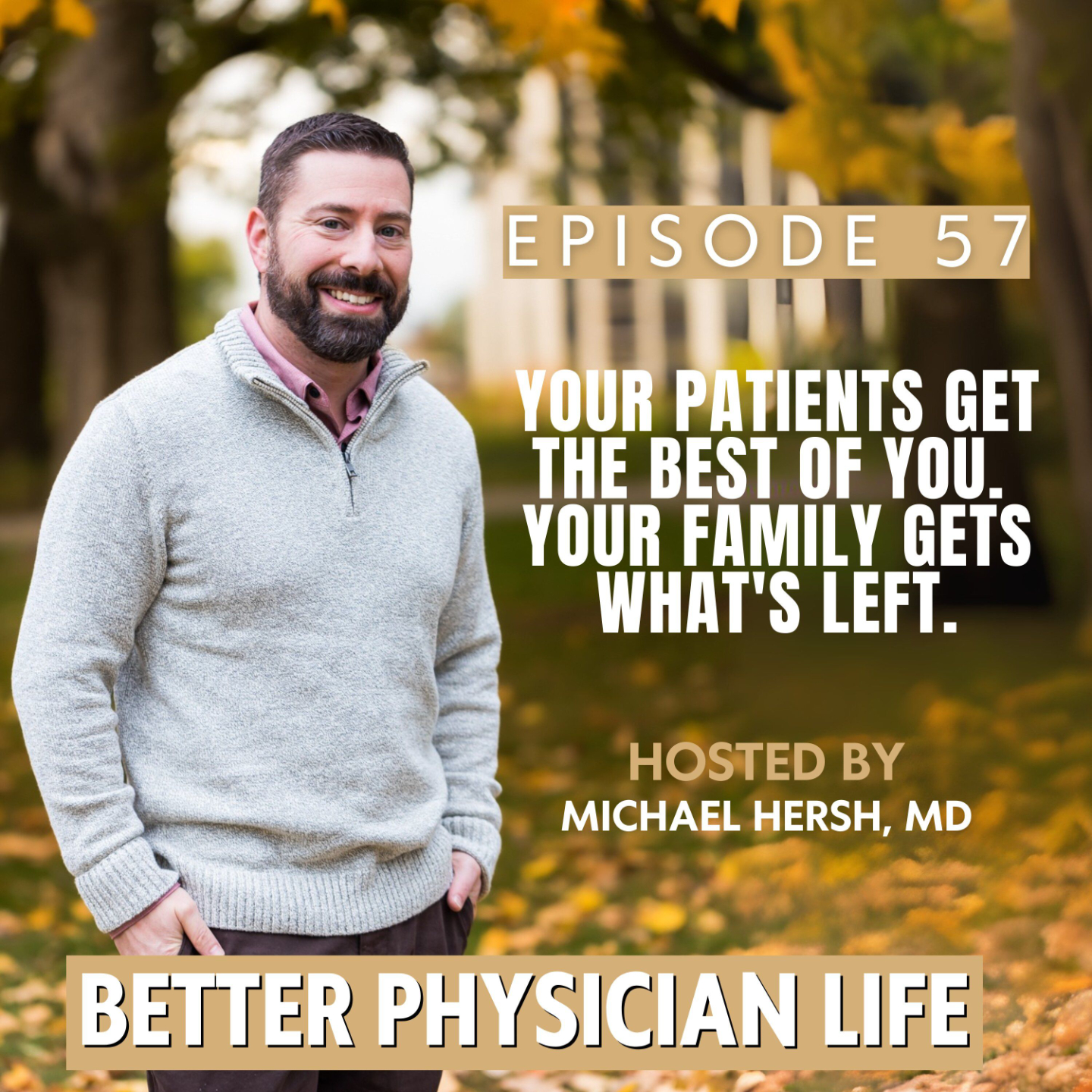
Your Patients Get the Best of You. Your Family Gets What's Left | Ep57
In this episode of the Better Physician Life Podcast, Dr. Michael Hersh explores the hidden cost many physicians bear: giving their best energy to medicine while the people they love most receive what's left over. Through real coaching stories, he examines why this pattern develops and what physicians can do to reclaim their lives.
Your kids get the leftovers. Your spouse gets the leftovers. And somewhere along the way, you stop noticing that nobody was saving anything for you. You didn't plan for it to go this way. You worked hard, you kept showing up. You did everything you were supposed to do. And somehow the life waiting for you at home, the one that's supposed to matter the most, keeps getting the version of you that's already been used up.
Well, hey everyone, and welcome to another episode of the Better Physician Life podcast. Thank you so much for being here today. And if that opening made you feel just a little uncomfortable…Good! Because that's exactly what today's episode is about.
Not physician burnout per se, not another wellness conversation about resilience and self-care, but the specific accumulating cost of being the physician everyone depends on. And what happens when you finally decide to do something about it. I know that opening will sound familiar to some of you because I've heard versions of it almost verbatim.
I was recently speaking to a pediatrician who works at a critical access hospital in Texas. Three kids under six years old at home, and he said, "I just want work to not suck so much, so much that it's seeping into the rest of my life. At home, everybody else has to accept the leftovers when it should be the other way around."
He wasn't burned out in the clinical sense. He loved his patients. He'd built something remarkable in a small rural town. Then a new CEO came in and brought big system expectations to his small critical access hospital. And the job started to feel different. Decisions that used to be made by people who knew the hospital and the community were now being made by people looking at spreadsheets from somewhere else.
There was more pressure to see more patients, do more, and move faster. Every day, he felt like he was being asked to practice a version of medicine that made sense in some conference room, but felt completely different when he was the one sitting across from the patient. At one point, he said, "I get why those decisions look good on paper, but my patients are literally my neighbors."
And by the time he walked through his front door at the end of the day, he had nothing left. He described it this way: "What my kids think is the crappy side of dad is here to hang out with them, not the fun one." Now, that phrase, the leftovers, I've heard it in countless conversations with physicians. I've heard some version of it from physicians in different specialties, different practice environments, and different stages of their careers.
The sentence is always the same, which tells me something important. This isn't a you problem. This is a pattern, and patterns have names. But before I give it a name, I want to say something about how we got here because I think this part gets missed. We were trained to override things: hunger, exhaustion, emotion, stress, the kind of uncertainty and overwhelm that would stop most people.
We learned to function through it anyway. It got us through residency, through night float, through the kind of shifts that most people would struggle to understand unless they'd done it themselves. But over time, the skill that made you successful as a physician can start working against you. We're trained to keep going, see the next patient, finish the notes, take the call, handle the problem in front of us.
And the question starts to shift from, "Why is this happening?" to, "How do I keep performing despite it?" One surgeon I was speaking with reflected on that stage of his career, and he put it this way: "None of it came without a cost. What I can do now is see the costs that I couldn't see in the moment." We get very good at not seeing the costs.
So good, in fact, that at some point we look up and realize we've become extraordinarily skilled at enduring our own lives. You're sitting at your kid's baseball game, and you're not really watching the game. You're replaying a conversation with administration from three days ago. You're sitting at dinner, and someone says something to you, and a few seconds later, you realize you didn't hear any of it because part of your mind is still back in clinic thinking about a patient from earlier that day.
You check the productivity dashboard before you walk through the front door, just a quick look, and whatever number is on the screen ends up setting the tone for the rest of the evening. You answer Epic messages after the kids are in bed, and by the time you close the laptop, it's 10:00 PM, and you tell yourself tomorrow will be different.
And then you do it all again the next day. And after enough years, a lot of physicians start realizing the trade-offs aren't temporary anymore. When I sit with a physician long enough, long enough to get past the CV and the accomplishments, past the, "I'm fine, I'm just tired," many of them eventually arrive at the same conclusion.
The word is betrayal. Let me tell you how they got there. A plastic surgeon, late 40s, in a private practice in California. Second-highest RVUs in his group, lowest salary. He's staying until 9:00 PM doing the long cases nobody else wants, and he brings it up at a meeting, and nothing changes.
In his words, "Every time I bring it up, I'm the one who's complaining." He'd been running the same equation for years: work harder, stay later, be the reliable one. And then he told me, "I thought if I just kept working harder, kept being the reliable one, it would eventually add up." It doesn't add up.
A mid-career ENT navigating a hospital acquisition, he was the one covering call and running the residency program.
He told me, "I can't grow any more unless I add nights and weekends." He knew exactly what he was worth to that hospital. He just couldn't figure out how to make them say it first. "I want to establish myself as infrastructure rather than just another employed doc." And then, almost as an explanation for everything that came before, "I'm ingrained in this community. I was born and raised here. This community means everything to me, and I'm not leaving."
A cardiologist, more than three decades in practice, employed by a large health system. Nobody from administration had spoken to him in over a year. He was hundreds of thousands of dollars short of a bonus threshold he had no realistic way to reach.
The procedure time simply wasn't available. He told me, "How am I supposed to achieve a number and get a bonus if I don't have the lab time to get there? I've been doing this for more than 30 years, and nobody seems interested in whether the target is even achievable." Three different physicians, three different specialties, different circumstances, same conclusion.
I keep working harder. I keep being the reliable one. It was supposed to add up. It doesn't add up. That's what betrayal feels like in medicine. Not a seismic shift, just the slow realization that the deal you thought you were making, the one where hard work and reliability and clinical excellence accumulate into something, was never actually the deal.
An ER doc, a physician who runs codes the way most people drink coffee, calm, decisive, completely in his element, said this in our very first coaching session: "I thought burnout was something that happens to other people." And he meant it. It wasn't bravado. It was his honest self-assessment. He was the guy who handled things, always had been.
Six weeks into our work together, he said something different. "It just hurts. It hurts a lot." And then he didn't say anything else. I think a lot of doctors are somewhere in between. We know the job feels different. We know the costs are adding up, but we're still trying to manage it instead of looking directly at it.
Here's what most physicians miss. We keep treating catastrophe as the threshold. As long as we're still getting through clinic, as long as we're still taking call, as long as we're still doing the work, we tell ourselves things can't be that bad. But functioning and fine are not the same thing.
Some of the physicians I work with figured that out early. Others took years to get there, and sometimes seeing it clearly isn't enough to change it. I worked with a surgeon who could see the pattern clearly. He understood it, he could explain it, and yet every time he found himself back in the same situation, he responded the same exact way. He said, "I can't put my finger on it, and I can't fix it. And as a surgeon, you can't excise it."
If you've ever caught yourself watching yourself do the thing while you're doing it and still couldn't interrupt it, you probably know exactly what I'm talking about. For some physicians, it's simpler than that. The job just doesn't stay at work. An internal medicine program director put it this way.
"I go into work, and it's like I put on this shield, and as the hours wear on, I find myself very burdened and saddened. As soon as I finish and leave, I'm like, 'Okay, I made it through another day.'" When making it through the day is the goal, and the people at home are getting what's left, that's the signal.
Sometimes, though, the issue isn't just that the job follows you home. Sometimes the job has occupied so much space for so long that it's difficult to know where the physician ends and the rest of you begins. A gastroenterologist I worked with put it like this. "I am the doctor, and the doctor is me. I have difficulty separating it."
He'd been practicing for over 25 years. It took him 28 years in medicine and 12 coaching sessions to say that out loud. And it turned out to be one of the most important things he said because until that moment, he'd never really questioned it. Of course, he was the doctor. That's who he'd been for almost three decades. Patients knew him as the doctor. Colleagues knew him as the doctor. The hospital knew him as the doctor. Most days, he knew himself that way too. The interesting part is that his wife had asked him a similar question, "Can you tell me who you are when you're not being a doctor?"
And he didn't have an answer. Not because he wasn't also a husband and a father, not because he didn't have interests outside of medicine. He just hadn't spent much time thinking about it. Medicine has this way of taking up more and more of the available space, and most physicians just don't notice it happening.
Why would we? The role is rewarded, the role is respected, the role is needed. And after enough years, it can become difficult to tell where the role ends, and the rest of you begins. The goal is never to stop being a doctor. The goal is to remember that we are more than that.
And then there's one more pattern I see all the time. You've read the books, you've listened to the podcast, you've done the course, the workshop, the retreat. A neurologist I work with put it this way: "I feel like I'm always looking for the next thing to make me happy. This next thing is gonna be the one that figures it out, but it never does." If that sounds familiar, pay attention because, from the outside, most of these physicians look completely fine.
You don't need to be in crisis to pay attention. You don't need to wait until you're burned out. You don't need to wait until you're ready to quit. You don't need to wait until something breaks. One physician told me his goal wasn't to love medicine again. It wasn't to find his calling. It wasn't to transform his life.
He just wanted to learn to whistle while he works. I thought that was one of the most honest goals I'd ever heard. And maybe that's the point. Not for everything to be different, not for the system to suddenly make sense, not for every frustration to disappear, just enough space to experience your own life while you're living it.
A PM&R physician I worked with said something after six months that has really stayed with me. "I actually lived." Not transformed, not fixed, not optimized, just lived. And a nephrologist, after a year of carrying anxiety home from work every day, described the change this way: "It's a crack in the door. Not a transformation, just a crack. Just enough light to move forward.”
If you're listening to this and you recognize yourself in even one of these stories, that's usually the signal that it's probably worth having the conversation. The physicians I work with don't come to me because their lives have fallen apart. They come because they're tired of being the most capable person in the room at work and the least present person at the dinner table.
They come because they've been running the same equation for years, and it keeps not adding up. They come because they finally got honest enough to say, "I know something needs to change, and I don't know what to do. I don't wanna figure this out alone." If that's where you are, even a little bit, a physician coaching call is the right next step.
Just a conversation where you can describe what's going on, ask whatever you want, and we figure out together whether the fit is right. And you can learn more at betterphysicianlife.com, and the link is in the show notes.
Because the physicians who do this work don't regret starting it. What they regret is how long they waited, telling themselves it wasn't bad enough yet, that they should be able to handle it, that the next book or the next framework was still out there somewhere. It wasn't, and you already know that. Thank you so much for being here today, and I'll see you next time on the Better Physician Life podcast