FULL EPISODE TRANSCRIPT
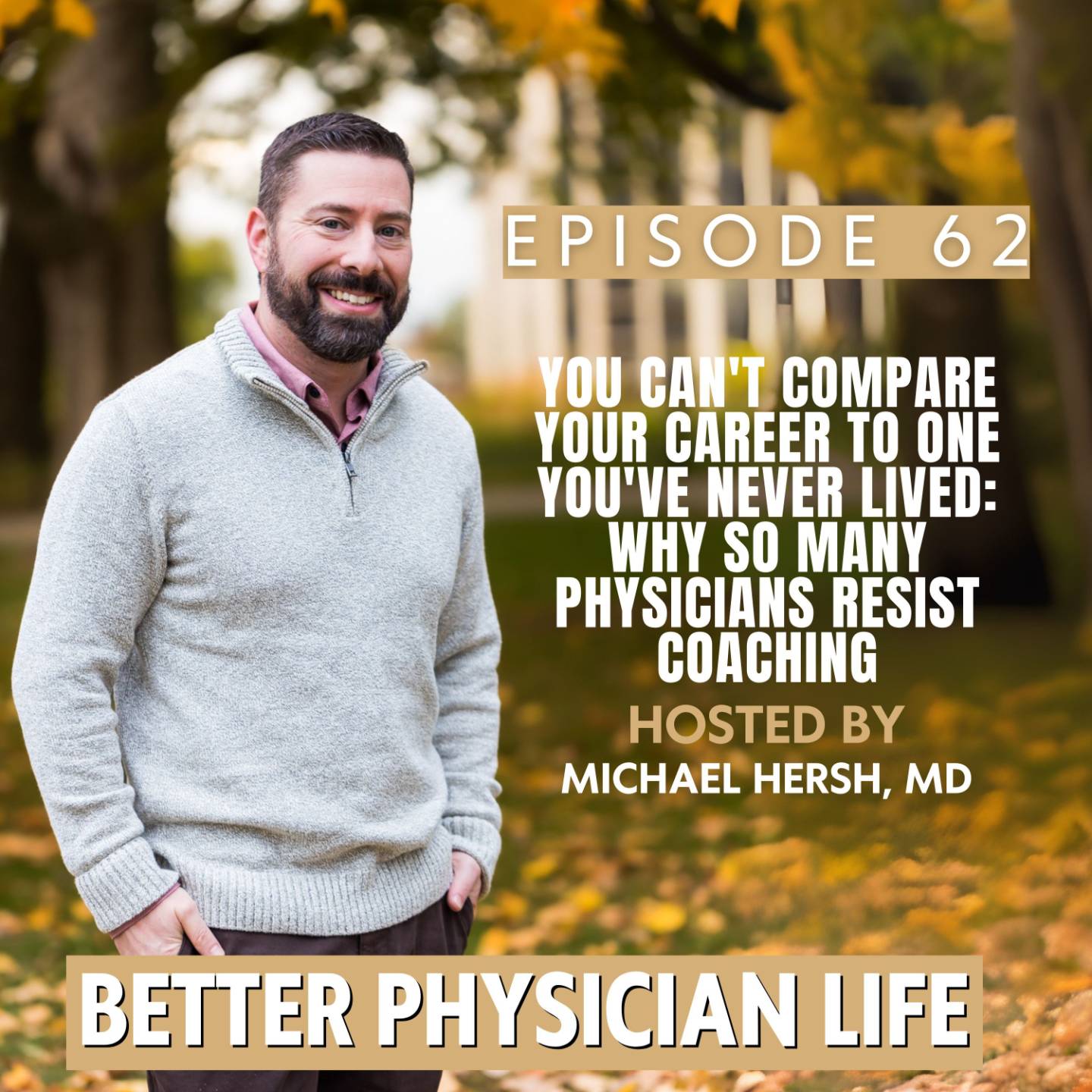
You Can't Compare Your Career To One You've Never Lived: Why So Many Physicians Resist Coaching | Ep62
Learn how the same traits that make doctors excellent clinicians can quietly keep them stuck, and what happens when you finally ask, “If I don’t do this, what changes?”
For years, I corrected my wife every time she called a lollipop a sucker. Not because I was trying to be difficult. Okay, maybe sometimes I was trying to be difficult. But mostly because in my mind, a sucker was someone who got taken advantage of, someone who fell for something, and I had no interest in being that person.
Not with money, not with business, not with my life. That's probably the best description of who I was before 2020. Proudly skeptical, proudly cynical. If you told me back then that I would eventually pay someone to help me think differently about my own life and career, I would have definitely rolled my eyes and assumed that you needed more help than I did.
Because good doctors don't do that. We gather the evidence, we make the diagnosis, we review the literature. We want to know where we're going before we take the first step. Trust comes after proof. That's our training. And besides, isn't this what we signed up for? Shouldn't we just put our heads down and get through it?
Well, hey everyone, and welcome back to another episode of the Better Physician Life podcast. Thank you so much for being here today. Now, if you've spent any amount of time in physician groups online, you've probably seen physician coaching take a beating. Someone mentions it, and the comments start rolling in.
It's a scam. It's overpriced. It's for physicians who can't figure things out on their own. Sometimes the criticism is even more direct. And whenever I read those comments, I don't hear arrogance. I hear myself. Because I wasn't always a believer in physician coaching, not even close. My first response was pretty much an eye roll.
But as COVID rolled on and my burnout got worse, I started looking for options. By then, I was pretty deep into the FIRE movement, and honestly, a lot of it made sense to me. Save aggressively, invest, build enough financial independence that eventually you don't need medicine. There was just one problem: ‘eventually’ wasn't helping me very much right then.
I had a family to support. I had responsibilities. There was no walking away from medicine. And at the same time, my trust in the profession was taking a hit. Medical malpractice was always sitting somewhere in the background. Productivity targets, patient satisfaction scores, quality metrics, more and more numbers telling me how I was supposed to be doing my job.
And prior authorizations were forcing me to spend time arguing about decisions I've already made with my patients. I was doing the job. I just wasn't particularly happy with what the job had become. Around that time, a physician I'd been following online announced a group coaching program.
I signed up to learn more, but I pretty much had zero intention of actually doing it. But somewhere in that process, he asked me a question: "If you don't do this, what changes?" I remember that question because I didn't have a very good answer. I had always thought of my skepticism as a strength, and most of the time it was.
It kept me from buying things I didn't need. It kept me from believing claims just because somebody made them confidently. It made me ask questions, look for evidence, and do my own homework. Those are very useful qualities, especially in medicine. But I had never really considered the other side of it.
Skepticism can keep you from making a bad decision. It can also keep you from gathering new information, and I think physicians are particularly susceptible to that because medicine rewards certainty, or at least the ability to function when certainty isn't available. Think back to your training. You didn't make it through residency because you always knew the answer.
You made it through because you learned to walk in a room where you weren't completely sure, assess what was in front of you, make a decision, and keep moving. And then you did it again and again. Eventually, you're the attending, you're the partner, you're the one the nurse calls when something doesn't make sense.
You're the one your colleagues come to with a question. You're the one the patient expects to have an answer. After enough years, figuring things out becomes more than something you do at work. It becomes something you expect from yourself. I certainly did. My patients needed me to have answers. My partners needed me to be the guy who could hold things together when the schedule fell apart.
And at home, I had gotten pretty comfortable being the person who was fine, always fine. So the idea of paying somebody to help me think through my own life and career? I didn't like it at all, because what did that say about me? I actually talked about some of this with my first physician coach, Dr. Jimmy Turner, back in episode sixteen.
But the part I keep coming back to isn't whether my skepticism was right or wrong; it's whether I had enough information to know. Because there's an important distinction here. Skepticism is useful, due diligence is useful, and there are legitimate reasons to be cautious about coaching.
I've talked with physicians who have already spent a lot of money on programs that didn't deliver what they expected. One physician told me very directly that he was concerned about the ROI of coaching, his return on investment. He'd already paid a substantial amount of money for a program that was supposed to help him build something outside of medicine, and it went nowhere.
By the time he talked with me, he wasn't being cynical for the sake of being cynical. He'd already been burned. Another physician told me he'd worked with a non-physician coach who just didn't understand medicine. They talked for a while; nothing really changed.
He walked away wondering what he'd paid for. And another physician told me he wasn't even sure coaching was what he needed. Maybe it was therapy, maybe it was better sleep, maybe it was fewer emails. Maybe his job really did need to change. That's not resistance, that's someone trying to figure out what would actually help.
And I think that's a reasonable place to be. Coaching isn't always the right answer, and not every coaching experience is going to be a good one. Physicians should ask questions about who they're working with, about what coaching can and can't do, about what they're actually paying for.
I certainly do when I'm signing up for coaching. The part that interests me is what happens when skepticism keeps us from looking any further. When “I'm not sure about this” becomes, "This could never help someone like me," because those aren't the same thing. I remember reading a thread in one of those physician financial independence groups online.
Doctors were comparing savings rates, retirement projections, real estate, how quickly they could get out of medicine. Then somebody mentioned physician coaching, and it got ugly pretty quickly.
Someone called it a scam with a Zoom link. Other physicians questioned whether coaches had any business helping doctors with personal or professional problems.
And maybe some of those questions are fair, but what interested me was how certain everyone seemed to be about the available options. Work, save, invest, get out. And maybe that's exactly the right plan for some physicians. There are bad jobs. There are bad partnerships. There are schedules that aren't sustainable.
Sometimes leaving is the right answer. But what if leaving isn't the only option available? That's a very different question, and it's one I don't think I ever seriously asked myself. Mostly because I was too busy just getting through the day, checking the inbox before clinic, looking at the productivity report, comparing RVUs, finishing charts after dinner, doing the math on how many more years I needed to work before I could finally cut back. When you're that occupied with getting through your life, you don't spend much time examining the assumptions underneath it.
You just keep moving. And medicine is very good at rewarding forward motion. That's a version of skepticism we don't talk about. It's not an argument; it's momentum, and momentum doesn't leave much room to ask where you're actually headed. I've also met physicians who aren't skeptical of coaching specifically.
They're skeptical of all of it. They've read the books, listened to the podcasts, tried the morning routine, tried exercising more, tried taking a vacation. There's always another technique, another framework, another thing to add to a life that's already full. At some point, the question stops being, does coaching work?
And it becomes, does any of this actually change anything? I totally get that, and I don't have a clean, one-size-fits-all answer. What I do have are experiences I didn't have when I first rolled my eyes at coaching.
One physician I worked with told me a few months in, "I stopped thinking and talking in circles. I started making decisions," real ones, about his schedule, about a partnership conversation he'd been avoiding for two years, things he'd been thinking about for a long time without actually deciding.
Another physician I worked with came back for a second round of coaching. Before we started, I asked him what he'd gotten out of the first 12 sessions, and he smiled. He said, "Well, I wouldn't call it 12 sessions. I'd call it six." I didn't get it. He had done 12 sessions. What does that mean? He followed up by saying, "For the first six weeks, I thought you were totally full of it."
Okay, he used a different word, but I'm keeping the podcast PG. Honestly, I loved that answer. It's one of my favorites because he hadn't shown up believing in coaching. He was skeptical while we were doing it. Then somewhere around six sessions in, he started noticing things. He would drive home after a rough clinic and realize he wasn't replaying the difficult patient encounter over and over again.
His mood at home was better. His wife noticed. Nothing about his job had changed. Same clinic, same inbox, same staffing problems. He just wasn't carrying all of it home the same way anymore. He didn't decide to believe in coaching. He had six weeks of information he didn't have before, his own experience, and nobody could have given him that ahead of time. At some point, one of my coaches asked me another question that I still think about.
This one's really good. On a scale of one to ten, how would you rate your life and career? Think about that for a second. Most people I ask land somewhere around a seven, and seven sounds pretty good. But then there's another question. Seven? Compared to what? The career you've had, the life you've had, the version of medicine you've experienced for the last ten or fifteen years?
Because if you've never worked in a way that felt sustainable, if you've never finished clinic with enough left to actually enjoy dinner, if you've never taken a vacation without checking the inbox, if you've never had a Sunday afternoon where Monday wasn't already taking up space in your head, what exactly are you comparing that seven to?
That's the part I had never considered. You can't compare your life to one you've never lived. And I think that matters because most physicians who come to coaching aren't falling apart. They're working, they're productive, they're respected, their patients like them. On paper, things look pretty good. But there's still a question lurking in the background.
Is this really it? Not because everything is terrible, and not necessarily because they want to leave medicine. They're just wondering whether there's a version of this career that feels different. Not necessarily easier, just one that doesn't require spending the entire weekend recovering from the week.
Maybe that means changing the schedule. Maybe it means having the partnership conversation you've been putting off. Maybe it means looking at the compensation math and realizing you can afford to cut back sooner than you thought. Maybe it means changing jobs. Or maybe nothing external changes at all.
The point isn't that I know which answer is right, because I don't. I'm not going to pretend I know your specialty better than you do. That's not the job. The job is creating enough room to examine questions that are difficult to think about when you're between patients, finishing notes at 9 PM, or answering, "Busy," every time someone asks how work is going. You're still the one making the decisions.
You always were. And honestly, I don't need anyone listening today to believe in physician coaching. Nobody argued me into it. I still wasn't convinced coaching was going to help, but I also knew I couldn't keep doing things the way I was doing them. So I got curious enough to try something before I actually believed it would work.
The trust caught up later. So if you're driving home from the hospital or clinic right now, or scrolling through a thread where physicians are explaining exactly why coaching could never help someone like them, I'm not going to tell you your skepticism is wrong.
Sometimes skepticism keeps us from making expensive mistakes. Sometimes it keeps us from believing things that don't deserve to be believed. That's truly helpful. But sometimes skepticism keeps us from looking at something long enough to even find out.
And maybe that's the question worth paying attention to. Not whether coaching works, not whether you should quit your job, not whether your life is really a seven or a two or a nine, just this: Is the version of medicine you're living right now the only version available to you?
I knew the version I was living wasn't working for me anymore. What I didn't know was whether there was another one, and I had no way to compare because I'd never experienced anything different. You can't compare your career to one you've never lived.
If you've been wondering whether there's another way to practice medicine without blowing up the career and life you've already built, that's exactly the kind of conversation I have with physicians in coaching.
If you'd like to learn more, you can head over to betterphysicianlife.com, and there's also a link in the show notes. You don't have to believe anything before you get there. I certainly didn't. But I'll leave you with the question that got me to take a closer look at my own life. If you don't do this, what changes?
For me, the honest answer was nothing. I would keep doing exactly what I'd been doing, and I'd probably keep getting exactly what I'd been getting. I didn't know whether doing something different would make things better. I just realized I had no way of knowing without doing something different. And for a skeptic like me, that was enough to gather a little more evidence.
Thank you so much for being here today. I'll see you next time on the Better Physician Life Podcast.