Better Physician Life coaching

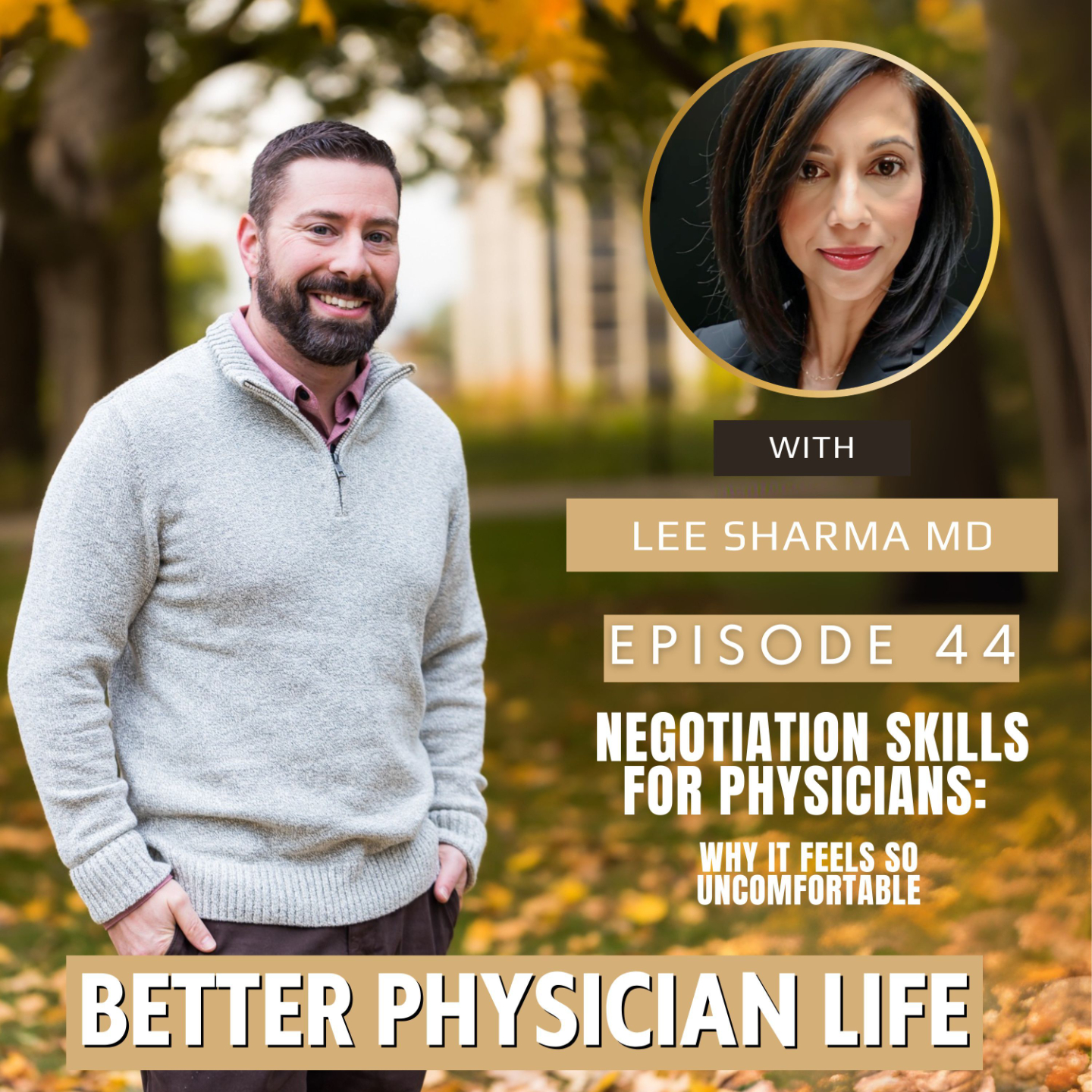
Negotiation Skills for Physicians: Why It Feels So Uncomfortable with Dr. Lee Sharma | Ep44

What if the real reason negotiation feels heavy for physicians isn’t the topic itself, but that we were never trained for it, and we’ve been taught to villainize instead of understand?

In this episode of Better Physician Life, Dr. Michael Hersh sits down with Dr. Lee Sharma, a practicing OB/GYN with nearly 30 years in private practice and a Master’s in Conflict Resolution. Together, they unpack why doctors are comfortable with life-and-death decisions but freeze when negotiating contracts, protected time, or boundaries. Dr. Sharma explains the destructive role of villainization, how we create stories with heroes and villains that shut down curiosity, damage relationships, and block real solutions.

They discuss practical mindset shifts: moving from “winning versus losing” to alignment, replacing compromise with shared goals, and getting crystal clear on what you actually want in your professional and personal life beyond just money and call. 

This conversation is essential for any physician who has ever felt uncomfortable asking for what they need or who has walked away from a negotiation feeling drained rather than empowered.

Watch on YouTube
Listen on Apple
Listen on Spotify

About the Show:

Created for physicians who want more than clinical competence, Better Physician Life is a space for honest reflection, reinvention, and reclaiming purpose beyond the pager.

Hosted by Dr. Michael Hersh, each episode dives into the questions we didn’t learn to ask in training, offering tools and conversations to help you live and lead with intention.

Top 3 Takeaways: 

  1. Villainization Kills Curiosity and Collaboration: When we turn people or systems into villains, we stop asking questions and start confirming our own story. This creates shame, blame, and broken relationships. Instead, look for common ground, even if it's just one small thing you share, to shift from enemy to collaborator.

  2. Negotiation is a Skill, Not a Personality Trait: Physicians are trained to advocate fiercely for patients but often feel guilty or uncomfortable advocating for themselves. Clarify exactly what you want. Not just “more money” or “better call”, including schedule details, support staff, technology, and daily workflow so you can negotiate with confidence and alignment.
  3. Move from Compromise to Alignment: Compromise often feels like a loss for everyone. Start negotiations from shared goals and alignment instead. This builds trust, fosters better long-term relationships, and helps create a practice and life that actually feel good at the end of the day.

Watch Now

 

Video Poster Image

If negotiating at work has always felt uncomfortable, you’re not alone.  

Many physicians were trained to step into the job and make it work, not push on the terms. But things like patient volume, call burden, support staff, and schedule structure often shape whether a job feels sustainable.

A physician coaching session gives you space to step back, look at where the strain in the work is coming from, and decide what may be worth handling differently. Use the link below to schedule a call with me. 

Book A Call
DOWNLOAD TRANSCRIPT

Negotiation Skills for Physicians: Why It Feels So Uncomfortable with Dr. Lee Sharma | Ep44

Michael Hersh, MD

[00:00:00] 

Most physicians are comfortable making life and death decisions. We're comfortable taking call and carrying risk and managing complications. But ask us to negotiate our contract, or push back in a meeting. or advocate for protected time, and suddenly it all feels personal. It's heavy, it's uncomfortable in a way that doesn't really match our training.

And the strange part is, negotiation is happening around us all the time. We just don't always recognize that we're in it, and most of us were never taught how to do it well. And that's what we're talking about today.

Well, hey everyone, and welcome back to the Better Physician Life Podcast. Thank you so much for being here today. 

So today, I am sitting down with Dr. Lee Sharma. Lee is a practicing gynecologist who's been in private practice in Alabama for nearly [00:01:00] 30 years. She trained in OB-GYN at UT Southwestern, earned a master's degree in conflict resolution, and now works with physicians, hospitals, and healthcare organizations on conflict analysis, negotiation, and the development of healthier systems. She also hosts the Scalpel and Sword Podcast, where she explores conflict and negotiation in modern medicine. I was so grateful to be a guest on her show, and what I love most about Lee's work is that she doesn't treat conflict or negotiation as personality traits.

She treats them as skills that most of us were never trained in. We were trained to advocate fiercely for patients. But when it comes to advocating for ourselves, our time, our compensation, our boundaries, things start to get uncomfortable. I'm so excited for this conversation. Dr. Sharma, welcome to the show.

Hey Michael, thank you so much for having me. I've been so excited for this. 

Absolutely. It is so great [00:02:00] to have you here, and I would love to jump right in. One of the things that we were talking about before we hit the record button was this idea about villainization in healthcare, which is something I think a lot of people are not really talking about, and there are so many aspects of it. I'd love for you to share your insights and some of what we were just talking about. 

Yeah, absolutely. So one of the things that happens so often in healthcare is we start telling stories. You know, as human beings, we're natural storytellers. And when we start telling these stories, especially around things that are bad that happen to us, unfortunately, if we're dealing with a bad outcome, which happens to all of us at some point.

We need to create something that helps us to understand it. And unfortunately, one of the shortcuts that it's easy to take in understanding is creating this villainization narrative. We're [00:03:00] actually creating a story where there's a villain. And the problem with creating a villain is that once we create the story, where there's an element of blame. If that's a blame of a person, that once we've created that narrative of a villain, we stop looking. We stop asking. We lose that essence of curiosity. That's gonna make us dig deeper into actually what's going on. And as soon as we create that villain and we stop looking, and we stop exercising curiosity, this becomes very destructive.

When we create villains, we create stories of shame. We create stories of blame, and those kind of stories don't just have an effect on us where we stop asking questions. It has an effect on the person we're blaming or the thing that we're blaming, and that starts to destroy relationships. Once that happens, you're in this really negative spiral, so it's really important for us to understand not only what Villainization [00:04:00] is, but how to recognize it.

Yeah. absolutely, and I think it's important to know, Every good story has a villain, right? And so as we think through, we're always rooting for one side. And, that is what makes a good story. And as you were pointing out, we are all creating narratives and stories in our minds all day long.

It is maybe a little easier to villainize the people that we are in conflict with. To villainize the areas that we don't like as much, or the policies that we don't like or the people making the policies. It's easy to do that. It is challenging to take a step back and really take a look at what is the story. And most importantly, what is the story I'm telling myself about this situation? How do you normally talk with physicians and organizations about working through this? 

So I was working one time with the [00:05:00] CEO of a healthcare tech company, and he was working with a hospitalization that was going to be using his tech, and he was very excited about this opportunity, but he had met some people within the administration that he felt like maybe weren't as receptive to his story. And so he's calling me before one of his meetings and said, Hey, I think you know some of these people and I actually did, and he's a big Star Wars geek, as am I. And so he says to me, hey Lee, is this a Jedi or a Sith that I'm talking to? And I thought about that question, and you know, when he's asking me that question, what he's actually doing is creating a villain narrative.

He's actually saying that the person he's talking to, he's already decided, is this person on my side or not on my side? And so I took a second, and I said, okay, so right now what you've done is you've created a story. We'll never find commonality with this person. You want to work with them. And if you walk into this already thinking this person's your enemy.

You're not looking for [00:06:00] commonalities. You're looking for things to reinforce the narrative you've already created, and that's what we do, right? Once we build those stories, we now selectively look for evidence that confirms our story. We are actually finding ways that my story is right. This person is my villain, and right then, conflict is going to ensue.

We know this. So I said, okay, go into it not thinking of Sith or Jedi, think of this person as someone who also has the force. This person also has your life energy and somewhere in this life energy, you have something in common with them. And your mission in the first five minutes is to find something that you have in common with this person.

It may be a sports team that you both root for. It may be you have kids the same age. It may be that you both really enjoy X activity. You both really enjoy good restaurants. Your mission is to find one thing, and when you find this one thing, I guarantee you this person will look less like your enemy and somebody that you can actually [00:07:00] find common ground with.

Yeah, and really, why this is important is that at the core of all of this is negotiation, is figuring out what do we want. What do other people want, and how do we, as you were just pointing out, find that common ground so that we can get the things that we want and need? And one of my favorite books is Never Split the Difference by Chris Voss, which was kind of my introduction to negotiation.

I feel like, as physicians, we don't really get good training in the art and tactics of negotiation. And this was my first real attempt to understand some of the tactics that are going on behind the scenes, because this is so challenging for doctors. And as I was mentioning earlier, we're negotiating all day long.

We're negotiating with our patients, we're [00:08:00] negotiating with systems, we're negotiating with our families. We're negotiating with ourselves. Talk to me a little bit about how this work all comes together for you. 

So I love how we are going from villainization to negotiation because I think one of the biggest things when we're walking into any kind of negotiation, and I love and you're so right about this, that we are negotiating constantly, that if we've created a villain narrative.

Of somebody who is a villain. A lot of times that villain becomes an obstacle. We see that as something or someone who's keeping us from getting something that we feel like we want, need, or deserve. And the problem with doing that is we are now moving that locus of power to that person, that person, for whatever reason, we have designed as the villain, is keeping us from getting what we want.

But if we actually step back and take ownership of the fact that I actually have the agency to negotiate for what I want, that's a different thought process. I'm actually [00:09:00] owning the fact that I can negotiate and advocate for myself. One of the things I think is really interesting when you talk to organizations that work with physicians doing contracts or people who do a lot of negotiations between physicians or physician groups and hospitals, is that very often when parties, specifically doctors, walk into these processes.

We think we know what we want, but we don't always know exactly what we want. If we may say to ourselves, well, we want more money, we want better call, and we have these very strict generalities. But have we really thought about what's really appropriate and what I'm asking for, what I feel like is my quality of work, what call schedule specifically will give me a quality of life that I can have a wonderful home relationship, that I can actually have self-care, and it's not just about call and money. There are boundaries that we negotiate. We do this all the time. What things are acceptable in terms of what [00:10:00] has the ability to be part of my daily life, and maybe what should be more scheduled or regimented.

We negotiate our identity. What kind of things am I doing that make me feel like I'm a positive, effective physician? Is having two extra slots on my daily clinic schedule gonna make me feel like a more effective doctor? Or is having just one slot, maybe the other slot for me, taking five minutes to breathe, and maybe go outside and walk around the block, is that gonna make me feel like a better doctor? 

We negotiate those kinds of things, and when we really sit down and think about what things are going to build my dream life, my dream professional day, if you really sit down and you detail that, not just generally, but very specifically, and then you go back to a negotiation.

You are gonna be much more likely to not only advocate for yourself in a really, really healthy, strong way, but you're going to walk out of that process feeling more [00:11:00] confident in that process. 

Absolutely. And I talk to a lot of physicians, and what I have noticed is that compensation and call become surrogates for all of the other things that we have lost control over. And so we argue for things like compensation and call because those feel within our grasp and things that we can control. And what you're saying here is that there is actually a lot more that we can control. If we take a step back and really take a look at what do I want my life to look at, and I agree with you, when you just frame things in terms of compensation and call, it becomes narrower and so it feels more controlled.

When you take a step back and say, look, what do I really want ? It can feel a little more confusing, a little less clear, because all of that stuff is much less concrete. How do you talk to physicians and systems [00:12:00] about navigating how they do these types of negotiations? 

That's a great question. One of the first things that we really talk about when you sit down to negotiate this is the idea that this is not about winning and losing. This is not a zero-sum game. That, especially when you're negotiating for a new contractor, joining a practice, or a physician group negotiating with a hospital, that this is the potential for everybody to win, and by win means that we're all building relationships that are gonna be ongoing and collaborative. The negotiation and even contracts. While we're definitely setting down rules and boundaries, it really becomes sort of a jumping-off point to continue trust in that relationship.

So first and foremost, we are understanding that I'm not trying to beat you. I'm not trying to manipulate you. I am trying to work with you so that we all get what we want to have an effective, healthy system. [00:13:00] That's a really great place to start. The second thing, I think a lot of physicians, and this may be a negative experience they've had in the past, maybe they had a really bad experience negotiating a previous contract.

Maybe they were in a practice where they really got taken advantage of that they're very suspicious of the process, that they're walking into another negotiation and we're a naturally conflict of orders. Physicians we're just not good at this. like you said, we've not been trained to do this. We have no skillset.

We are great at clinical diagnosis. We are good in the clinic. We are built in terms of training for clinical medicine, but we are not taught relationally how to do any of this. So this is definitely stuff we're learning by watching other people, and unfortunately, past experience can really shape how we perceive this process occurring.

So if I see you as potentially someone who's trying to take advantage of me. I may not be forthright, I may not be as communicative. And if I'm not sharing with you exactly what I want, how am I gonna [00:14:00] negotiate it? How am I going to actually design and really get the things that mean something to me?

And like you were saying, Michael, that really does mean being very intentional about thinking what makes my practice day or what makes my OR day look really good? If having one extra patient tacked on is gonna make me wanna walk into my office and throw things. Then please put that in your contract.

Say, these are how many patients I will see. This is my box. This is what I will do. I have a system for work-ins when I need to see work-ins, but apart from that system, that's it. This is stuff that we negotiate that literally, if you know that something really ticks you off, negotiate that. And that's going to actually, number one, make you more confident in the process.

Number two, when other physicians look at you and see that you engage in this process and got something very healthy in terms of your daily practice out of it, they will buy into that process too. [00:15:00] 

Yeah. That's amazing. And I think you named one aspect of all of this that makes it challenging for physicians, which is a prior bad experience, which I think many physicians have had those negative experiences in terms of contracting.

I think the other piece here is that medicine kind of, self-selects for people pleasing. Right. So we are trained from a very early age of like, how do you go with the flow and be unassuming and not ask for too much, so that you can ascend in the ranks and get into medical school, get the residency and or fellowship of your choosing.

And so when it comes to negotiations, sometimes asking for the things that you want feels very uncomfortable because you don't wanna ask for more than you deserve, or you don't wanna upset anybody. And clearly this is not how lawyers negotiate. This is not how corporations negotiate. How do [00:16:00] you navigate that people-pleasing aspect of doctors when they're negotiating?

I think that's such a brilliant insight, and I totally agree with you that our culture and our education trains us to not ask, to not complain, to not demand. The key to success, especially in residency and medical school, is being the person that puts your head down and get the work done. And as physicians are walking to that negotiation process, one of the things that you really have to encourage them is you are not here to make somebody happy.

You are here to make you happy, and you have to think about this. And this is one of the things I encourage people to do. I want you to think about when you walk out of this door, after the negotiation is over, what things as you walk out are gonna make you smile? What things that you have negotiated in this process that when you get in your car and you drive home are going to make you feel good that you went through [00:17:00] this process and asked for and got what you wanted?

Because those things that initially come to your mind about what's gonna make you feel good after negotiation process is over are the things you need to articulate at the beginning. And it is that level of thinking about, because we're not good at it. We're not good at asking for what we need. We're not good at saying, these are the things that I should have.

And the other thing I wanna touch on, because you said this so beautifully, is this idea that we don't feel like we deserve it. That we work so hard, and I'm really, really happy to get whatever you give me. And I'm really, really happy to get to go home. And here's my paycheck, and this is terrific, and we're really taught that's all we should get.

And I feel like especially both of my parents were physicians who trained in the sixties and practiced all the way through to the late two, late 1990s, two thousands. And my dad was a brilliant surgeon, but he definitely had that. I'm just gonna take what I'm gonna get and I'm gonna work really hard and I really appreciate anything you do for [00:18:00] me.

He took such good care of his patients, but he really got the short end of the stick sometimes with his colleagues. And now that I've been in this process, more part of me wishes I could have said to my father at that point in my life, "Dad, seriously, you can negotiate much better your quality of life and still be great for your patients and still do beautiful work, but actually see us more.” And I think those are the kind of things that we need to encourage doctors to do because that's not a voice that they hear very often. 

Yeah. I think that's what struck me so much about, I'll bring up the book again. Never Split The Difference because I hadn't really thought about negotiation tactics at all.

And when Chris Voss goes on to explain why we never split the difference, it's because when we split the difference, when you and I are both compromising on the things that we want, nobody's happy. Right. And so how do you come to the table asking for all of the things that you know [00:19:00] you want and need and being prepared for it?

Because the hospitals are doing that. The medical group practices are doing that. They are coming to the table very clearly. Telling you the things that they want and need, and I'd love to get your opinion on compromise. That's actually gonna be my next question for you.

When we compromise, really, if we just do everything that the other party is asking for, the people who walk away from the table, unhappy is us. And that is the downside of people pleasing. But I guess in my mind, there's always a role for compromise. Talk to me about what that looks like when we are negotiating.

So one of the things about the word compromise, which I think especially in traditional negotiation, is sometimes a little bit of a sticky word because compromise sounds like loss. Compromise sounds like you had to give up something to get something. And [00:20:00] one of the biggest things about compromise, I think.

I would rather, and when we talk in negotiation, I like to use the word alignment over compromise because alignment. Implies some very different things. And this is what I think and tell me what you think. 'cause when I hear the word compromise, a lot of times I think loss and I think a lot of people at the table, if you've got negotiating parties and use the word we're going to compromise, the natural expectation is, okay, we both are about to lose something right now.

And it makes people, again, very suspicious. They feel like they're gonna walk away from the table. And this was not a successful negotiation 'cause we had to compromise. And when you start talking about alignment. Alignment's a very different concept because alignment speaks to shared goals as opposed to me giving up something and you giving up something somewhere in here, we both want the same thing. If this is a physician practice and they're trying [00:21:00] to negotiate another physician. They want that physician to be aligned with that practice. We have shared clinical goals, we had shared financial goals. We wanna be aligned on those things, and then once we have alignment, we can start to look at details.

So I would rather start from. A place in the middle where we're aligned and then move out as opposed to starting on the outside and moving in, which I feel is so much more of what compromise is, is you're here and I'm here, and now we're gonna meet in the middle. Let's not do that. Let's both of us start in the middle, be aligned, and then once we're aligned.

Then we can start to look at how that looks for both of us, and then we can look at details. And I think that way, when you approach the process with alignment and not compromise, you actually, number one, you build trust because I'm gonna start to trust you more. Number two, we are probably gonna get something closer to what everybody wants when we're aligned, as opposed to feeling like someone's lost [00:22:00] something.

That's such an interesting way that you put that because the moment you said compromise is loss, I started to think if a building structure is compromised, like it's at risk of falling down. Right? And so it is a fascinating way of thinking about that word. Again, I'm not sure I had given it much thought prior to this conversation, and alignment does feel much better because the truth is everybody would love to make a ton of money and not work. That sounds wonderful. And we do need to be aligned with our systems and our employers, and making sure we have skills that can translate to compensation, and how do we align those two things? And I think that's a wonderful way of thinking about it.

And I think too, when you start thinking about alignment, and this is one of the things coming back to negotiation when people walk into negotiations, and you said it really well, a lot of times we'll just limit ourselves to call schedules [00:23:00] and payment.

And that's what the things we think about. We don't think about alignment also, meaning support staff. We don't think about alignment, also meaning access to technology. We don't think about alignment. Also, meaning that you and I have abilities if I need subspecialists, if I need referral bases, if I need support staff to actually do my prior authorizations.

And I know that all of those things are gonna help me do my job, then for us to be truly aligned, then I have clearly stated to you that I need all of those things. And then you have clearly stated to me that you're able to provide them in some way. So I think alignment also makes us much more, circumspect and how we think about what we are expecting from and bringing to that negotiation.

And just bringing this conversation full circle, this is why understanding and recognizing the villainization is so important 'cause it is. Nearly impossible to align with somebody that you think is the villain. It's hard to be on the same [00:24:00] page and find common ground as you were, laying out earlier, if you just think that the other party is out to get you.

And so finding commonality and finding ways to create alignment while still showing up and asking for the things that you want and need is so incredibly important. And it's complicated. And that's. Why you exist to help us all navigate this. What haven't we talked about? What else do you think is important for physicians to know when it comes to negotiations?

I think the most important thing with negotiations, and I think it's really hard for us as doctors, and this is also why I think it's really great that there are so many people now in this conflict resolution space that are trying to work with doctors specifically, and it is just a joy for me to see that there's an interest in this topic is I would encourage physicians to find somebody who can really help you understand and learn about the process. Somebody who has experience with negotiation, and there's a lot of people who [00:25:00] are now nurses, MDs, who have also have undertaken this educational process. Find somebody you trust. And then as you find somebody who you can trust, that you can actually get feedback on or be able to reflect into that negotiation before you walk into it.

And learn to trust the process. And if you will, avail yourself of those resources. And there's so many others out there that are passionate about this. Learn about the process. Really understand yourself and what you're expecting from the process. And then trust it. And then, as you trust that process, even if you've had a bad experience in the past, if you trust the process with somebody who really does understand what negotiation of medicine and what negotiation for doctors looks like, I think doctors will not only grab skills that will help them throughout their daily lives and not just professionally. Personally, I will definitely say that as I studied negotiation, it made me a [00:26:00] better wife. It made me a better mom 'cause I was able to engage in conflict, not as a negative process, but as a vital sign and an opportunity for growth.

And as I was able to approach conflict in this way, it's really changed so much of not only what I do, but who I am. And I guess that's what I really hope doctors will discover as they learn more about conflict. 

That's phenomenal. As you're saying all of this, I'm thinking back to what negotiating my very first contract out of Fellowship looked like.

And what that looked like for me was handing it over to an attorney and saying like, can you negotiate this and figure this out for me? And it was a completely hands-off approach. And obviously over the last 18 years since I went through that process, I've learned a lot about negotiation, but I think it's important for doctors to know you don't have to wait 20 years to figure these things out.

There are so many resources available and you don't have to offload this. And I think understanding the process [00:27:00] and then trusting the process is essential for, again, creating the lives and the practices that we all really genuinely want . 

100%, absolutely. 

This has been phenomenal.

I would love for you to tell the listeners where they can find you and how they can learn more from Dr. Lee Sharma. 

Oh my gosh, Michael, this has been awesome. So they can hit me up on my website rleesharma.com and I'm always on LinkedIn. I'm active there and I would appreciate anybody reaching out. This is a topic I'm really passionate about and I love talking about it, and if anybody wants to just reach out, ask questions, get help, I am here. 

What are the kinds of things that you do help with specifically for doctors? 

So I work with individual physicians. Physicians that may be navigating conflicts at work dealing with peer review. I will work with negotiating between physician [00:28:00] practices and hospitals. I will work with people in the tech sector helping them interact more successfully with the healthcare system. I do lectures for residencies and physician practices. I also do workshops in terms of conflict resolution, and I really like to focus on how we deal with conflict in very high pressure, fast moving situations. especially being an OB GYN, that's something that's, I've witnessed a lot and so I really feel like I'm trying to make a difference there as well. 

Incredible. Dr. Lee Sharma, thank you so much for being here today. Love this conversation. 

To the listeners, thank you so much for being here today with us, and I will see you on the next episode of the Better Physician Life Podcast.

Previous Episode
Next Episode