Better Physician Life coaching

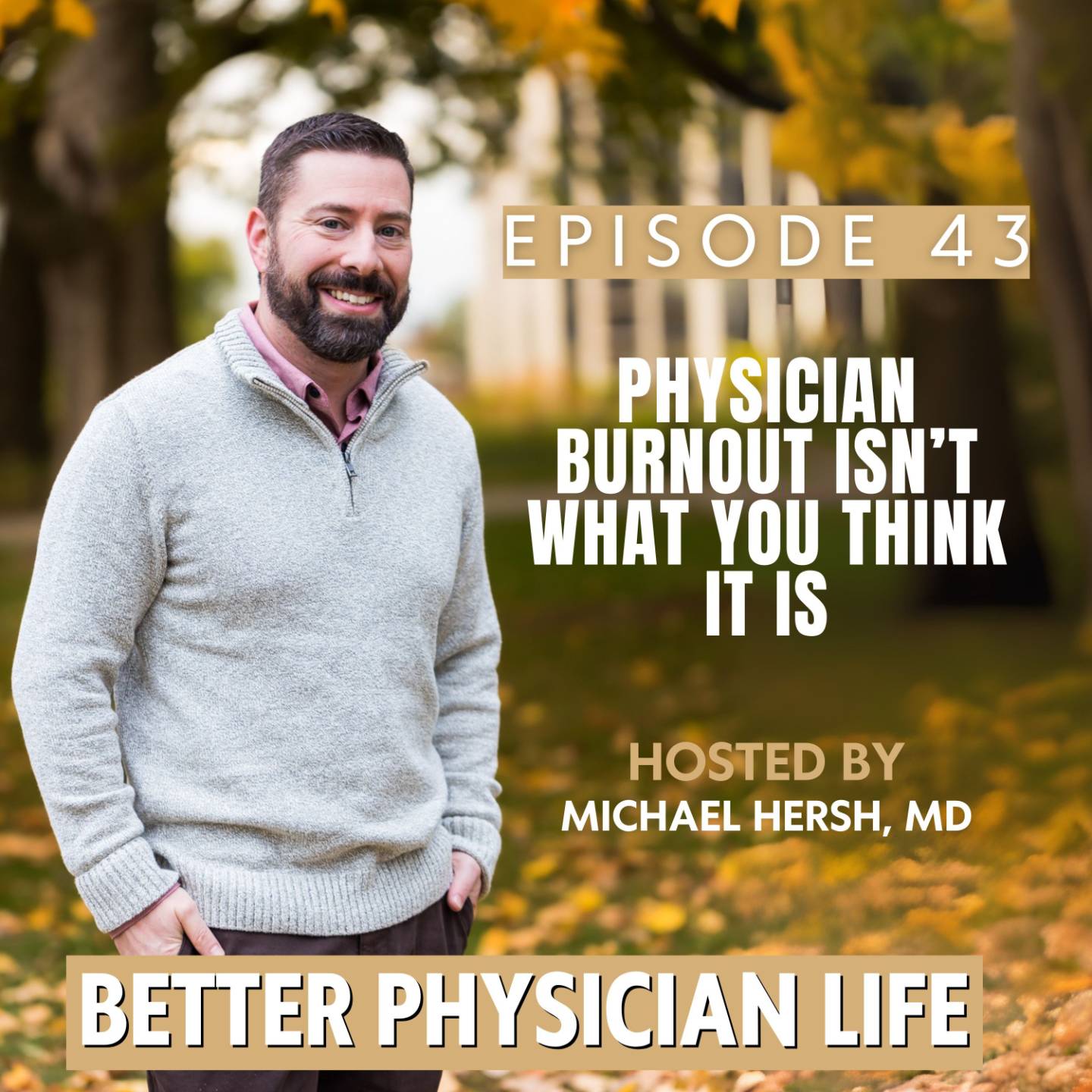
Physician Burnout Isn’t What You Think It Is | Ep43

What if the real issue isn’t hating medicine, but that medicine never really leaves you at the end of the day?

In this episode of Better Physician Life, Dr. Michael Hersh reframes physician burnout not as disliking the work but as the inability to shut it off. Many doctors still love complex cases, enjoy diagnostics, and care deeply about patients, yet their brains keep thinking about the work during the drive home, dinner, and bedtime. Drawing from his coaching experience (including the story of “Mark,” a cardiologist who still enjoys medicine but can’t put the hospital down), Dr. Hersh explains why medicine rarely gives a clean ending: unfinished notes, pending results, and open questions keep the mind in physician mode long after leaving the building.

He challenges the typical “resilience” and self-care narratives that miss this core issue and introduces a practical way to deliberately close the workday so you can actually be present at home. 

The free 5-Minute Commute Reset is highlighted as a tool to create that mental shift, protecting family time without lowering clinical standards or abandoning the work you still love.

🔗 Free 5-Minute Commute Reset for Physicians:  betterphysicianlife.com/commutereset 

Watch on YouTube
Listen on Apple
Listen on Spotify

About the Show:

Created for physicians who want more than clinical competence, Better Physician Life is a space for honest reflection, reinvention, and reclaiming purpose beyond the pager.

Hosted by Dr. Michael Hersh, each episode dives into the questions we didn’t learn to ask in training, offering tools and conversations to help you live and lead with intention.

Top 3 Takeaways: 

  1. Burnout Often Looks Different Than You Think: Many physicians don’t hate medicine; they still enjoy the puzzles, cases, and patient relationships. The real pain point is that the job never fully ends: unfinished thoughts follow you home. Notice one moment when hospital mode invades family time and name it.

  2. Medicine Doesn’t Give a Natural Off Switch: Training teaches you to keep thinking “Did I miss anything? What’s next?”, which protects patients but prevents mental closure. Recognize that pending labs, open notes, and unresolved questions keep your brain in physician mode. It's structural, not a personal failing.
  3. Deliberately Close the Day to Reclaim Your Evenings: Create a clear endpoint so your mind can stand down. Download and try the free 5-Minute Commute Reset daily. It's designed exactly for the drive home or walk from the clinic, helping you transition so you’re actually present with the people who matter most.

Watch Now

 

Video Poster Image

If you’ve found yourself wondering whether this is burnout, you’re not alone. 

Many physicians still care deeply about the work, but notice it’s getting harder than ever to actually feel done with the day. When your mind is still in clinic long after you get home, even good work can start to feel harder than it should.

A physician coaching session gives you space to step back, look at what’s keeping the day from feeling finished, and decide what may be worth handling differently. Use the link below to schedule a call with me.

Book A Call
DOWNLOAD TRANSCRIPT

Physician Burnout Isn’t What You Think It Is | Ep43

Michael Hersh, MD

[00:00:00] 

Physician burnout. Most doctors hate that phrase. You hear it coming and you know exactly what's next. Another article, another wellness seminar, another hospital initiative about resilience. More statistics, more surveys, more reminders to take better care of yourself. And most physicians hear that and think the same thing.

This again? Because a lot of burnout, conversations completely miss the mark. They talk about self-care while physicians are dealing with productivity dashboards, overflowing inboxes and charts waiting at 9:30 at night. They frame burnout like a resilience problem when many doctors know it's not that simple, and they often describe burnout as hating medicine when a lot of physicians actually still really [00:01:00] love their work.

So the whole conversation starts to feel off. But here's the interesting part. Physicians still search the word burnout thousands of times every month. Which tells us something pretty important. Doctors may reject the label, but they're still trying to understand what's happening to them.

And when you listen closely to how physicians describe their experience, a different pattern starts to show up. And once you see it, the whole burnout conversation starts to look a little different.

Hey everyone, and welcome back to another episode of the Better Physician Life Podcast. Thank you so much for being here today. Okay, I get it. Doctors do not want to talk about burnout, but ignoring it doesn't make it go away. And if you listen closely to how physicians actually describe their [00:02:00] experience, burnout often looks very different from the way it's usually talked about.

Most doctors assume burnout means hating medicine, dreading work, wanting to quit, and, honestly, sometimes it does, but that's not what many physicians are actually describing. A lot of physicians still love the work. They enjoy complex cases. They care deeply about their patients. Their problem is something else.

They can't shut it off. You hear this pattern from physicians all the time. They leave the hospital, but the hospital doesn't quite leave them. You're driving home thinking about the patient with the abnormal labs. You sit down for dinner and suddenly remember the chart you forgot to finish. You lie down at night and your brain starts replaying a clinic visit from earlier in the day.

Not [00:03:00] because anything went wrong, but because the case is still open in your mind. And when that happens, day after day, something subtle starts to happen, work slowly expands until the rest of life. Your body leaves the hospital, but your mind is still rounding. And over time, that's where a lot of physicians start to feel the real weight of burnout.

Not because they stopped loving medicine, but because medicine never really leaves them. So today I wanna talk about that version of burnout. The one physicians actually describe what it looks like, why it happens, and most importantly, what you can do about it. And before we go any further, it's worth acknowledging something we all know, physician burnout is real.

Depending on the survey, you look at somewhere around half of all physicians [00:04:00] report symptoms of burnout. During the peak of the pandemic, that number climbed even higher. Clearly, something is going on and there are lots of reasons physicians feel burned out. Sometimes it's the volume, the inbox, the RVU pressure, the staffing gaps, the loss of control.

So this isn't about reducing burnout to one cause, but when you listen closely to how physicians describe their day-to-day experience, one pattern keeps showing up again and again. Many doctors don't say they hate medicine. What they say sounds more like, I still like the work. I still enjoy the complex cases. I still care about my patients. 

And that's where the story becomes more complicated, because if physicians still love medicine, why are so many of us feeling burned out? [00:05:00] Part of the problem is that medicine rarely gives us a clear ending to the day. In a lot of jobs, the work is finished when you leave, but medicine, it doesn't really work like that.

There is always something pending. Outstanding results. Notes you didn't quite finish. Patients you're still thinking about. A case that still doesn't quite make sense yet. So when physicians walk out of the hospital or clinic, they're often leaving in the middle of unresolved responsibility, and that's hard for physicians to ignore.

Because from the beginning of training, medicine teaches us to keep thinking about the case. We're trained to ask ourselves, did I miss anything? What else could this be? What's the next step? That kind of thinking makes you a good doctor. It protects patients, [00:06:00] but it also means your brain gets very good at carrying unfinished things.

The patient, you're still not completely satisfied about. The result you haven't seen yet. The note you meant to finish before you left. So when the day ends, your brain doesn't actually get the signal that the work is actually over. I worked with a physician not too long ago who described this almost perfectly.

I'll call him Mark. Mark is a cardiologist in his mid-forties. Great doctor, very busy practice. The kind of physician other doctors send their complicated patients to because they trust his judgment. When he first reached out, he said something interesting. He said, I don't think I'm burned out. I actually still really like my work.

He really meant it. He enjoyed the diagnostic puzzle. He liked figuring out why a patient's symptoms didn't quite match the echo. He liked walking into [00:07:00] a complicated case and working through it step by step, but then he added something else. I just can't seem to shut my brain off. He described what the drive home looked like.

Replaying the day. Thinking about the patient with the borderline troponin. Remembering the chart he hadn't finished yet. Running through tomorrow's cath lab schedule in his head, and by the time he walked through the front door, part of him was still in clinic. His kids would run up to greet him, his wife would start telling him about her day, and about 30 seconds in, he realized he hadn't heard a single word because part of his mind was still in clinic. He was there, but not really. At one point, his wife looked at him and asked, can you put the hospital down for five minutes? And that was the moment he realized something needed to change. Not because he [00:08:00] wanted to leave medicine, but because medicine had started to take over way too much of his life.

It wasn't just occupying his workday anymore. Medicine was occupying his attention, and once we stepped back and looked at it together, something became very clear. Mark didn't hate medicine. The work itself wasn't the problem. The problem was that the work never really stopped. There was always one more thing running in the background.

And when that carries on day after day, it starts to feel a lot like burnout. Not because the work lost meaning, but because the work keeps following you home. And Mark's story isn't unusual. I hear versions of it from physicians all the time. Doctors who still enjoy the work, who still care about their patients, but whose brain never really powers down when the day is over.

For a lot of physicians, the problem isn't just [00:09:00] the workload, it's that the work keeps occupying the transition points of the day, the drive home, the first hour of the evening, the time right before you go to sleep. The moments where your brain is supposed to shift out of physician mode, that's where the hospital tends to follow.

And once you see that pattern, clearly the conversation about burnout starts to look a little different. Because if the problem were simply that physicians hated medicine, the solution would be obvious. You'd leave. You'd leave the job, you'd leave the career. But that's not what most physicians want. They still care about the work.

What they want is for the work to stop occupying their mind when the day is over. They wanna walk through the door at home and actually be home. And for most physicians, that transition doesn't happen automatically. You leave the building, but the day is still running in your mind. You're [00:10:00] replaying cases, thinking about labs running through tomorrow's schedule.

So the real skill isn't caring less about medicine. The real skill is learning how to close the workday deliberately. A moment where your brain recognizes the shift is over, where the unfinished pieces of the day get parked somewhere outside of your head, where the physician part of your brain can stand down for the evening.

Most physicians were never taught how to do that, but once you start seeing it, the next step becomes a lot clearer. And if you're listening to this and thinking, okay, this all makes a ton of sense, but how do I actually do that? For some physicians, that shift starts by simply talking it through with someone who understands the work.

A colleague, a partner, a coach, stepping back, looking at the patterns, figuring out where the job has expanded into the [00:11:00] rest of your life. Sometimes just having that conversation creates the clarity you need to start changing things, and sometimes it starts with something even simpler. Just a way to close the loop before you walk through the door at home.

And that's exactly why I created the Five-Minute Commute Reset for Physicians. It's a short audio guide and worksheet designed to help you close the workday before you walk through the door at home. Just a simple structure to help your brain shift out of physician mode and into the rest of your evening.

You can download it for free at betterphysicianlife.com/commutereset, and I will link it in the show notes.

Because for years, the conversation around physician burnout has focused on things like pizza parties, meditation apps, and reminders about self-care, and none of those things are bad, but they miss the real problem.

The problem isn't that physicians don't know how to [00:12:00] relax. It's that the job follows us home every day, and the real cost of that usually doesn't show up in the hospital. It shows up at the dinner table. In the conversations you have here. In the moments where someone you love realizes you're there, but not really there. 

Thank you so much for listening and I'll see you next time on the Better Physician Life Podcast.

Previous Episode
Next Episode