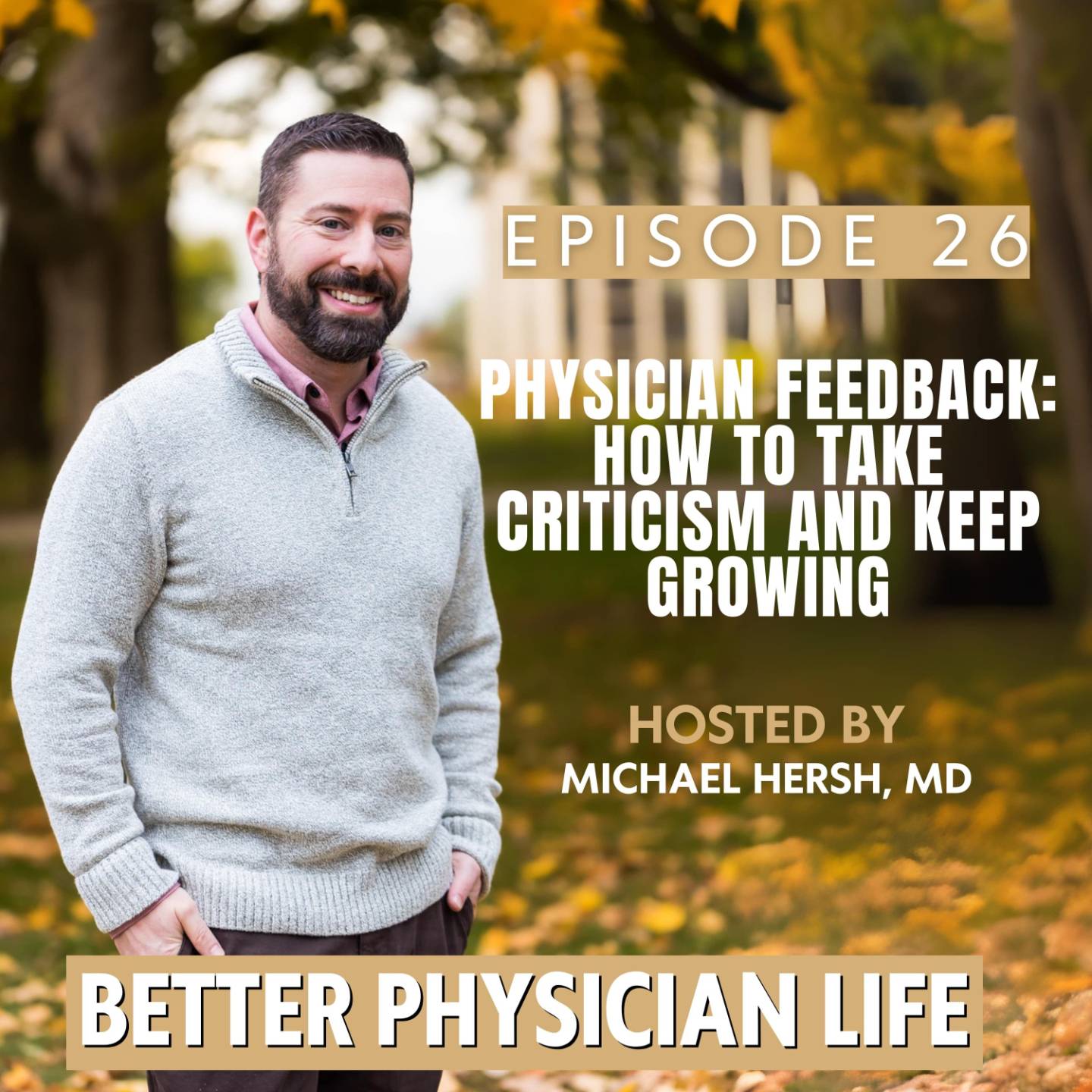
Physician Feedback: How to Take Criticism and Keep Growing | Ep26
Michael Hersh, MD
[00:00:00]
Hey, um, I was just looking at something and I was hoping to give you some feedback. Do you have a minute? If you just cringed a little, you are not alone. You can probably feel it right. That little jolt in your chest, your brain starts scanning. Uh oh. What did I miss? What did I do wrong? It doesn't matter if it's from an attending, a patient, a colleague, your spouse.
Feedback can feel like a spotlight shining on every flaw, every defect, everything that's wrong with you, everything you've been trying to hide. What if that reaction, that quick defensiveness, is actually where the growth starts. Stick around because that's what we're talking about today.
Hey everyone and welcome back to the Better Physician Life Podcast. I'm Dr. Michael Hersh. Thank you so much for being here today. [00:01:00] So today we are talking about a word that can strike fear in even the most confident physician, feedback. Because for most of us, feedback doesn't just land like something helpful, like some useful information.
It lands as judgment, like proof we did something wrong, or like we're not measuring up, and it makes sense. From the first day of medical school, we're taught that precision equals safety, that mistakes have consequences. So when someone points out an area for improvement, our brains go straight into defense mode.
But feedback isn't a verdict. It's data. It's a chance to learn, to adapt, and to get better, not just in medicine, but as [00:02:00] partners and parents, and as leaders. So in this episode, we're gonna unpack what makes feedback so uncomfortable, how to reframe it so it actually helps, and how to give and receive feedback.
Without losing your confidence in the process. Alright, let's get into it. So, before we can really use feedback to our advantage, we have to be honest about why it hits so hard in the first place. Because for physicians, it's not just about the words, it's about what they mean to us. Medicine wires us to take feedback personally.
From the start, we are trained that mistakes equal risk. That perfection isn't just the goal, it's the standard. I will never forget being a fourth-year medical student rounding in the ICU, watching an intern get [00:03:00] absolutely torn to shreds by the attending for not knowing every detail about the patient.
It was brutal to watch. It stuck with me and I'm sure you have a similar experience. That wasn't feedback, that was fear training. The message was clear, don't mess up. Don't miss anything. And when that's the environment you grow up in, of course, you learn to brace when someone says, Can I give you some feedback?
Because in that world, feedback isn't a chance to grow. It's a setup for shame. So it's no surprise that even years later, performance reviews, patient satisfaction scores, or even a quick hallway comment [00:04:00] can still feel like a verdict. That's the conditioning in our training, feedback was often delivered under pressure.
In front of a team in the middle of rounds or at the end of a long call, night when you were already running on fumes. It wasn't about growth; it was about survival. So we learned to brace instead of listen, and that pattern, it doesn't just disappear when we finish residency, we carry it into our careers and sometimes even into our homes.
Because the truth is when feedback activates that old wiring, it's not really about performance anymore. It's about identity. And being a physician becomes part of who we are. So any critique, even a small one, can feel like someone is questioning your worth. Now, there is a reframe here because that discomfort isn't [00:05:00] proof that you're doing something wrong.
It's just proof that you care. It's a signal that you are invested, right, that you want to improve, to do better, to show up fully. And once we can see that discomfort as data, not danger, we can start to use feedback differently. The shift starts when we stop seeing feedback as a verdict and start seeing it as information, right?
It's not an attack. It's data. And when you look at feedback the same way you look at a lab result, not as a judgment, but as a clue, it loses its sting. Now it's not. I failed. It's here's something I can work with, and that shift can change everything. Feedback stops being a threat and starts becoming a tool.
That is how you actually get better because feedback is just awareness. It shows you what's working [00:06:00] and what's not in clinic at home, even in how you're showing up for yourself. The more you practice taking it in without getting defensive, the clearer you get. The steadier you feel, the easier it becomes to separate who you are from what you do.
That's when feedback stops feeling like failure, and it starts looking a lot more like leadership. So how do we actually do that? How do we take feedback, something that used to activate stress or self-doubt and turn it into something useful? Well, it starts with a pause. The pause is one of the most powerful tools we have because for most of us, the instinct when we hear feedback is to react.
It's to respond. We explain, we defend, we clarify, we [00:07:00] rationalize, and that's our training kicking in. Fix the problem and fix it fast before too many people notice. We are doctors, we fix things, but when we jump straight into reaction mode, we skip the part that actually helps us grow: listening. So here's the first shift.
Listen before you respond, let the feedback land before you decide what it means. Take a breath. Even if your internal voice is screaming, that's not true, or they don't get it, just pause for a moment. You can always decide later whether the feedback fits, but if you shut down too fast, you'll miss what might actually help you see something that you couldn't see before.
Once you've had a chance to [00:08:00] listen, the next step is to reflect. It's to ask yourself what part of this might be true? What actually is the data here? Not am I terrible, but Is there something I can take from this? And here's an important point, a really important point. You don't have to take every piece of feedback that comes your way.
Not all of it is accurate. Not all of it is fair. Not all of it is even yours to carry. Feedback is simply an offering. You get to decide what you want to do with it. Take what's useful, leave the rest. Even if 90% of it doesn't fit. That last 10% might be exactly what changes how you communicate, lead, or connect with other people.
You [00:09:00] can stay open to feedback without surrendering your self-worth over to it. And that's the difference between being teachable and being a sponge. When I started seeing feedback that way as one more form of data. It got a lot easier to stay curious instead of defensive. It's just another result to interpret.
You don't get mad at a lab value. You use it to guide your next move. That's the mindset. Feedback isn't a judgment. It's a diagnostic piece of information that helps you decide how to proceed. And the more you practice this, the faster that reflex changes. Now, you'll still feel that little jolt that tightening in your chest, but you'll know what it is.
It's just your old wiring, firing off, warning you, and then you can notice it. Pause and move on. The last piece here is giving yourself some [00:10:00] grace. Feedback isn't supposed to feel comfortable. It's supposed to stretch you. If you already knew how to do the thing, you'd already be doing it. So when you feel that tension, instead of thinking, I am failing, try to ask, What's this trying to teach me?
That single question can change how you respond to the challenge, because at the end of the day, the goal isn't perfection. It's progress. It's improving with less shame. And more awareness. So that's how we start receiving feedback differently. But what about the other side of it? Giving feedback? Because if we're honest, most of us aren't exactly trained how to do that well either.
We've all seen it done badly. The attending who unloads on a resident during rounds. The colleague who drops [00:11:00] constructive criticism like a grenade, and then just walks away. Even at home, when we blurt out, You never listen to me instead of taking a breath and saying what we actually mean. Feedback only works when it feels safe, and safety starts with trust.
So before you open your mouth, ask yourself, have I earned enough trust here for this feedback to land? Because without the foundation, even the most thoughtful feedback will get lost in defense. Now, once trust is there, the next key is clarity. Be specific. It's the difference between saying your bedside manner needs work.
And I noticed during rounds that you didn't make eye contact with your patient when you explained the plan. One attacks character. The [00:12:00] other highlights behavior, and that small difference can change everything. When you give feedback, focus on what you saw, not what you assume. Describe, don't diagnose.
And yeah, that is hard for us as doctors. That fixer reflex runs really deep, but that's where the work is. And if you really want the feedback to stick, connect it to impact. Remember, everyone's always asking the same question. What's in it for me? Why should I change? Instead of, you need to do this better, try.
When you take that extra moment to make eye contact, the patient seems calmer and more engaged, and it makes the whole team's job easier. That's what people remember. The why. It's also important to give feedback while it's fresh. The longer you [00:13:00] wait, the fuzzier it gets. Timely feedback feels relevant, and delayed feedback usually just feels like resentment.
And one last thing, make it a conversation. This isn't a lecture. Stay curious. Ask questions like, How did that feel to you? Or what do you think worked? And what would you try differently next time? Feedback lands best when it feels collaborative, not judgmental. When both people walk away a little clearer, a little more connected.
Because at its core, good feedback isn't about control, it's about awareness. It's about helping someone see what they couldn't see on their own. And when you can do that, whether it's with a trainee, a colleague, or your spouse. You're not just giving feedback, you're creating connection. You're helping the people around you, and you're helping yourself.
You're opening [00:14:00] the door for growth on both sides, and that's the thing. This doesn't just apply at work. At home, feedback is how we keep relationships strong. It's how we stop resentment from quietly building in the background. Ask your spouse or even your kids, Hey, what's something I could do better this week?
And then be ready to listen. Now, the first few times it might sting. Okay, it will sting. But when your family sees that you can take feedback without shutting down, you're modeling emotional maturity and humility. Two things every home could use more of. And when it's your turn to give feedback, keep it grounded in love and respect, not correction.
The goal isn't to win, it's to stay connected because feedback at home works the exact same way it [00:15:00] does in medicine. It only builds trust when it starts from respect. So here's a question for you. When was the last time you got feedback that really changed you? What made it stick? Was it the way it was delivered or the way you received it?
We can't control how other people give feedback, but we can control how we process it and what we do with it, and when we approach feedback as data, not judgment. We stop seeing it as proof that we're broken and start seeing it as evidence that we're still growing. That's what growth really looks like.
Not perfection, but awareness. Not a verdict, but an opportunity, and that's the way to a better physician life. Before we wrap up, I wanna leave you with one small next step. If you've ever walked through the door after work and [00:16:00] realized your head is still at clinic or the hospital, you're replaying conversations, today's procedures, tomorrow's schedules, or maybe even feedback you got that day.
I created something that can help you switch gears from doctor mode to home mode, because that mental transition, it doesn't happen automatically. It takes intention and so that's why I created the 5-Minute Commute Reset for Physicians. It's a short audio guide and optional worksheet that is designed to help you leave work at work, clear your head and walk through the door, ready to connect with your family and your priorities.
And it also includes a quick lock screen reminder of the model, so you can use it anytime and you can download it for free at betterphysicianlife.com/commutereset and I'll link it in the show notes. Because presence and growth don't happen by accident. They happen by choice [00:17:00] And feedback is one of the best tools we have to keep choosing better.
And remember, you don't have to be perfect. You just have to keep learning. Thank you so much for listening, and I'll see you next time on the Better Physician Life Podcast.