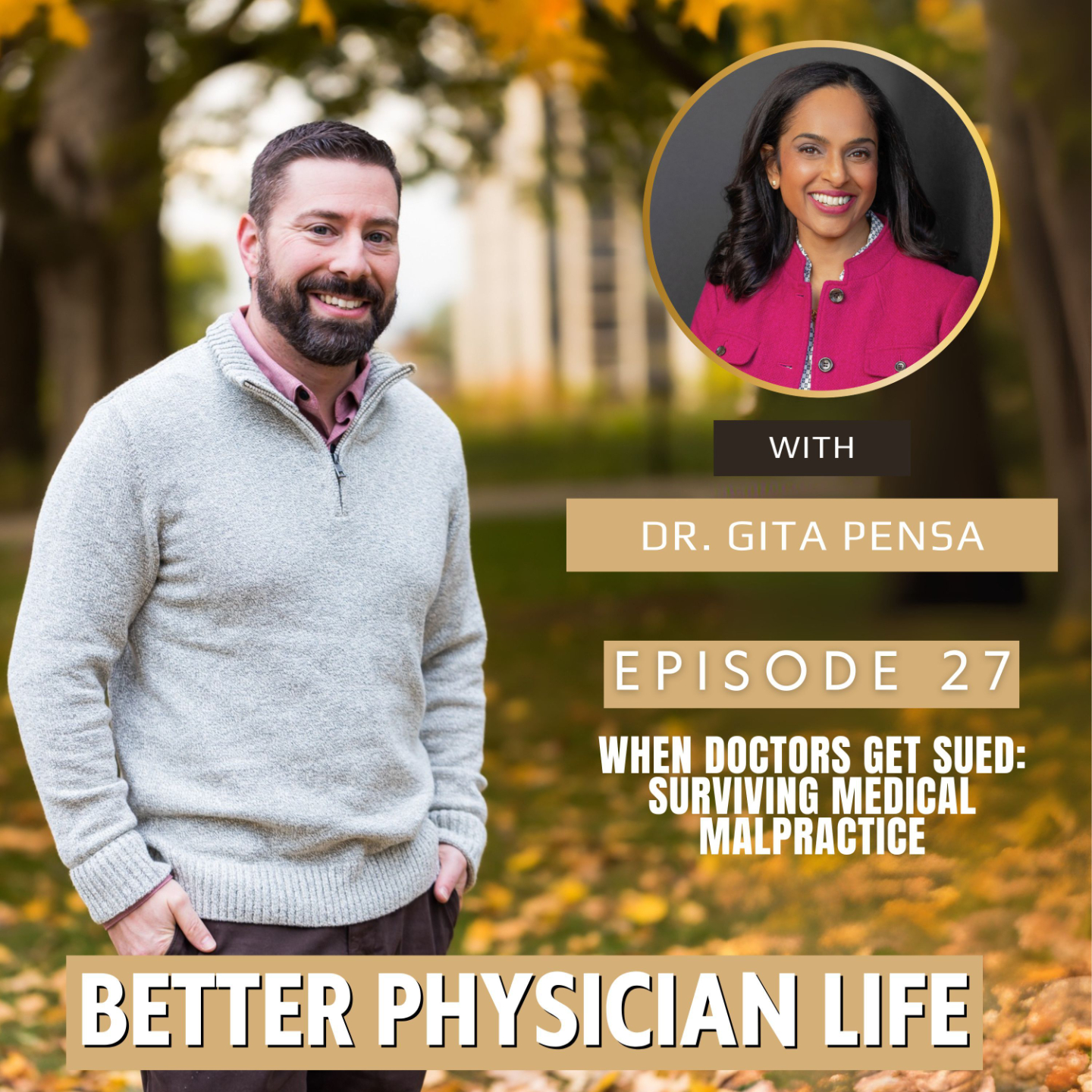
When Doctors Get Sued: Surviving Medical Malpractice with Dr. Gita Pensa | Ep27
In this episode of Better Physician Life, Dr. Michael Hersh speaks with emergency physician Dr. Gita Pensa about what it’s actually like to be named in a malpractice lawsuit—and how to get through it without losing your footing. Drawing from her own 12-year case, Dr. Pensa explains the emotional impact most physicians aren’t prepared for, including shame, doubt, and isolation, alongside the practical realities of what to do after you’re served.
They walk through early mistakes to avoid, how to protect your focus and identity while a case is ongoing, and why litigation is an unspoken part of the “fine print” of medicine. The conversation also covers how to find support without compromising your case, how to approach depositions and testimony with clarity, and why these skills can be learned—rather than endured in silence. This episode is for physicians facing litigation now, or who want to be better prepared if it ever happens.
About the Show:
Created for physicians who want more than clinical competence, Better Physician Life is a space for honest reflection, reinvention, and reclaiming purpose beyond the pager.
Hosted by Dr. Michael Hersh, each episode dives into the questions we didn’t learn to ask in training, offering tools and conversations to help you live and lead with intention
Top 3 Takeaways:
-
What to Do First After Being Served: Your first call should be to your insurer or risk management team so a defense attorney can be assigned. Avoid chart access, addenda, or independent research outside of attorney–client privilege. Don’t rush to conclusions. Give yourself time to gather information and stabilize before making decisions.
- Managing the Psychological Hit: Shame, fear, and isolation are common responses to litigation and don’t reflect your competence as a physician. You can (and should) talk about how you’re feeling with trusted people without discussing case details. Litigation is part of medicine’s unspoken fine print. It doesn’t erase your value or your career.
- Focus on the Parts That Matter: For most physicians, litigation performance comes down to the deposition and, in fewer cases, trial testimony. Learning how the system works helps right-size fear and restores a sense of control. With preparation, coaching, and support, this becomes a skill set, not a personal referendum.
Watch Now

If a lawsuit (or even the fear of one) is taking up more space in your head than you want to admit, you are not alone.
Most physicians keep pushing through, just hoping it settles down on its own. But that's no way to live.
Use the link below to schedule a call with me. One physician coaching session can help you slow things down, get clear on what actually matters right now, and keep this from spilling into the rest of your life.
Book A CallWhen Doctors Get Sued: Surviving Medical Malpractice with Dr. Gita Pensa | Ep27
Michael Hersh, MD
[00:00:00]
You've just been served. What do you do when the worst news of your career shows up at your door? Today, we are talking about something most physicians fear, few are prepared for, and almost no one talks about out loud, medical malpractice litigation, not as an abstract risk.
As a lived reality that can pour gasoline on the burnout flame, shake your identity, and make you question whether you even want to keep practicing medicine. And we're gonna talk about how to face this with the structure and strategy that put you back in the driver's seat.
Well, hey everyone, and welcome back to the Better Physician Life Podcast. Thank you so much for being here today. My guest is someone who knows medical malpractice litigation from the inside out and has spent years turning her experience into real support for physicians.
Dr. Gita Pensa is an emergency physician and an adjunct associate professor at Brown University. [00:01:00] You probably know her best from her incredible podcast, Doctors and Litigation: The L Word, a resource so many of us wish we'd had long before we ever saw our name on a complaint. She created the Litigation, Education, and Performance courses now used by hospitals and insurers to prepare and educate newly named defendants.
And beyond that, she coaches physicians in active litigation and consults nationally on how to navigate the psychological and performance demands of these cases. In short, she took a 12-year lawsuit that could have ended her career. And turned it into a roadmap for how physicians can stay clear-headed prepared, and grounded when the legal system comes knocking.
And I am so glad she's here today. Dr. Gita Pensa. Welcome to the show. Michael. I am so happy to be here. It's really nice to see you again. It is great to see you. We always have such great conversations. We were chatting [00:02:00] before we hit the record button, and I'm always just so appreciative because as we were saying, your podcast was honestly transformational.
For me. Any physician who has ever been named in a medical litigation lawsuit knows all of the feelings that are associated with that. The shame, the feelings of just loneliness, and just not being able to talk to anybody. And I didn't have your podcast when I was experiencing my own foray into the medical malpractice world.
And it was still lingering when you released that episode, and it really was so transformational to have you in my ear and to hear you talking about all of the things that I had experienced. I would love for anybody that's been hiding under a rock and doesn't know your story.
I would love for you to share a little bit about what got you into this work. I'll make it very brief 'cause we do get into it in the podcast. And some of the regular [00:03:00] listeners are gonna be sick of it by now. But I am an emergency physician in about. Five years outta residency, I got named in a lawsuit.
And it was a really confusing case that involved a young defendant who wound up having a stroke, and it did disable her. And so if you know anything about litigation, you know, a young person, she was an engineer, there was a lot of economic damages. I live in a state where there's no caps on non-economic damages.
She had a lot of life ahead of her. So this translates to, especially in a very plaintiff-friendly state where I live. This translates into to big money litigation Now, did I understand any of that at the time? No. Had I been taught thing one about what to do when you were named in a lawsuit? No.
And I'd sort of been bred to believe that if I just followed all the risk management principles, this should not happen, and then it did happen. And so in what ways had I come up short? To make this thing happen. And then all the crushing doubts about your own abilities and your identity and all of that.
You know, it seeped into [00:04:00] every part of my life. I wanted to quit medicine, but I didn't know how to quit medicine because I know you talk about like, yes, we can sort of take control of, I had no idea how to take control of my career. What was I gonna do? I had loans. I didn't know how to do anything else.
And so, you know, this went on for many, many years. I wound up. Going on trial in 2011, I won after a four and a half week trial. I don't even know how that happened, but I went back to work eventually. Totally miserable, same misery. and then I found out about their Intent to appeal.
And then they wound up appealing my verdict and went through all the layers of the courts. And when I got a call from my lawyer in 2015 saying, you've gotta go back to trial again. So now this is 2006 is when I saw this patient, right? So now we're talking about, this is now 2015, and I've been living in misery all this time.
When he called and said, you've gotta do this again. I actually lost my mind. And had been brewing for a long time. And so what came out of that was thankfully, I decided to try to swim instead of just [00:05:00] completely succumbing. And what came outta that was. A real study in, how to you dig yourself out of a hole.
And also at the same time, like, what is this thing that like none of us know how to deal with? How do we contend with it? Like, why aren't we taught what to do? How do you do it? How do you do it well? Is that something we should be learning how to do? And so while I was working on my own mind, I was working on just like a deep understanding. I didn't go to law school, but just a deep understanding about like, what does it mean to be a doctor in litigation and why do we not approach this the way we approach every other problem in medicine, which is to throw ourselves at it and learn all about it, to simulate it, to get good at it.
Why can't we do that? And so everything that's come out of that since then, the podcast, the courses, all of that stuff has to do with. Figuring out, I learned it and if something can be learned, it can be taught. And figuring out how to teach it. Then in a more condensed way to people who are actively undergoing litigation, helping them [00:06:00] with performance strategies, helping them to manage fear, and, you know, a lot of the emotions that you talk about on this podcast, how to do that in this really singular, crushing arena that we were never taught how to contend with. We've got no role models to show us the way historically, and so we've been really deprived of a very important education because this is so common in medicine.
And as you were pointing out, the desire to learn the education, for most of us doesn't happen until you're thrust into the world and as we as lifelong learners know, it's the absolute worst time to try to learn something when you are under the pressure of needing to learn it and the associated shame and all of the other feelings that are coming up for you. I think you noticing that this had been going on for so long.
You described it as this kind of like miserable. 10-year experience. When you found out that you were going back [00:07:00] to trial, how did you. Take a step back, right? Because it does require taking a step back and noticing like, oh, like this is an opportunity to learn. That's a big shift.
Well, that did not happen right away. Te primary concern at that moment, at my kitchen table when he told me that, was that I was afraid for myself. Like I'd been contemplating some pretty dark stuff for a long time, and I knew I was miserable. That was not a secret to me. It might have been a secret to some of the people I work with cause we try to hide Stuff. But don't even know if I should use the word worried about myself. I had been miserable and I knew it, and some part of me felt like, you know, maybe I deserved to be miserable, but like, once litigation started like I accepted this new role of just miserable person, right?
It seemed like that was the way it was meant to go. In perpetuity and I didn't question it. And I was meant to be now somebody who hated their job and who was scared of patients and who was scared all the time of doing the wrong thing and who did have a lot of doubt in [00:08:00] her abilities.
And I accepted that role. But when this thing happened, and I was told you're gonna have to go back and go to trial again. The trauma of that first trial, sitting there for four and a half weeks every single day, like what that actually, really felt like it did to me.
The prospect of doing that again, was something that all I could think about was, how am I gonna avoid this? And I could only think about one way, then I was gonna avoid it. Right. So being in that stance where I could look back at the last decade and be like, wow, like I've missed a whole decade of my life and something's gonna happen now, right? Like, either I'm gonna end this all, or I've gotta figure something out. I think the best thing I ever did for myself that day was like, I tell the story about, you know, when I give talks about it and stuff, I went upstairs and I read a book that someone had left at my workstation that I had never read, and they left it there like two years ago before that.
And it was called When Good Doctors Get Sued. And sometimes I would look at the title. Just think it was in my bedside table. I would just open the drawer and look at it [00:09:00] and the lightest lift I did the whole time, but turned out to be the most important thing that I did was to get that book out and start to read it and to start to notice that there was some relief in reading it.
And so the first things that really started to happen was figuring out like, one, I deserve to save myself. And two. The answers are not in my own head. You know, I'd been trying to like DIY my way out of it, or just believe like, this is how it's supposed to be now for a long time. And the best things I, and the hardest things to accept at first was I'm gonna have to look outside myself.
And maybe it's possible, maybe there's a different way to think about this, everything else that came. After that was a result of that, just that little shift in thinking of, the answers aren't in my head, but maybe it's possible. Yeah. I think so many physicians approach everything that we are confronted with, I have to figure this out on my own and a lot of times we can. [00:10:00] and it's instilled in us that maybe we should. And frequently we can do this with support and with help and with assistance in different ways and talking to people, and it makes it easier, it makes it faster, it makes it more enjoyable, and it takes us out of our own heads, which is sometimes the most dangerous place to be living.
Highlighting, because when you notice the resistance, right? It was like you found out about it and you're like, how do I avoid it? And there's so much that we can learn from the resistance, from the what am I trying to avoid? Mm-hmm. And when you can just notice that that resistance is there, that like, I don't want to do this, that is when you start getting curious, and that's when you can start to recognize like that is likely the most effective way forward.
And the thing keeping us from doing that is shame. So shame is the primary problem in all of this. And we didn't invent that shame, like medicine [00:11:00] created that atmosphere of shame around this. And then the plaintiff's attorneys capitalize on it and the language and the complaints and everything else.
Capitalizes on it in your own head where you've always been worried like, am I actually good enough at this? Right. That capitalizes on it. And so when you feel shame around that, the natural thing to do is to try to avoid it, right? Is to try to just avoid dealing with it. These are highly uncomfortable feelings.
I don't wanna learn about it. I need to find a way to avoid it. This is when we start to see things like substance use and abuse and certainly suicide and things like that when we start, just like I cannot contend with this. But the shame is largely, unfortunately a thing of our own creation, in medicine by our refusal to talk about it.
Mm-hmm. And so we've been wired to believe that talking about litigation is harmful and shameful and Yeah. I know you've got some attorneys on the other side saying like, well, you can't talk about it. Don't talk about it. Right. [00:12:00] Which is both misguided and cruel. And I get in front of rooms of attorneys on the regular, and I tell them that, and sometimes they push back
There is no other arena that I can think of where you absolutely traumatize an individual, and that's what this is. This is trauma, right? This is a threat to identity sometimes, a threat to life, certainly a threat to, you know, livelihood and things like that are, at least we interpret it as such. The shame is so, so crippling in so many ways.
Like this is really traumatic. And then you take that person and tell them, you're not allowed to talk about it. It's wrong, right? You can, and you should talk about your feelings. You could talk about the fact that it's happening. Everything that's in the complaint is public record, right? You just need to be able to show up at your deposition and say, I haven't discussed the details of my care.
With anyone but my legal team. But you need to get what you need to help you through this process. And oftentimes [00:13:00] what we need to process trauma is to be able to do it with people who can empathetically hear you. Then we have to start building better systems around that. Or at least sort of loosening this like choker of like, no, you can't.
No you can't. No you can't. Yes you can. Yes, you can be smart about it. You understand HIPAA, right? Like we know how to talk about medicine without divulging. PHI, like you can learn this, right? And then like know how to show up and talk about it at your deposition. We've just been beaten down in so many ways. And we gotta stop this.
A hundred percent. And you know, it's fascinating because we spend our twenties becoming doctors, right? it becomes a part of our identity and then something like this happens. And, I think one of the things that I heard frequently when I was going through this is: This isn't about you.
It's hard, right? When you've spent, you know, 10, 15, 20, 30, your entire life becoming a physician, incorporating that [00:14:00] into your identity, and then all of a sudden you're told, oh, this isn't about you. And so, yeah. I'd love to hear your thoughts on that. It doesn't ring true, right? Like it doesn't ring true when someone says it isn't about you.
Like, just treat it like it's not about you. In what world, or is a physician going to be able to say, this isn't about me right now, what I would like to say is that it's like, it's not as much about your medicine as you think it is, right? And it's not about you as a human being like, but this is happening to you.
There may be a way to nuance it by saying like, this is happening to you but not about you. And it's important to make the distinction that like the outcome of this doesn't mean anything about you, but we do have to be careful when we tell people, like don't worry.
And when did that ever work? Right? When you're just like, don't worry about it, you're fine. Which is what I got told over and over again. Like, don't worry about it. Don't you worry, you're pretty little ahead about this thing. Like, we're gonna take care. It doesn't work. And so I think a much more effective way of dealing with is really actually learning the ins and [00:15:00] outs of it and then gathering the evidence that shows to you like, oh.
This is actually not about my medicine. This is really not about my care, because the people who are adjudicating it don't understand medicine. So, this is about a story, but the chief thing that we have to understand that like when it is about us, is that we deserve to defend ourselves.
We do, even when maybe you weren't as perfect that day as you wish you were. That's medicine, that is practicing medicine. It's like, it's a job like no other on the planet. But we have to be able to be compassionate to ourselves in that moment and understand ourselves, like, I am good at this.
You know, especially if you really want to defend your care, that was reasonable, right. We've given these external, judgment in the system, the ability to make us believe something that isn't true about ourselves. And a lot of that has to do with the way that we're [00:16:00] taught to judge ourselves as we move along in medicine and the way we're taught to adjudicate care through this perfectionistic lens, right?
I just got off a coaching call with someone and I asked her this question because she is facing this, like, she has to go to trial. Every time she looks at a deposition, she has this recurrent feeling of like, they're making me feel like a bad doctor. I feel like I'm a bad doctor.
She's a parent. I said, you know, do you feel like you're a good parent? You feel like you're a good mom? She's like, yeah, I really do. I was like, okay, so what if Some hoo-ha comes over and says like, I think you're a bad parent because you vaccinated your kids. You would be like, what?
Like, no, like you're totally wrong. Like not only is the premise wrong, but like, there would be something in you saying like, I know who I am and you are wrong about this. Why can we not do the same thing when this is an accusation about your care, especially when you feel like, I did what was reasonable in this case, right?
But then we start to sort of internalize this, like, maybe they are right, maybe I am bad, like, maybe I should put on this hair [00:17:00] shirt. What is it about us being doctors that make us do that when in other arenas of our life we would not?
I've heard you speak before. The reason is because everything that is done is essentially being done to emotionally manipulate you into feeling that way. Mm-hmm. And so it's really hard to notice that somebody is intentionally trying to emotionally manipulate you when you are being emotionally manipulated.
And so you're just falling prey to the things that are being presented to you and how can you notice them? Take a step back and be like I have a role here and my role is to defend myself. Just like you were giving in your example of I have a role here as a mom to vaccinate and protect my children, and I'm gonna defend that role no matter who thinks differently.
And so, how can we bring that belief system to medical malpractice litigation? Part of it has to be removing the shame around it, right? Because the shame is what's gonna make you question over and over again. Like, am I doing the right thing? Am I okay? And [00:18:00] mostly it's gonna be like, I am bad.
Like, I think I always knew it in there somehow, but like now everyone's gonna know, right? So there's that bit to contend with, and we can talk for hours about the ways in which medicine sort of conditions us to feel like everybody else is great at this, and I'm the one who's struggling.
And then there is the true understanding when you start to understand, I often use the example of the borderline patient, right? Someone's pushing your buttons and you like, oh my gosh, this person's getting me so upset. And then you find out that they have a borderline personality disorder, then you can step back and be like, oh, like this is what this person does. When you understand the plaintiff's attorney is just acting according to the nature of a plaintiff's attorney, and that's their job. They feel like that's the right thing to do. The expert witness over here is acting sadly, according to the nature of a liar, if that's what they are, right?
They're good experts out there too. Like we need good experts. I want everyone to have some practice doing expert witness work, frankly. Right? And where do we have this belief that like, that expert witness is more expert than me? [00:19:00] Like when you're really good at your job, bad expert witnesses, like they could be three years your junior and like have half your training and they decided they're gonna be an expert witness.
Like they are not necessarily more expert than you. So this person under the guise of expert witness coming to tell you all the ways in which you messed up, Maybe you do take that with a grain of salt, but you can only start doing these shifts when you understand just like understanding, oh, this person has a diagnosis of borderline personality disorder.
Oh, they are acting according to their nature in this whole ecosystem. They have their own interests. I don't have to put that on me. That does not have to be my role. The plaintiff's attorney, the expert witnesses, they're trying to hand you a role. They're like, here is a dress.
We'd like you to put this on, and that thing is ugly. You don't have to put it on. Yes. They want you to wear it, like it doesn't fit you. It's not for you. You could decide what you're gonna wear. [00:20:00] Yes. I think that is so important, right? I just wanna highlight.
That there are so many underlying thoughts that are going on here and it's why I think your work to coach physicians that are going through active litigation is so important because even the different thoughts are not one size fits all. Everybody's gonna have some different thoughts that come up for them when they are presented with medical malpractice.
How do you approach coaching physicians who have recently been served or have active litigation ongoing? There are organizations that do witness prep work and things like that. I'm different from them because my primary interest is actually the well-being of the defendant.
And then performance and litigation will come as a side benefit from that when they actually understand the process and their role. And so everybody has sort of the same knowledge gaps, and we've all been sort of trained to have this underlying sort of fear, shame, et cetera, et cetera, around it. The way that [00:21:00] manifests that can differ a lot from person to person, but there are definitely themes, right?
So like a common theme is anger. You've got anger at the system, anger at the time it's sucking up, right? Anger that this feels unfair. It feels unjustified. Anger that we have the stupid system that nobody advocated for. Like, there's a lot of anger, right? So when I identify that's what we're dealing with.
Okay? Then we're gonna sort of work around the thoughts that are creating those feelings. There's a lot of 'em, right? There's a big stew, right? Oftentimes also intermingled with fear or shame. A lot of it is when you really get down to it like, what if other people believe these allegations? What if other people find out and think, I am a bad doctor?
Like that is at the root of a lot of it, and a lot of people, I say, yes, we should talk. A lot of people don't want to because we tend to isolate ourselves when we're feeling shame and when we're feeling pain that we feel like should be secret. We have this tendency to [00:22:00] isolate ourselves because we're worried somebody is going to actually believe whatever the allegations are.
Or, you know, let's say you did make a mistake, right? They are going to decide that your entire worth as a human being and a doctor is eradicated because you made a mistake. And so, really trying to get people to acknowledge what's happening. In their own minds, to not run away from the feelings, but to accept them as data, right?
And to say what are the thoughts that are creating these feelings and these sort of models of thinking. And then recognizing that your thoughts are largely conditioned and aren't necessarily facts. And so bringing things back to the facts, looking sort of in an intellectual way almost at how do we get here?
Like what did medicine teach us about this process? And what is probably not fact. About this, while giving people a real understanding of what the process is and transferring skills. So it's not just coaching, it's kind of coaching slash mentoring slash teaching slash like, kind of all of it in [00:23:00] one thing.
But like everybody needs those parts because we've been so deprived in terms of education and modeling and all of that. But we often have to do it on a timetable, but we can get there. Yeah. and to those who have not experienced coaching before, there may be an eye roll going on when you think about thoughts, creating feelings, and it goes back to that thing that if you don't notice, you are living at the effect of your life, right? Like you've got all of these thoughts that are going on. The brain produces thoughts, like the mouth produces saliva; it's going all the time. And if you don't take the time to take a step back and notice what those underlying thoughts are, you can't take the steps forward needed.
As we were discussing to play the role that you need to play, and so taking a moment to unpack those thoughts, what is going on underneath all of it all? What are your thoughts about you and this process? Then you can effectively move forward and play the role that you need to [00:24:00] play when you're defending yourself.
Absolutely. And a lot of the work that we do, too is around those self-critical thoughts that a lot of us have used as a motivating tool. And then, you know, we get to this point where you are gonna be your own biggest enemy.
If you talk to yourself in a way where you are highly critical of yourself and everybody around you in this system is gonna be, you know, or at least on the plaintiffs side of things, it is going to be critical of you if you also are in there. Um. Telling yourself all these terrible things about yourself and ruminating over, you know, your lack of perfection or whatever it is.
Like these are things that we have to examine and that we maybe have to update a little bit. Absolutely. So now, some practical tips. Those first 72 hours after being served are frequently filled with panic. We talked about shame, Google, and if you could stand next to a physician in that moment, what are some practical moves that you'd [00:25:00] recommend or suggest for protecting themselves, for protecting their brain like we were just referring to?
Yeah. And so, I have the analogy, I use a lot of the snow globe, right? So getting served, getting noticed, like there is a snow globe thing that happens. You shake that thing up and there's so much stuff flying around in your head. This is not a good time to make big decisions or big moves or anything like that, right?
Like, don't do anything rash, right? A lot of us in that period of just like abject confusion, what is this about? Who is this? What was this case? I can't believe there's all of this. Allow it. Right? Just allow it, it's gonna settle. You will be able to calm that down, but don't do anything rash.
So there are some do's and don'ts. The first call is to your insurance carrier, right? Or to risk, or whoever it is that's gonna be handling this. That's your first call, okay? Then they are going to tell you what to do from there, right? Sometimes they're the ones telling you about it, and they're gonna give you the next steps, which are gonna be that you're gonna get a defense attorney, et cetera, et cetera.
Try [00:26:00] not to go into the chart. And if you are in there, do not touch anything. Don't change anything. in fear. Sometimes people do really stupid things, right? So going in and writing an addend or what after that, don't do that, right? 'cause the audit trail is gonna get you and also
It's not the smarter, right thing to do, right? So you're not touching anything. You're not changing anything. Do not immediately start Googling stuff, right? Like wait till you have an attorney and then you're gonna, you know, find a way with your attorney to say like, how are we gonna set this up so that I can do a little research to make myself feel like I maybe did the right thing, or to find out like, more about this or whatever.
You don't wanna create evidence. Right. And so if you're doing that and you're doing a search or making notes or anything like that outside of the protection of attorney-client privilege, that is going to be evidence, right? And so when your asset deposition about note-taking, research, things like that, you really wanna be able to say, only under the direction of my attorney, right in [00:27:00] that attorney-client bubble. Don't make evidence. Don't destroy evidence. If you had notes, that's a crime. It's called spoliation. Don't destroy anything either. Okay. So try not to make or destroy evidence. And then. You've gotta just kind, you know, this is a lot of it's uncertainty and you, we want certainty. We wanna know, did we do the right thing?
We wanna see the chart. we have to be able to sort of recognize like this is gonna be uncomfortable for a little while. While we get more information. While I find out what this is about, I'm gonna spend a little time in this and it's okay. Reminding yourself, this is common. This was part of your contract with medicine.
This was always gonna happen in some way, shape, or form. I tell people when I work with them that like, we have this contract with medicine, right? Your actual contract, but what we think we're getting right when we sign up to be doctors and the pursuit of the feeling, right? That's a lot of what drives us in it to become doctors, right?
We want to have the experience of being an individual who does this, [00:28:00] right? Who helps people who has this feeling of satisfaction around their career and all this. There is fine print in there, like at the very bottom, which is there are two things that are gonna happen at some point during every career.
One is that you're gonna mess up, you're gonna mess up big. And two, is that someone is gonna blame you for something big. They may not actually correlate, like they may not be the same thing, right? Like a lot of times you get accused for stuff that you didn't do, and you do wrong things that nobody comes after you.
Like doesn't make any sense. But those two things were coming and so this was always coming right? It's okay, right? And so now remind yourself there are resources I can learn about this. This happens to a lot of good doctors. I'm gonna be okay. Just gotta wait for the information to come in.
Don't do anything rash, and then take care of yourself. It's a hard time. Take care of yourself. You deserve to take care of yourself. And then you're gonna take it day by day. Yeah. I'll add one thing. it goes back to something we were talking about earlier in this conversation. Doctors are so good at [00:29:00] compartmentalizing about keeping the litigation over here and your family over here, and your work over here.
And it's really helpful, right? It helps us in our day-to-day work when something terrible happens in room one and we have to put on a smile and walk into room two, like nothing happened. Finding somebody, a trusted friend, colleague, spouse, that you can talk to about what you're feeling.
Again, not the details of the case, not anything that you can't discuss, but how you are feeling, what you're going through, the emotions that are coming up for you, I think coaching can be incredibly beneficial for this, but even just a really great friend who's going to listen and not try to just say, don't worry. Right. they're not gonna be able to solve it for you. But they can do one thing. This is honestly what we need a lot during this time is that they can reaffirm our value and our worth. You are a really good doctor. Whatever this thing says, Michael, [00:30:00] like you are a fantastic doctor.
And so you're not gonna wanna hear it, but it is helpful to hear like, one of the things that we fear the most is that this does erase our value and our worth and of everything that we've been trying to build with our lives. Right? And so the trusted people that you could say that this is happening, right?
This is hard. Again, what's in the complaint? Public record. That's not details, right? This thing is happening. This is really hard. I'm frightened. I don't know what this means. This is really uncomfortable. This makes me, gosh, like, should I quit? What should I do? Do you need people in your corner when stuff like that happens?
And so, yes, please do. Yes. I was remiss in not adding that again to the list, but like talk to your people. Find your people. And let your people hold you up for a little bit. A hundred percent. Now you, have these, LEAP courses that you have created.
Can you tell the listeners a little bit about that? Yeah. So LEAP stands for Litigation, Education, and Performance. And so what they [00:31:00] are is a combination of some of the coaching that we're talking about with knowledge translation in terms of like, here's what you really need to know about it. And then moving into how do you perform.
There's only really two things that you've gotta perform for in litigation, right? And for most people, only one like, and that is actually your deposition, right? And some small percentage of us are gonna have to testify at trial, and then. That's kind of it. And everything else is like what's happening in our heads and what the lawyers are doing, and our interpretation of what the lawyers are doing, and our lack of understanding about what the lawyers are doing.
There's only really two times that we gotta show up. And for most of us, again, only the one. And so, really sort of learning how to, like, real size the worry that we have, understanding what your role actually is, how to be a good deponent, how to give effective trial testimony. I basically lay it out for you in a CME course.
So I have two of these. I have something called Defense LEAP. And that's the course that has been licensed by quite a number now of insurance companies and hospitals. And they [00:32:00] give it, it's not meant for just the high-risk case for every single person who comes into this that is sort of like deer in the headlights. Like this is the place to start. And so they offer it to them early. It gets everybody sort of on the same page and gets 'em to the place where they really are ready to be a member of their defense team.
And then the other course is called LEAP for Clinicians. That's something that doesn't matter whether you're in litigation, outta litigation, worried about litigation, whatever. That's, another CME course that you can find on my website. My website is: doctorsandlitigation.com . It's long, it's 16 hours, but it's eligible for 16 hours of CME credit, so you can use a CME funds and it is. Sort of soup to nuts. It's got covers the coaching, it covers the, legal language.
It covers like the ecosystem who makes money, how, all the things you've gotta understand about people's motivations. The other stakeholders, who are you in this? Where do you have influence? Where do you not? I sort of lay out all the stuff that I wish someone had taught me before I had to like climb Everest to learn it myself.
Let's see if I can put it in one [00:33:00] spot for people, but thanks for asking about that. So, absolutely an incredible resource and for anyone who has not listened to Doctors and Litigation: The L word, a phenomenal podcast, which I just have appreciated so much. I listen to every episode, and I appreciate you for talking about the thing that none of us wants to talk about because it's so important.
It impacts so many of us, and I just cannot express how much I appreciate you and your work. I really thank you for that. I really do appreciate it. And I'm a fan of your podcast. I'm a fan of all the work you're doing too, and I will talk to you about this anytime. Thank you. Absolutely. The invitation is open.
Well, Dr. Gita Pensa, thank you so much for being here today. To the listeners, thank you so much for spending time with us today, and we'll see you on the next episode of Better Physician Life. Take care.